
Energy Drink Export Documentation, AES/EEI & Customs Readiness
A reference guide to energy drink export documentation for international B2B buyers — covering pro forma and commercial invoices, packing lists, Schedule B classification, AES/EEI filing, USPPI/FPPI roles, export certificates, records retention, and destination requirements.
- 10-Pallet Export MOQ
- AES / EEI Guidance
- Schedule B Classification
- 5-Year Records Retention
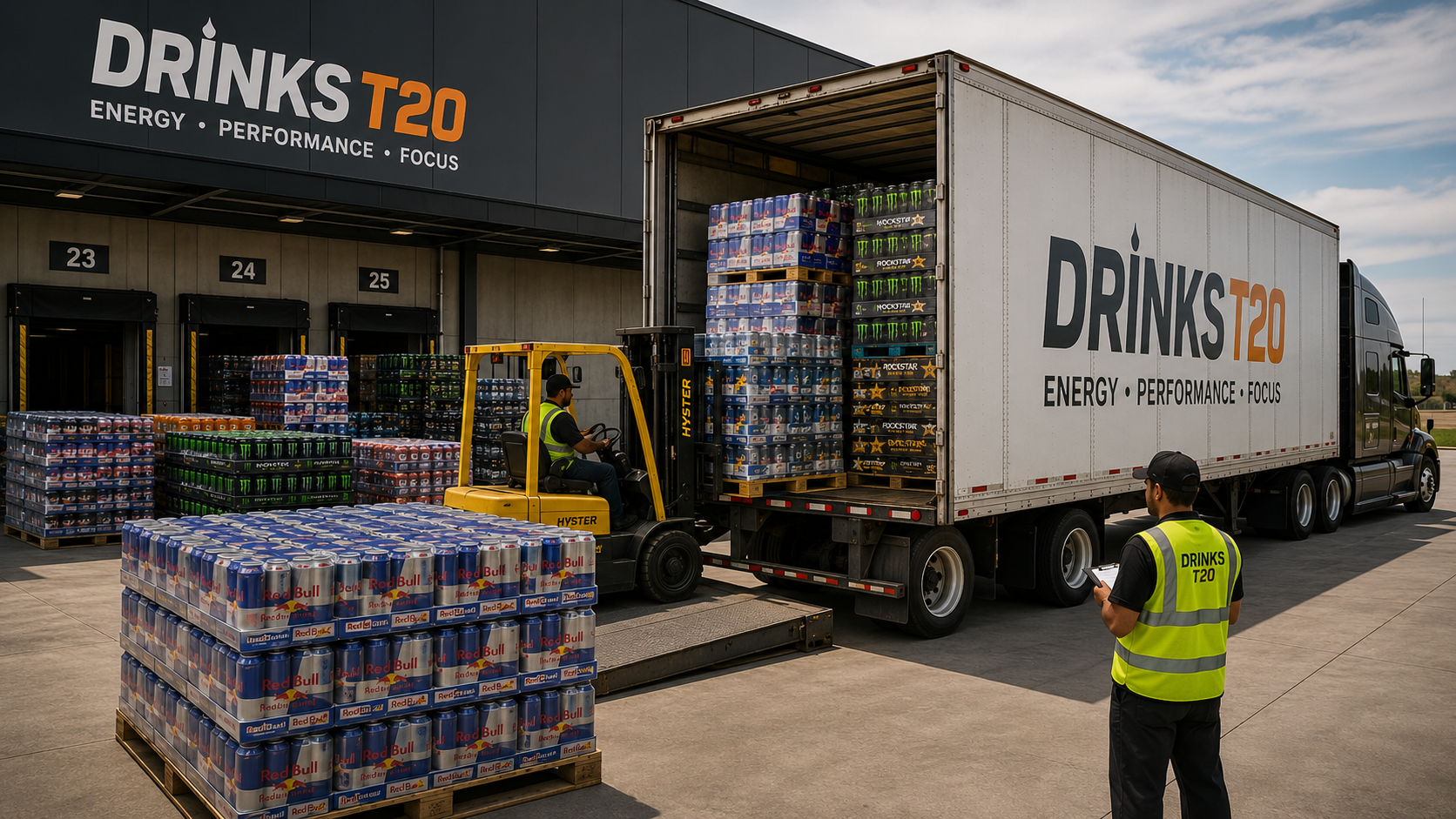
Export Documentation Is a Controlled Information Chain
A professional export file tells the same commercial story across the quotation, invoice, packing list, freight document, and regulatory filing: who sold the goods, who bought them, what is being shipped, how much, its value, its origin, where it is going, and who will receive it.
What Was Sold?
Product description, quantity, unit price, total value, currency, and agreed commercial terms.
What Physically Ships?
Pallet/carton counts, package marks, gross/net weight, and dimensions where applicable.
What Must Be Reported?
Schedule B, value, origin, export parties, licence data, and EEI/AES information when required.
What Must the Importer Provide?
Consignee details, customs/import requirements, licences, registrations, or certificates requested by the destination market.
Documents Used in an Energy Drink Export Transaction
U.S. Trade.gov recommends starting with the foreign customer/importer or freight forwarder to identify the exact document set needed for customs clearance. The documents below are commonly used — additional destination-specific documents may apply.
Pro Forma Invoice
Pre-shipment commercial document used to quote the proposed transaction. Identifies goods, quantity, price, weight, and specifications before the final sale.
Commercial Invoice
Legal seller-to-buyer document stating the goods and amount due. Customs authorities commonly use it to assess transaction value and duties.
Export Packing List
Detailed cargo info: seller, buyer, shipper, invoice, transport mode, package quantities, description, package type, net/gross weight, marks, dimensions.
Bill of Lading / Air Waybill
The transport document depends on freight mode. Ocean bills of lading and air waybills serve different functions and must match the shipment.
Certificate of Origin
Some countries or transactions require a signed origin statement or certification. Requirement and validation depend on destination and trade arrangement.
AES / EEI Proof or Exemption
Where EEI is required, the accepted AES filing produces an ITN. Where an exemption applies, the correct exemption citation is used instead.
Product Specification Data
SKU, pack, GTIN/EAN, ingredients, nutrition, batch, or best-before data supports buyer and importer review where required.
Destination-Specific Documents
Some countries require health, safety, compliance, registration, inspection, or other supporting documents beyond the standard file.
| Document | Main Purpose | Who Uses It | Important Check |
|---|---|---|---|
| Pro Forma Invoice | Pre-shipment quotation / transaction proposal | Buyer, bank, importer, internal sales | Products, quantities, value, and trade term match the offer |
| Commercial Invoice | Final seller-to-buyer commercial declaration | Customs, buyer, broker, carrier | Buyer/importer, goods, and value are accurate |
| Packing List | Physical cargo breakdown | Customs, carrier, warehouse, receiver | Pallet/carton counts and weights match prepared cargo |
| Bill of Lading / AWB | Transportation contract / shipment record | Carrier, shipper, consignee, bank where relevant | Names, destination, and cargo description align with shipment |
| Certificate of Origin | Support declared origin when required | Importer, customs, chamber/authority | Requested before shipment if destination requires it |
| AES / EEI | U.S. export reporting where required | U.S. Census / enforcement agencies / carrier | Correct parties, Schedule B, quantity, value, and destination |
When Electronic Export Information May Need to Be Filed Through AES
Electronic Export Information (EEI) is export data filed through the Automated Export System (AES). U.S. Census describes AES as the electronic system used to collect export information, and EEI as the export data submitted through that system.
A key filing threshold is the value of merchandise under each individual Schedule B classification. U.S. Census guidance states that commodities valued at more than $2,500 per individual Schedule B number generally require filing, while commodities valued at $2,500 or less per Schedule B number may qualify for the low-value exemption — when no mandatory filing condition applies.
The threshold is not the only rule. An export licence or other mandatory filing condition can require EEI regardless of value. Canada also has a special exemption framework: ordinary U.S.-to-Canada shipments are generally exempt from AES filing unless one of the listed exceptions applies, such as a required export licence or certain onward-transit situations.
Classify the Products
Identify the correct current Schedule B number(s) for the merchandise being exported.
Check Value by Code
Evaluate export value under each individual Schedule B number — not just the shipment total.
Check Mandatory Filing
Review destination, licensing, and any exception that removes the low-value exemption.
File or Document Exemption
Use AES when required and provide the ITN, or use the applicable exemption citation when filing is not required.
Schedule B Codes Identify the Commodity for U.S. Export Reporting
The U.S. Census Bureau maintains the Schedule B classification system and a dedicated search tool. Codes can change — classification should be checked against the current Schedule B, not copied indefinitely from an old shipment.
Schedule B Number
The 10-digit U.S. export classification used for statistical reporting and AES data. Reflects the actual commodity.
Commodity Description
The written product description should be sufficiently accurate to support classification and customs understanding.
Quantity & Unit
AES data may require quantities and units of measure associated with the Schedule B classification.
Export Value
Export reporting value follows U.S. Foreign Trade Regulation rules — not retail shelf price.
Know Who Each Party Is Before Export Documents Are Prepared
Export documentation often fails because names are treated casually. U.S. Foreign Trade Regulations distinguish the U.S. Principal Party in Interest, Foreign Principal Party in Interest, ultimate consignee, and forwarding agent. These roles affect EEI filing responsibilities.
USPPI
The U.S. Principal Party in Interest is generally the U.S. person or entity receiving the primary benefit from the export transaction — often the U.S. seller or manufacturer.
FPPI
The Foreign Principal Party in Interest is generally the foreign buyer shown in the export transaction and may have special responsibilities in a routed export transaction.
Ultimate Consignee
The party located abroad that actually receives the export shipment. Can differ from the foreign buyer in a drop shipment or onward-sale transaction.
Forwarding Agent
A U.S.-authorized party that may facilitate cargo movement and/or prepare and file required export information when properly authorized.
Routed Export Transaction
A transaction in which the foreign principal party authorizes a U.S. agent to prepare and file EEI, with responsibilities divided under the Foreign Trade Regulations.
ITN
The Internal Transaction Number generated after AES accepts an EEI filing. Serves as the proof-of-filing citation for the shipment.
FDA Certificates Are Destination-Driven — Not Automatically Required
FDA states that it does not require written certification simply to export food from the United States. Foreign customers or governments may still request an eligible certificate. The exporter follows both U.S. requirements and the requirements of the destination country.
Certificate to a Foreign Government
FDA says this certificate is available for eligible conventional foods and certain other food categories that meet applicable U.S. marketing requirements.
Certificate of Exportability
Available in eligible circumstances for conventional foods and certain products that cannot be marketed in the U.S. but meet the statutory conditions for legal export.
Certificate of Free Sale
FDA currently limits this certificate to dietary supplements, medical foods, and foods for special dietary use. We do not promise it for ordinary conventional energy drinks.
Do Energy Drink Exports Need an Export Licence?
Do not treat "export licence" as a standard document every beverage shipment automatically needs. U.S. Trade.gov describes an export licence as a government authorization for specific goods, quantities, destinations, or end uses — and notes that licensing requirements depend on the item and destination.
For an ordinary commercial energy drink transaction, the correct approach is to make the required licence determination for the actual products, destination, and parties — rather than advertise a blanket "no licence required" promise. Sanctions, restricted parties, unusual ingredients, or another government-agency requirement can change the compliance review.
If a licence is required, the low-value AES exemption does not remove the filing requirement.
Keep the Export Transaction File After the Shipment Leaves
U.S. Census guidance states that parties to the export transaction must retain export-related records for five years from the date of export under the Foreign Trade Regulations. Another agency can impose a longer retention period for transactions under its authority.
Sales Records
Approved quotation, buyer correspondence, and final commercial agreement establishing what was sold.
Commercial Documents
Commercial invoice and cargo breakdown used for the export shipment.
Freight Documents
Bill of lading, air waybill, carrier, routing, and freight-forwarder records applicable to the transaction.
Regulatory Records
AES proof or exemption citation, classification work, authorizations, and certificate or licence records where applicable.
Seven Mistakes That Delay Beverage Shipments at Customs
Most export delays come from preventable documentation errors — not from regulatory prohibitions. These are the ones we see most often with commercial beverage shipments.
Wrong Schedule B Classification
Using an outdated or incorrect code causes AES filing rejection and customs scrutiny. Always verify against the current Census Schedule B.
Inconsistent Naming Across Documents
Buyer name on the invoice not matching the importer on the packing list causes customs holds. Names must match exactly across every document.
Missing Importer Tax / Registration Number
Many destinations require the importer's tax ID, VAT number, or registration number on the commercial invoice. Missing values delay entry.
Filing AES Too Late
EEI must be filed and the ITN provided before the carrier receives the cargo. Late filing blocks departure.
Promising Free Sale for Conventional Foods
FDA limits the Certificate of Free Sale to dietary supplements, medical foods, and foods for special dietary use. Conventional energy drinks are not eligible.
Assuming FOB/CIF Applies to All Routes
FOB and CIF are sea/inland-waterway terms. Canadian overland shipments and multimodal routes need different Incoterms.
Skipping the Importer Readiness Check
Assuming U.S. labels are automatically resale-ready abroad causes destination-side rejections. Confirm label and registration requirements before shipment.
No Retained Export File
FTR requires 5-year retention of export records. Missing documents can create issues during post-export audits or enforcement inquiries.
Export Terms International Beverage Buyers Should Understand
Clear terminology reduces confusion between freight, customs, and commercial responsibilities.
AES
Automated Export System: the U.S. electronic system used for filing and processing export information.
EEI
Electronic Export Information: the export data submitted through AES when filing is required.
Schedule B
The U.S. 10-digit export commodity classification maintained by the Census Bureau.
ITN
Internal Transaction Number: proof that an EEI filing has been accepted by AES.
Commercial Invoice
The seller-to-buyer legal commercial document used as a central customs valuation document.
Export Packing List
A detailed physical cargo list that supports customs, carrier, and receiving checks.
Certificate of Origin
A statement/certification of product origin required by some countries or transactions.
Bill of Lading
An ocean/transport document governing the carrier's movement of goods and, depending on type, possession/title functions.
FOB / CIF
ICC sea/inland-waterway Incoterms. The exact named port and rule should be written in the quotation — not used as universal labels for every cross-border route.
Document Requirements by Destination Market
Beyond the standard U.S. export file, some destinations require additional documentation or pre-registration. Here is the standard reference — the importer confirms exact requirements before shipment.
| Destination | Standard Documents | Additional Requirements | Importer Responsibility |
|---|---|---|---|
| Canada | Commercial invoice, packing list, BOL | CFIA Safe Food for Canadians licence; bilingual label; Health Canada supplemented-food label | Importer holds SFCR licence; confirms label compliance |
| European Union | Commercial invoice, packing list, BOL, EORI on invoice | Destination-language mandatory info; EU importer address; caffeine warning; food business operator registration | EU importer is responsible for food information compliance |
| Brazil | Commercial invoice, packing list, BOL, certificate of origin | RADAR registration for importer; ANVISA registration for some food products; Portuguese label | Importer maintains RADAR; ANVISA product registration |
| United Kingdom | Commercial invoice, packing list, BOL, UK EORI | Post-Brexit customs declaration; UK FBO address; UK-compliant label | UK importer files customs entry; confirms label |
| Colombia | Commercial invoice, packing list, BOL, certificate of origin | Import license may apply; INVIMA registration; Spanish label | Importer handles INVIMA and DIAN entry |
| Chile | Commercial invoice, packing list, BOL, certificate of origin | Aduanas entry; ISP registration for food; Spanish label | Importer handles Aduanas and ISP requirements |
| Peru | Commercial invoice, packing list, BOL, certificate of origin | SUNAT entry; DIGESA registration; Spanish label | Importer handles SUNAT and DIGESA |
Information to Confirm Before Cargo Release
The exact checklist changes by destination, but these controls help prevent common documentation errors in commercial beverage shipments.
Buyer & Importer
Legal name, registered address, tax/import number where relevant, contact person, and customs-broker details.
Ultimate Consignee
Identify the party that will actually receive the goods abroad — especially where buyer and receiver differ.
Product Description
Exact brand, SKU, pack size, flavor, quantity, and clear commercial description.
Classification & Origin
Current Schedule B classification and domestic/foreign origin indicators required for U.S. export data.
Value & Currency
Commercial value aligns with the transaction and export reporting rules.
Destination Documents
Importer confirms special certificates, registrations, translated labels, or customs documents before dispatch.
Freight & Incoterm
Named port/place, freight mode, forwarder/carrier, and exact trade term match the written commercial offer.
AES / Exemption
Complete EEI filing where required and retain the ITN, or document the correct exemption citation.
Final Document Match
Review names, quantities, value, package count, and destination across invoice, packing list, and freight documents.
Use Current Government Sources for Final Export Decisions
Export regulations and classification data can change. Buyers and logistics partners should confirm final requirements against current official guidance for the specific shipment.
Common export documents, commercial invoices, packing lists, certificates of origin, and export compliance overview.
Common Export Documents →Current Schedule B classification search and annual code files for U.S. export reporting.
Schedule B Search →AES, EEI, export parties, low-value exemption, Canada exemptions, ITN, and record-retention guidance.
Foreign Trade Regulations →Food export responsibilities, export certificates, and certificate eligibility for conventional foods.
FDA Food Exports →Questions Buyers Ask About U.S. Energy Drink Export Documentation
What documents are normally used for an energy drink export?
A commercial export file commonly includes a pro forma invoice during quotation, a commercial invoice, export packing list, and transport document. AES/EEI proof, certificate of origin, or other special documents may apply depending on transaction and destination.
What is the difference between a pro forma invoice and commercial invoice?
The pro forma invoice is used before shipment as a quotation/transaction proposal. The commercial invoice is the final seller-to-buyer commercial document used as a key customs and valuation document.
Is a packing list the same as a commercial invoice?
No. The export packing list describes the physical cargo in much greater detail. Trade.gov specifically notes that it is not a substitute for the commercial invoice.
When is AES / EEI required?
A common filing trigger is merchandise valued over $2,500 under an individual Schedule B number. Mandatory filing can also apply for reasons such as an export licence. The rules include exemptions, including special treatment for many U.S.-to-Canada shipments.
Is the $2,500 AES threshold based on the entire shipment?
The Census low-value exemption is applied by individual Schedule B classification — not simply the grand total of the shipment. Mandatory filing exceptions can still override the exemption.
Do shipments from the United States to Canada require AES?
Many U.S.-to-Canada shipments are exempt from EEI filing, but Census lists exceptions including shipments that require an export licence and certain onward-transit or controlled situations.
What is a Schedule B number?
Schedule B is the U.S. 10-digit commodity classification used for export reporting. The Census Bureau provides the current classification search tool and code files.
Who is the USPPI?
The U.S. Principal Party in Interest is generally the U.S. person or entity receiving the primary benefit from the export transaction. Often the U.S. seller or manufacturer, depending on the transaction structure.
What is an ultimate consignee?
The ultimate consignee is the party located abroad that actually receives the export shipment. Can differ from the foreign buyer in a drop-shipment or onward-sale arrangement.
What is an ITN?
The Internal Transaction Number is generated when AES accepts an EEI filing and serves as the proof-of-filing citation supplied for the shipment.
Does every energy drink export need an FDA certificate?
No. FDA states that written export certification is not required simply to export food. A foreign government or buyer may request an eligible certificate for a specific destination or product.
Can T20 provide an FDA Certificate of Free Sale for ordinary energy drinks?
We do not promise that certificate for ordinary conventional energy drinks. FDA currently limits its Certificate of Free Sale to dietary supplements, medical foods, and foods for special dietary use. Eligible conventional foods may use other FDA export certificates.
Is a Certificate of Origin always required?
No. Trade.gov notes that certificates of origin are required by some countries and transactions. The importer should identify the requirement before shipment.
Does every beverage shipment require a U.S. export licence?
No blanket rule should be used. Licence requirements depend on the goods, destination, end use, and applicable U.S. regulations. The correct approach is to make the licence determination for the actual transaction.
How long should export records be retained?
U.S. Census guidance states that export-transaction records under the Foreign Trade Regulations generally must be retained for five years from the date of export. Another agency may require a longer period for transactions under its authority.
What is T20's minimum export order?
T20's international export minimum is 10 pallets for qualified commercial buyers.
Prepare Your Export Enquiry With the Right Information
Send the importer/consignee details, destination, products, pallet quantity, and any required destination certificates or documentation. We'll review the commercial order, export-information requirements, and international shipping structure before issuing the quotation.