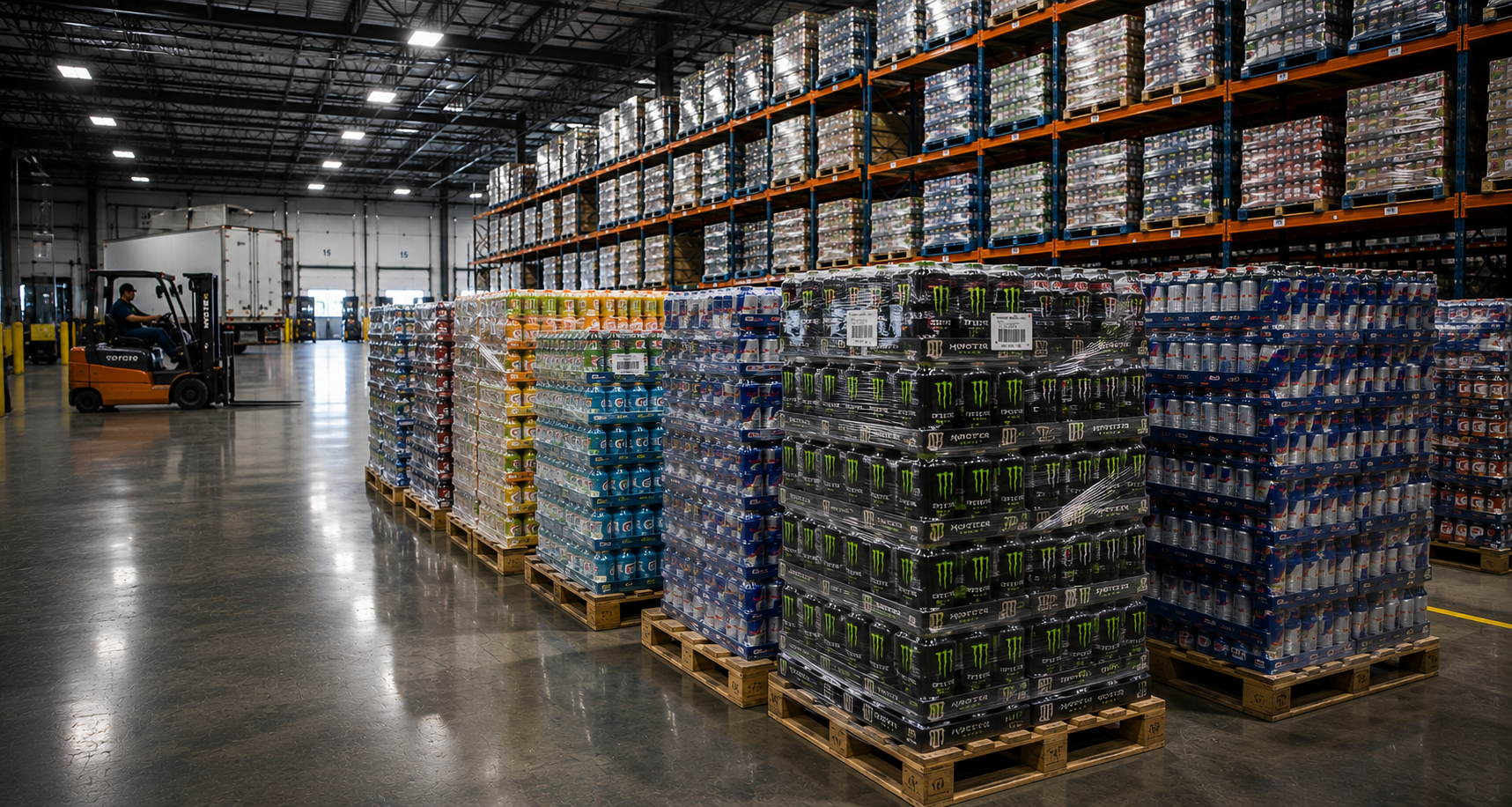

Pallet ordering is the purchasing format that most commercial energy drink buyers eventually land on, and for good reason. It sits in a practical middle position between smaller bulk case purchases and the scale of full truckload supply. You get enough inventory to run a consistent cooler set, stock multiple vending machines or supply a territory of retail accounts, without the warehouse footprint and cash commitment that a truckload requires. For businesses with confirmed demand and a predictable replenishment cycle, buying energy drinks by the pallet is simply the most operationally efficient way to purchase.
This guide explains how energy drink pallet orders work in practice, who buys them, how pallet configurations and pricing are structured, what logistics considerations apply and what separates a reliable pallet supplier from one that creates problems. For buyers who are still evaluating their wholesale options, the energy drink wholesale USA overview provides broader market context that complements the pallet-specific detail covered here.
What Are Energy Drink Pallet Orders?
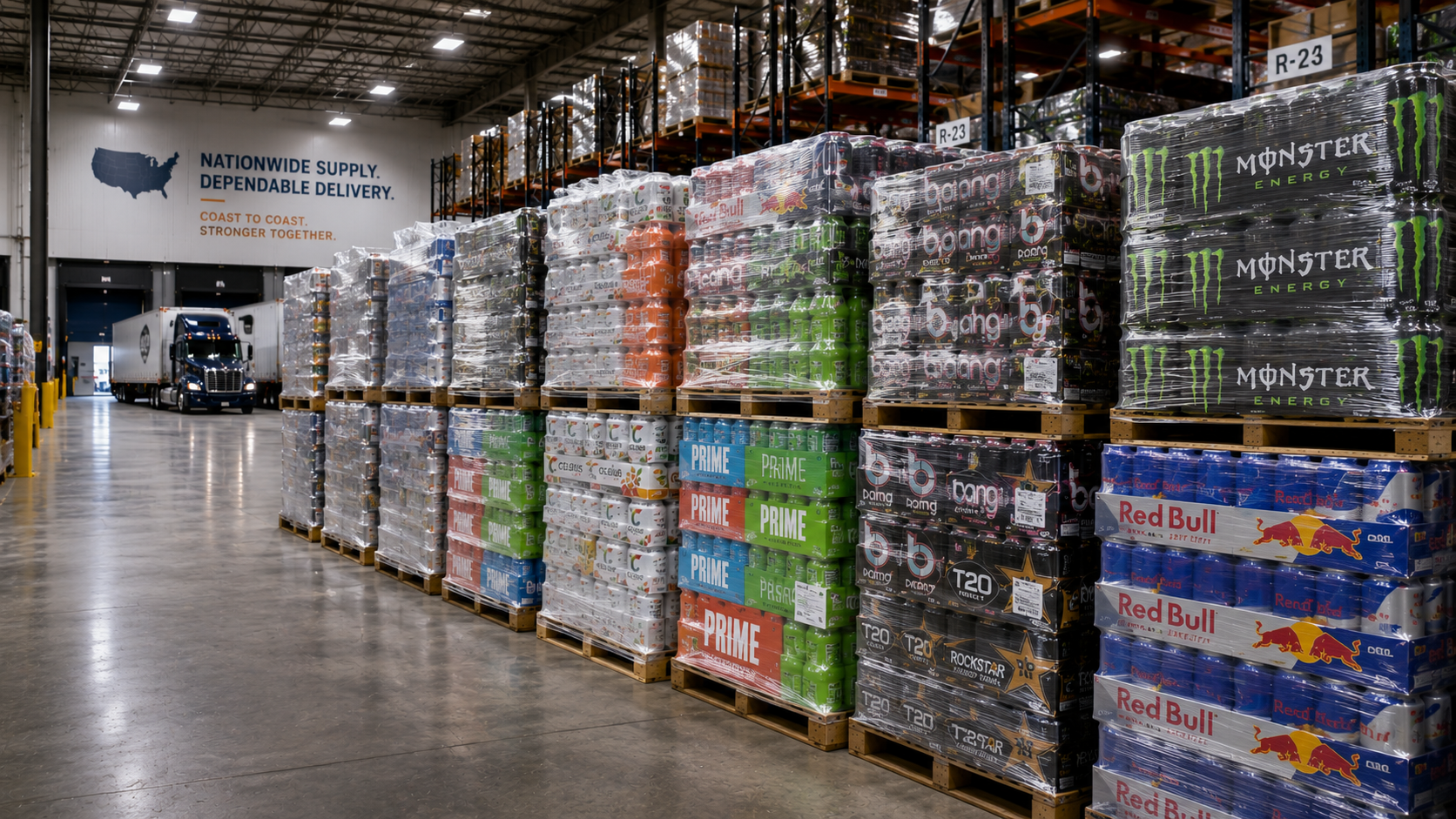
An energy drink pallet order is a commercial purchase of multiple cases stacked and shrink-wrapped on a shipping pallet for freight transport and warehouse handling. Instead of ordering individual cases and receiving them as loose cartons, a pallet buyer receives a consolidated, freight-ready shipment that moves through the supply chain more efficiently at every stage.
The pallet format is standard across beverage distribution because it matches how warehouses, freight carriers and commercial receiving areas are designed to operate. Forklifts, pallet jacks and loading docks are built around pallet dimensions. When a business receives a palletized energy drink shipment, the product arrives in a format that is faster to unload, easier to count and more organized to store than individual case deliveries.
Pallet orders occupy a defined position in the wholesale purchasing ladder. They represent more volume than bulk energy drink orders and less commitment than truckload supply. That positioning makes them suitable for a wide range of commercial buyers whose demand is consistent enough to justify pallet quantities but not yet large enough to fill a full trailer.
One important point that buyers sometimes overlook: pallet configurations are not standardized across every brand or product. The number of cases on a pallet varies depending on the manufacturer, can size, packaging format and how the product stacks. A pallet of 12oz cans will typically have a different case count than a pallet of 16oz cans. Slim can formats stack differently from standard cylindrical cans. Before placing any pallet order, buyers should confirm the exact case count, product format and pallet configuration with their supplier.
Why Businesses Order Energy Drinks by the Pallet
The operational reasons for moving to pallet purchasing are straightforward once a business has confirmed consistent demand. Small-format ordering creates a procurement overhead that grows as the business grows. Placing multiple case orders each week across several brands, tracking each delivery, processing each invoice and managing each replenishment cycle individually consumes time that could be directed elsewhere. Pallet purchasing consolidates that activity into a smaller number of larger, more organized transactions.
Inventory stability is the other primary driver. A business that operates on small frequent orders is always one supply disruption away from a stockout. A supplier delay, a logistics issue or a missed order window can leave coolers empty or vending machines sitting idle. Pallet-level inventory provides a buffer that absorbs those disruptions without affecting the retail or distribution operation downstream.
There is also a warehouse efficiency argument. Palletized inventory arrives in a format that is ready for organized storage. Products are grouped by brand and SKU, quantities are confirmed on the delivery documentation and the physical stack is already in the orientation needed for FIFO rotation. Compare that with receiving multiple individual case deliveries across different days and the organizational advantage of pallet purchasing becomes clear.
For growing businesses, pallet ordering also serves as a natural intermediate step. Most commercial buyers do not begin with truckload purchasing. They start with bulk cases, confirm their demand, then progress to pallet orders as volume and confidence in their sell-through justify the larger commitment. The pallet format supports that progression without requiring a sudden jump to truckload quantities that may exceed current storage or cash flow capacity.
Who Typically Buys Energy Drink Pallets?
Pallet purchasing is used across every major commercial channel for energy drinks. The specific purchasing rationale differs by buyer type, but the common thread is confirmed regular demand that makes frequent small orders inefficient.
Convenience Stores
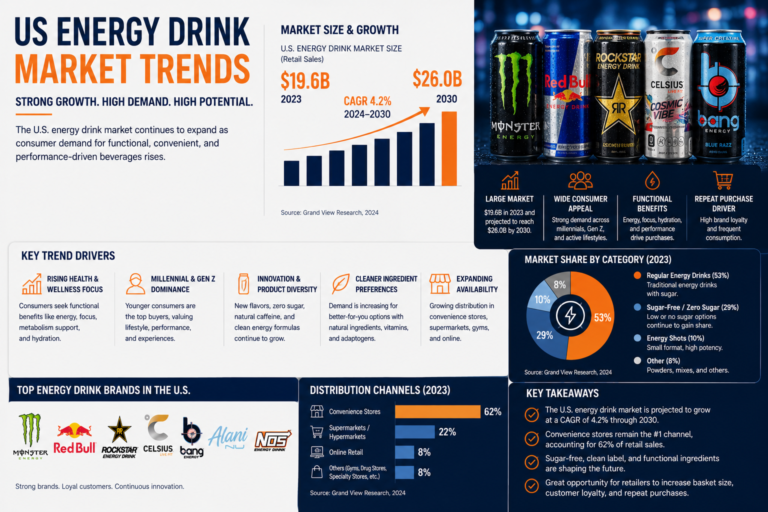
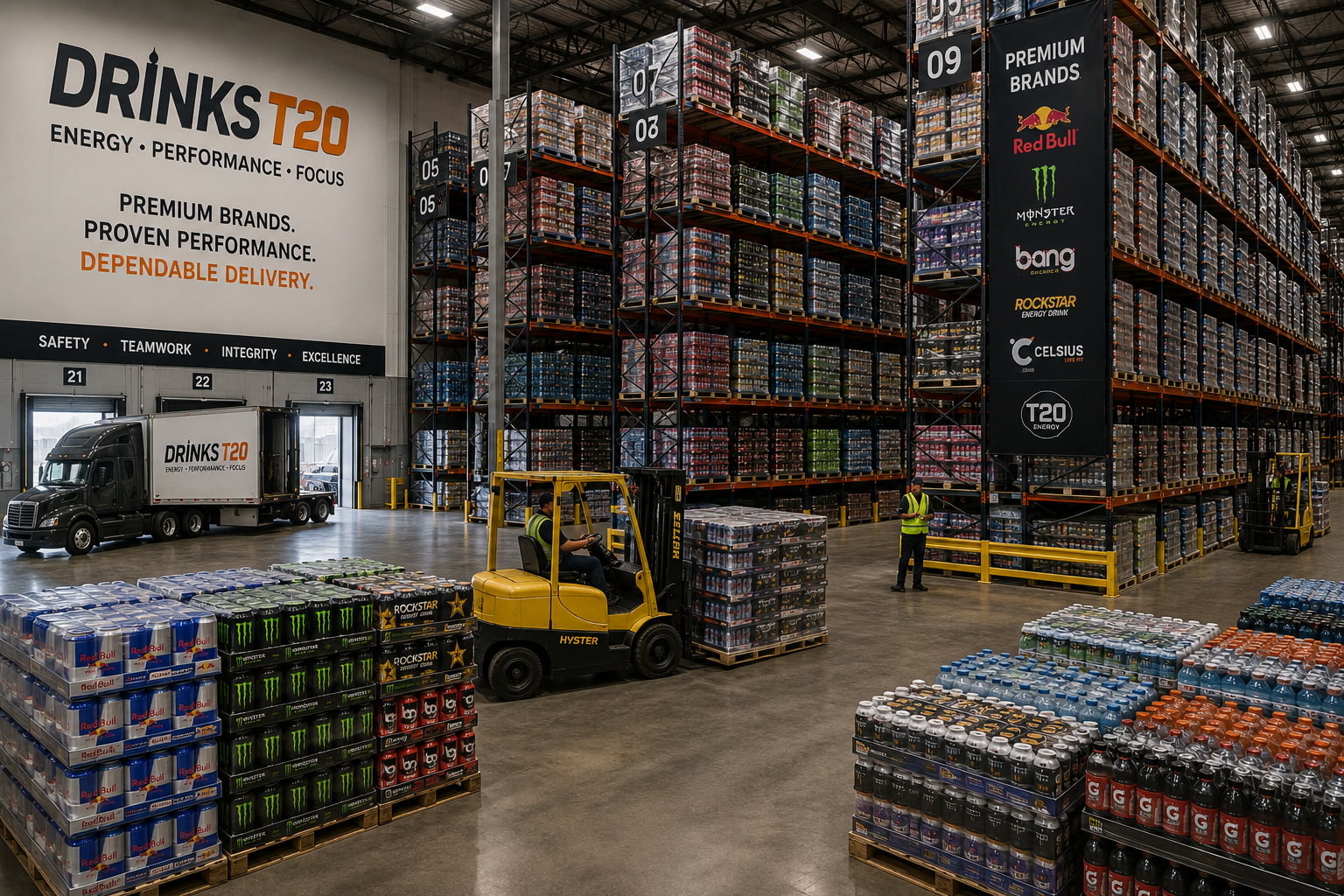
Convenience stores are the highest-volume retail channel for energy drinks in the United States, and pallet purchasing is a natural fit for operators running active cooler sets with multiple brands and SKUs. A convenience store moving 60 to 100 energy drink units per day across a mixed set needs a supply format that keeps pace with that velocity without requiring daily reordering.
Pallet orders give convenience store operators a defined replenishment quantity tied to their sell-through cycle. A store that knows it will move through a pallet of core Monster and Red Bull SKUs in roughly three weeks can build its ordering schedule around that cycle, maintaining inventory without overstocking. The buffer also covers unexpected traffic spikes, long weekends and periods when supplier lead times extend slightly.
For multi-location convenience store operators, coordinating pallet orders across sites simplifies procurement further. Instead of managing separate case orders for each location, a regional operator can consolidate purchasing into pallet quantities per site on a synchronized replenishment schedule.
Gas Stations and Travel Centers
Gas stations experience predictable demand patterns tied to commuter traffic, weekend travel and truck route activity. Morning commuter peaks, afternoon drive-time waves and overnight trucking stops all generate energy drink purchases. For operators who understand their traffic patterns, pallet purchasing allows them to stock appropriately for those peaks without scrambling for product mid-week.
Travel centers serving long-haul truck routes have particularly strong energy drink demand because the customer base depends on the product for work. A travel center that runs out of Monster or Red Bull during a busy overnight period loses sales to the next stop down the highway. Pallet-level inventory prevents that outcome and supports the promotional cooler and front-of-store display capacity that travel retail requires.
Supermarkets
Supermarkets approach energy drink purchasing through a category management lens. Buyers work with planogram requirements, promotional calendars and weekly sales velocity data. Pallet ordering fits this model because it provides enough inventory to support planned shelf quantities, endcap promotions and beverage aisle depth without requiring constant replenishment that disrupts category flow.
A supermarket running a two-week promotional feature on Celsius or Red Bull multi-packs needs a supply position that covers the promotional uplift in demand. A pallet order placed ahead of the promotion provides that coverage. Without pallet-level inventory planning, promotional commitments become supply risks.
Vending Companies
Vending operators manage a distributed inventory challenge. Product needs to be available at a central point for route drivers to load and distribute across a machine network that may span offices, warehouses, gyms, universities, hospitals and transit hubs across a wide geographic area. Pallet purchasing at the warehouse level simplifies that supply chain by ensuring the route distribution point stays stocked without constant supplier touchpoints.
For vending operators running 20 or more machines, the logistics of pallet receiving at a central warehouse far outweigh the complexity of receiving multiple small deliveries. The inventory is organized, the case counts are verified in one receiving event and the route drivers pull from a consolidated stock that is easier to manage than scattered case purchases.
Beverage Distributors
Beverage distributors are among the most active pallet buyers in the wholesale energy drink market. Their business model requires holding inventory that supports multiple downstream retail accounts simultaneously. A regional distributor serving 30 convenience stores, 10 gas stations and 5 supermarkets cannot manage that account base on bulk case purchasing. Pallet quantities are the minimum practical format for a distributor operating at any meaningful scale.
Distributors also use pallet purchasing as a stage in their progression toward truckload supply. As the account base grows and weekly energy drink movement increases, the per-unit economics of truckload purchasing become attractive. But pallet buying is where most distributors spend a significant period of their growth, building supply relationships and confirming downstream demand before committing to full trailer volumes.
For distributors evaluating wholesale supply partners, the T20 distributor program is designed for buyers operating at this level.
Understanding Energy Drink Pallet Configurations
Pallet configuration is one of the most practically important details in wholesale energy drink purchasing, and it is one that buyers frequently underestimate until it creates a problem. The number of cases on a pallet is not fixed across the industry. It varies by brand, can size, packaging format and how the manufacturer or supplier has configured the stack.
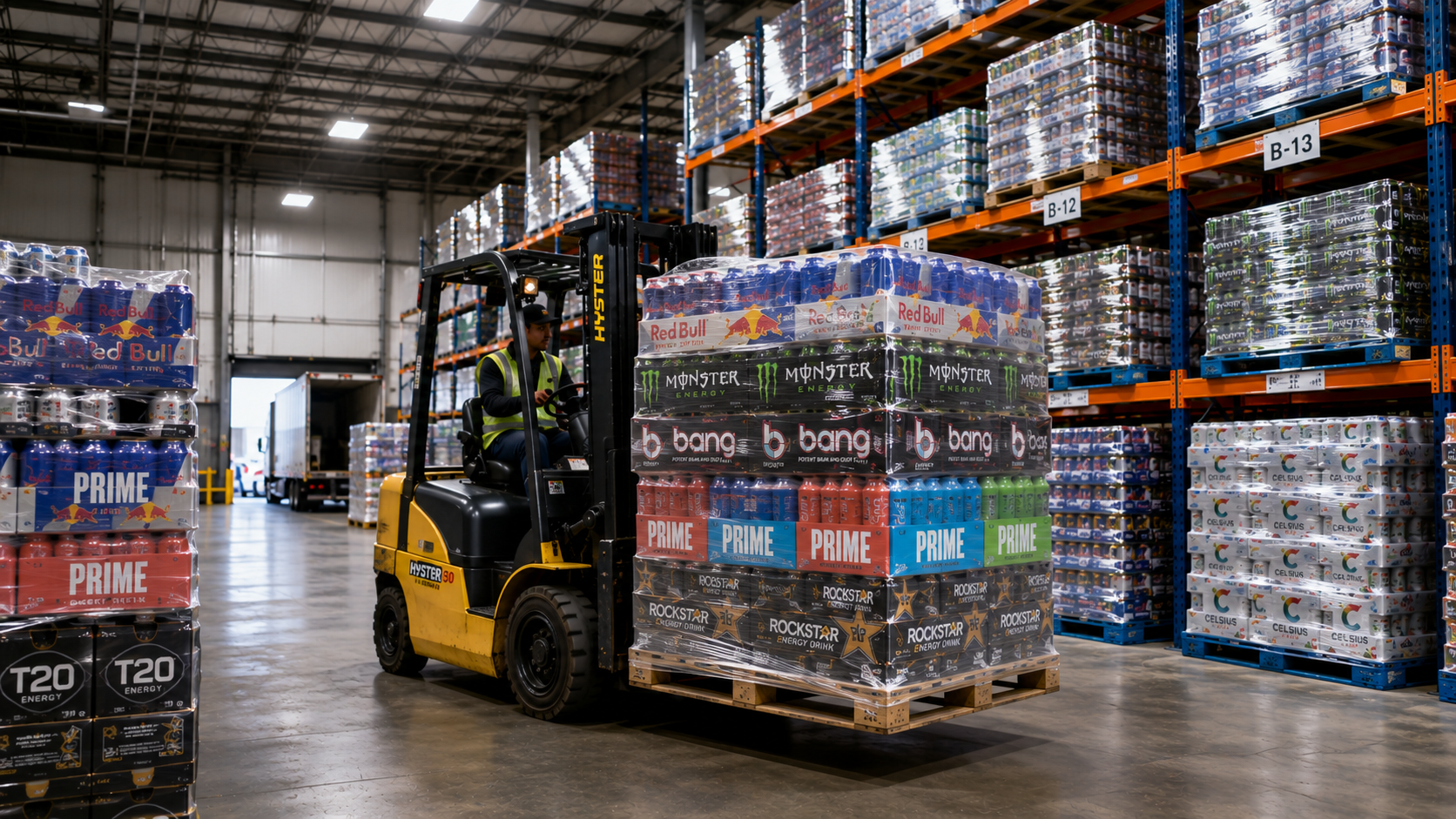
A standard 16oz Monster Energy case typically contains 24 cans. But the number of cases on a pallet depends on how those cases stack physically and what the pallet’s weight and height limits allow. A pallet of 12oz Red Bull slim cans stacks differently from a pallet of 16oz Monster cans in standard format. Multi-pack configurations, tray packs and mixed-SKU pallets all affect the final case count.
This matters commercially because buyers comparing pallet quotes need to compare the same thing. A lower pallet price from one supplier may reflect a lower case count, a different product mix or less favorable packaging configuration. The headline price per pallet is not a reliable comparison point without knowing what is actually on the pallet.
A reliable wholesale energy drink supplier should provide clear pallet specifications before the order is placed: brand, SKU, can size, cases per pallet, units per case and total unit count. Buyers who receive quotes without this detail should request it before committing. The specification sheet is the basis for evaluating value, not the headline number.
Pallet Logistics and Delivery Considerations
Pallet orders are operationally simpler than loose-case deliveries in many ways, but they require more preparation on the receiving end. A buyer who has not thought through their receiving setup before placing a pallet order is likely to encounter complications that could have been avoided with basic planning.
The first question is physical access. Can a freight truck reach the delivery location? Many convenience stores, smaller gas stations and independent retailers are located in commercial strips or areas where large freight vehicles have limited maneuverability. If standard freight delivery is not accessible, liftgate service may be required, which should be confirmed with the supplier at the time of ordering.
The second question is unloading equipment. A pallet weighing several hundred pounds cannot be hand-unloaded efficiently or safely in most cases. A pallet jack is the minimum requirement for most pallet deliveries. A forklift is needed for loading dock operations. Buyers who lack handling equipment need to arrange it before the delivery arrives, not after.
Storage space is the third consideration. A pallet takes up a defined floor footprint. Buyers should confirm they have the warehouse, backroom or storage area to receive and organize the inventory before placing an order sized beyond what their space supports. Overcrowded storage creates product handling problems, rotation errors and safety issues that negate the operational benefits of pallet purchasing.
Additional logistics considerations for commercial pallet buyers:
- Receiving hours and staffing availability for unloading
- Dock height compatibility with freight carrier equipment
- Product rotation planning to support FIFO inventory management
- Temperature and handling requirements during transport and storage
- Freight lead time from order placement to delivery
- Single-brand versus mixed-brand pallet logistics
Pallet Orders vs Bulk Orders vs Truckload Orders
Choosing the right purchasing format is a practical decision based on sales volume, storage capacity, cash flow and how the business is structured logistically. Each format serves a different stage of commercial purchasing.
Bulk Energy Drink Orders
Bulk orders are the right format for buyers whose demand is above retail levels but not yet confirmed at pallet scale. This includes new commercial accounts, single-location retailers testing new brands, vending operators adding their first few machines, offices or gyms purchasing for employee or member use and event suppliers with variable demand. Bulk ordering provides commercial pricing and product access without the inventory commitment of a full pallet.
Energy Drink Pallet Orders
Pallet orders suit businesses with established, consistent demand that justifies receiving a defined larger quantity in a single freight shipment. The format works for convenience stores running active cooler sets, gas stations with steady daily traffic, vending operators managing multiple machine locations, supermarkets with category planning commitments and regional distributors supplying retail accounts. Pallet purchasing provides better per-unit economics than bulk and a more manageable inventory commitment than truckload.
Truckload Energy Drink Orders
Truckload supply is for high-volume buyers with the warehouse capacity, cash flow and downstream demand to justify filling a full freight trailer. Regional distributors serving large account bases, retail chains with central distribution centers and commercial operators managing high-volume multiple-location supply are the primary truckload buyers. The per-unit economics are the most favorable at this scale, but the planning requirements are significantly greater than pallet purchasing.
Most commercial buyers progress through these formats in sequence. Bulk ordering establishes the supply relationship and confirms product demand. Pallet ordering follows once sales velocity is understood. Truckload supply becomes viable when pallet demand is consistent across a scale that makes trailer quantities efficient.
How Pallet Ordering Supports Inventory Planning
One of the clearest operational benefits of pallet purchasing is the discipline it brings to inventory planning. When a buyer receives a defined quantity in a single shipment, they have a concrete starting point for tracking sell-through, forecasting reorder timing and understanding which SKUs move fastest in their specific environment.
A convenience store that receives a pallet and tracks how long it takes to sell through has real data for the next order decision. If a mixed pallet of Monster and Red Bull sells through in 18 days, the buyer knows their reorder cycle and can place the next order with enough lead time to avoid a gap. If one SKU sells in 10 days while another takes 30, the buyer has information to adjust the mix on the next order.
This kind of inventory visibility is harder to develop with small frequent purchases where quantities fluctuate and sell-through data is less consistent. Pallet purchasing creates a more structured purchasing cycle that naturally generates better inventory data over time.
The FIFO method, placing newer stock behind older stock so older product rotates out first, is the standard practice for managing palletized beverage inventory. It applies especially to energy drinks, which carry defined shelf life requirements. Buyers who receive pallet deliveries should build FIFO rotation into their receiving process from the first order, not as an afterthought after an expiration issue occurs.
Energy Drink Brands Commonly Purchased by the Pallet
Brand selection for pallet orders should reflect the consumer demand at the specific retail location or distribution territory, not general market popularity alone. The brands that move fastest nationally may not be the brands that move fastest at a particular gas station in a specific market. That said, the most commonly requested pallet brands reflect broad consumer demand that applies across most commercial buying environments.
Monster Energy Pallets
Monster Energy is the most requested brand for commercial pallet purchasing in the U.S. market. Its SKU range covers Original, Ultra sugar-free, Juice blends, Rehab and various seasonal and limited editions, which means a Monster pallet can be configured to serve multiple consumer segments from a single brand. Convenience stores, gas stations and vending operators with high-traffic locations typically include Monster as a core pallet component.
Red Bull Pallets
Red Bull commands premium retail placement and maintains some of the strongest brand loyalty in the category. Its 8.4oz original remains a staple single-serve SKU across virtually every retail format. Red Bull pallets suit buyers serving consumer bases that prioritize brand familiarity and premium positioning. The brand’s sugar-free and flavor extensions provide additional SKU options for buyers looking to carry the Red Bull family more broadly.
Celsius Pallets
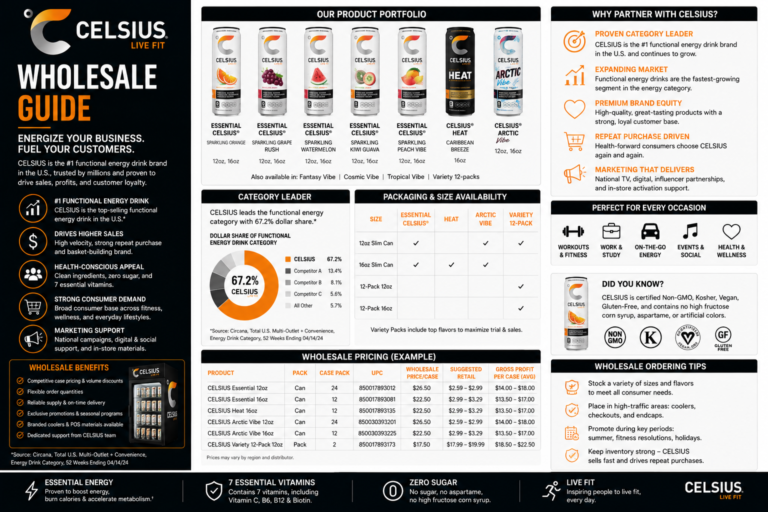
Celsius has established itself as the leading functional energy drink in mainstream retail distribution. Buyers sourcing Celsius by the pallet are typically serving fitness-oriented consumers, health-conscious shoppers or demographics that have moved away from traditional high-sugar energy formats. Celsius pallets work well for supermarkets, gym-adjacent vending, lifestyle-oriented convenience formats and any retailer whose customer base skews toward wellness positioning.
Prime Energy Pallets
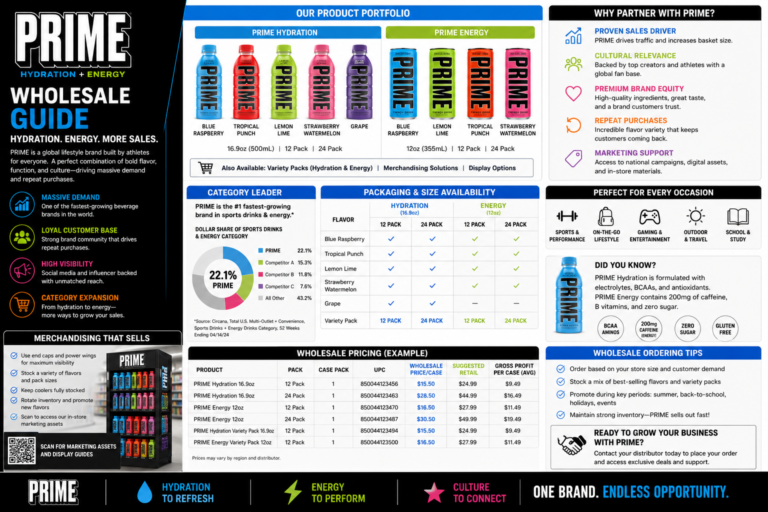
Prime Energy performs well in retail environments serving younger demographics and consumers interested in high-visibility beverage brands. Buyers considering Prime for pallet purchasing should evaluate their specific customer profile before committing to full pallet quantities. In locations where Prime’s consumer base is confirmed, it adds meaningful variety and trial-purchase potential to the energy drink set.
Buyers interested in exploring the full range of available brands before committing to pallet quantities can review the energy drink wholesale options for current brand and SKU availability.
How Wholesale Energy Drink Pallet Pricing Works
Pallet pricing is not a fixed number that applies uniformly across every buyer and every order. It reflects a combination of variables that affect the commercial value of the supply relationship, and buyers who understand these variables are better equipped to evaluate quotes accurately.
Brand demand is the most significant pricing variable. Monster and Red Bull command higher prices than less-established brands because consumer demand for them is stronger and more consistent, which means suppliers can hold firmer pricing. Celsius pricing has increased alongside its market growth. Newer or emerging brands may offer more accessible entry pricing, but buyers need to weigh that against sell-through risk.
Pallet configuration directly affects per-unit cost. A pallet with a higher case count at the same price delivers better unit economics than a pallet with fewer cases. This is why confirming the full pallet specification before accepting a quote is essential, not optional.
Delivery destination affects total landed cost. A buyer in South Florida sourcing from a Florida-based supplier has different freight economics than a buyer in the Pacific Northwest. Total landed cost, product price plus freight, is the correct comparison metric when evaluating competing quotes. A lower product price with significantly higher freight may not represent better value.
Common factors that affect wholesale pallet pricing:
- Brand demand and current market pricing
- Case count and unit configuration per pallet
- Can size and packaging format
- Single-brand versus mixed-brand pallet requirements
- Delivery destination and freight handling requirements
- Order frequency and account relationship stability
- Current product availability and supply conditions
Buyers should submit their specific requirements through the Request Pricing page to receive a quote that reflects their actual order rather than a generic published rate. Generic price lists do not reflect the variables that determine what a commercial buyer actually pays.
How to Choose the Right Energy Drink Pallet Supplier
Supplier selection for pallet purchasing is more consequential than it is for small bulk orders, because the stakes are higher. A pallet represents a larger inventory commitment and a freight delivery that requires receiving coordination. A supplier who fails to deliver on time, sends incorrect product or provides poor communication around a pallet order creates operational disruption that cascades through the buyer’s retail or distribution operation.
The questions that matter most when evaluating a wholesale pallet supplier:
- Is the supplier structured for commercial B2B purchasing or are they primarily a consumer retailer selling in larger quantities?
- Do they carry the specific brands and SKUs your customers purchase most frequently?
- Can they confirm pallet specifications clearly before the order is placed?
- What are their realistic lead times for pallet delivery to your location?
- How do they handle supply shortfalls, substitutions or delivery delays?
- Is communication responsive during the quotation and order process?
- Can they support repeat pallet orders on a consistent schedule as your business grows?
- Do they understand the commercial channel you operate in?
A supplier who answers these questions clearly and specifically is demonstrating operational competence. A supplier who gives vague answers, quotes without specifications or cannot confirm lead times is showing you what the relationship will look like after the first order is placed.
Responsiveness during the quotation process is a useful proxy for post-order service quality. Suppliers who are slow to respond, unclear in their communications or unable to answer straightforward commercial questions before the sale rarely improve once money has changed hands.
Common Mistakes Buyers Make When Ordering Energy Drink Pallets
Pallet purchasing errors are more costly than bulk purchasing errors because the quantities are larger. These are the mistakes that create the most operational and financial disruption for commercial energy drink buyers.
Ordering Without Demand Forecasting
Front-loading inventory before demand is confirmed is the most common mistake new pallet buyers make. A buyer who orders two pallets of a new brand before understanding how quickly it sells at their location may find the product sitting in storage past its optimal sell-through window. The right approach is to confirm sell-through velocity on smaller quantities first, then scale pallet orders to match confirmed demand.
Choosing Price Over Supply Reliability
The lowest quoted price for a pallet is not the best deal if the supplier cannot deliver consistently. A stockout caused by a supplier’s inability to fulfill a reorder costs more in lost sales and customer disappointment than the per-unit savings from a cheaper quote. Evaluate total supply value, not just headline pricing.
Ignoring Storage and Receiving Requirements
Confirming storage capacity and receiving setup before placing a pallet order is not optional. A buyer who places a pallet order without a pallet jack, adequate floor space or appropriate receiving hours creates a delivery problem that falls on both the buyer and the supplier. These logistics should be confirmed before the order is submitted, not discovered on delivery day.
Carrying Too Narrow a Product Mix
Buying a full pallet of a single SKU without variety limits the buyer’s ability to serve the full range of consumer preferences in their retail environment. A cooler or vending set that carries only one energy drink option leaves revenue on the table from consumers who would buy a different brand or flavor if it were available. Mixed-brand or mixed-SKU pallet orders address this problem for buyers whose supplier supports that format.
Not Planning for Business Growth
Buyers sometimes select a supplier based only on their current volume, then find the supplier cannot support them when demand increases. Choosing a supplier that offers bulk orders, pallet orders and truckload supply within the same relationship provides the flexibility to scale without changing supply partners as purchasing requirements grow.
Managing Energy Drink Pallet Inventory Effectively
Receiving a pallet is the beginning of the inventory management process, not the end. Commercial buyers who handle pallet inventory well maintain better product availability, reduce waste and generate more useful purchasing data for future orders.
FIFO rotation is the foundational practice. New stock should always go behind existing stock so older product moves out first. For energy drinks with defined shelf life requirements, this practice prevents expiration losses and maintains product quality on the shelf or in the machine.
Routine inventory counting helps buyers stay ahead of reorder timing. A business that checks inventory levels on a set schedule, weekly for high-velocity locations, bi-weekly for moderate-turnover environments, knows when a reorder is needed with enough lead time to receive the next pallet before a stockout occurs.
Tracking sell-through by SKU generates the data needed to refine future pallet orders. If Monster Ultra sells through in 12 days while Monster Mango Loco takes 25 days, the next order should reflect that difference. This kind of data-driven purchasing is only possible when buyers are tracking inventory systematically, and pallet-level purchasing provides a natural framework for doing so.
Building a Long-Term Wholesale Supply Relationship
Wholesale purchasing works best as a relationship, not a series of one-off transactions. Commercial buyers who work consistently with a reliable supplier benefit from clearer communication, more predictable ordering processes and better supply continuity over time.
An established supplier relationship also provides more flexibility when market conditions change. When a new energy drink brand enters strong demand, a buyer with an established supplier relationship is better positioned to access product quickly than one who is sourcing transactionally from whoever offers the lowest spot price at any given moment.
As purchasing volumes increase, a long-term supplier relationship also creates the foundation for better pricing conversations. A buyer who has demonstrated consistent pallet purchasing behavior over several months has legitimate grounds to discuss volume pricing, preferred lead times and product allocation that a new or irregular buyer does not.
Why Businesses Choose T20 Energy Drink USA LLC
T20 Energy Drink USA LLC is a Margate, Florida-based wholesale energy drink supplier operating as a B2B supply partner for commercial buyers across the United States. The company’s purchasing model is built for business accounts, not consumer transactions, which means the entire process from inquiry to delivery is structured for commercial buyers with real operational requirements.
T20 supports pallet purchasing for convenience stores, gas stations, supermarkets, vending companies, beverage distributors, retail chains and commercial procurement teams. Buyers can request pricing for single-brand pallets, mixed-brand configurations, bulk case orders and truckload supply through the same commercial process, which simplifies the supplier relationship as purchasing needs evolve.
Buyers with distributor-level requirements can explore the distributor program for supply structures designed to support multi-account distribution operations.
Every pricing request is reviewed against the buyer’s stated product requirements, order quantity and delivery destination to ensure the response reflects what the buyer actually needs rather than a generic rate that may not apply to their situation.
Request Wholesale Energy Drink Pallet Pricing
Looking for a dependable supplier for energy drink pallet orders? T20 Energy Drink USA LLC works with commercial buyers across the United States, including convenience stores, gas stations, supermarkets, vending companies and beverage distributors. Submit your product requirements, order quantity and delivery location to receive a customized wholesale quotation.
Frequently Asked Questions About Energy Drink Pallet Orders
What is an energy drink pallet order?
An energy drink pallet order is a commercial shipment of multiple cases stacked and shrink-wrapped on a shipping pallet for freight transport and warehouse handling. It is the standard format for mid-volume commercial energy drink purchasing between bulk case orders and full truckload supply.
How many cases are on a pallet?
Pallet case counts vary by brand, can size and packaging configuration. A pallet of 16oz Monster cases will have a different count than a pallet of 8.4oz Red Bull slim cans. Buyers should always confirm the exact case count, unit count and pallet specification before placing an order. A reliable supplier will provide this detail before quoting.
Who typically buys energy drink pallets?
Convenience stores, gas stations, supermarkets, vending operators, beverage distributors, retail chains and commercial procurement teams are the most common pallet buyers. Any business with consistent, predictable energy drink demand and the storage capacity to receive a full pallet is a good candidate for pallet purchasing.
Are pallet orders better than bulk orders?
It depends on your demand volume and storage capacity. Bulk orders suit buyers whose demand is above retail levels but not yet consistent enough to justify a full pallet commitment. Pallet orders are the right format when demand is confirmed and predictable and the business has the receiving infrastructure to handle a freight delivery.
Can pallet orders include multiple brands?
Mixed-brand pallet availability depends on the supplier’s inventory and operational capabilities. Buyers who want a mixed pallet across Monster, Red Bull, Celsius and other brands should discuss that preference during the quotation process. Not all suppliers can accommodate mixed configurations, so confirming this capability upfront avoids order complications.
What factors affect wholesale pallet pricing?
Pallet pricing reflects brand demand, case count per pallet, can size and packaging format, delivery destination, freight handling requirements, order frequency and current product availability. Total landed cost including freight is the correct comparison metric when evaluating quotes from different suppliers.
Can energy drink pallets be delivered nationwide?
Delivery options depend on the buyer’s location, freight requirements and order specifications. Buyers should provide their delivery address when requesting pricing so freight costs and logistics can be factored into the quote accurately.
What do I need to receive a pallet order at my location?
Pallet deliveries require physical access for a freight vehicle, a pallet jack or forklift for unloading and adequate storage space for the received inventory. Buyers without loading dock access may need to request liftgate service, which should be confirmed at the time of ordering to avoid delivery complications.
How do I request pallet pricing?
Commercial buyers submit product requirements, preferred brands, estimated order quantity and delivery location through the Request Pricing page. The T20 team reviews each request and responds with a customized wholesale quotation based on the buyer’s specific needs.