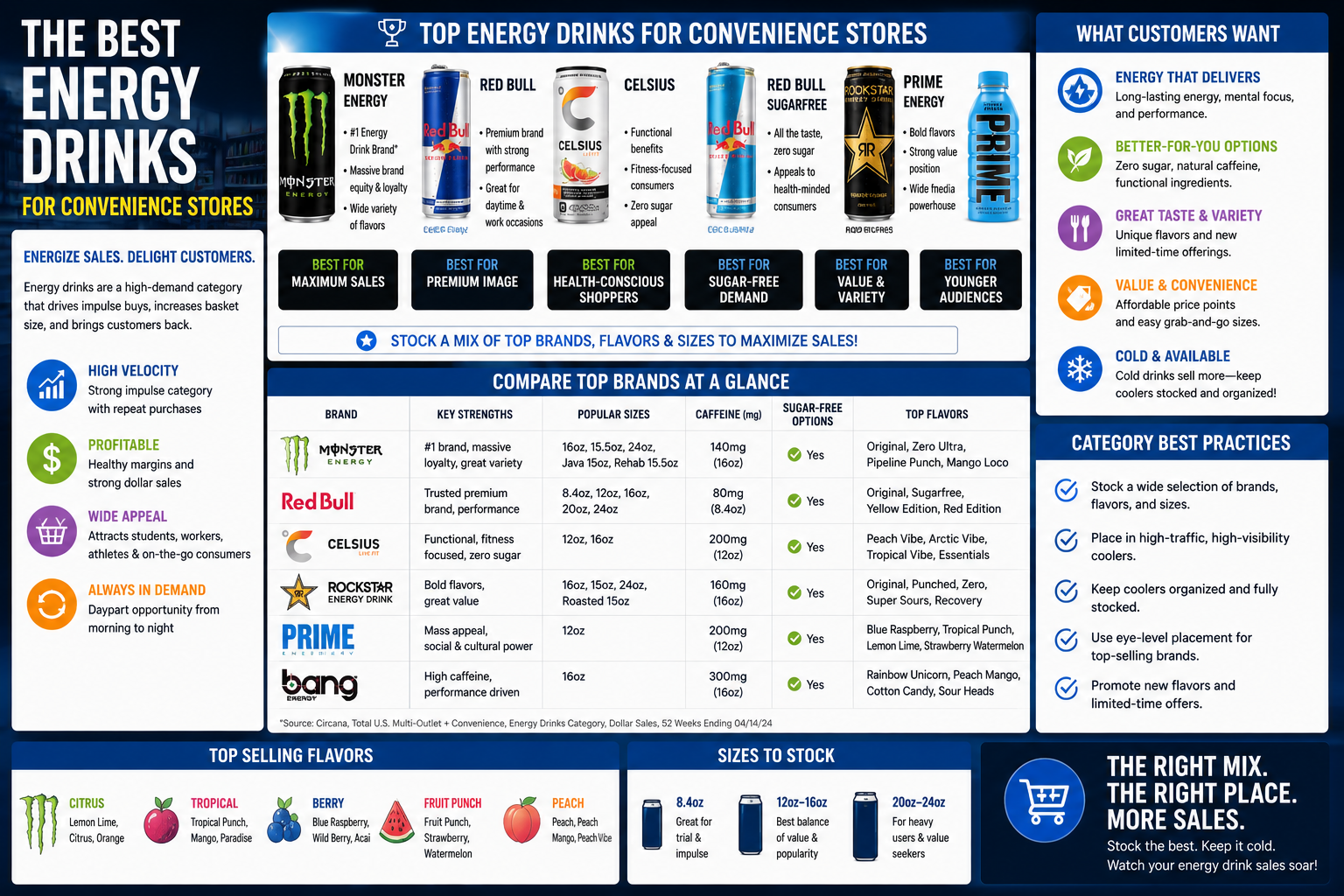

The energy drink cooler is one of the highest-revenue assets in a convenience store, and most operators underutilize it. They stock the obvious brands, refill when inventory runs low and treat the cooler as a passive storage unit rather than an active revenue driver. The stores that get the most out of their energy drink category do something different. They make deliberate decisions about which brands earn which positions, how many facings each SKU gets, when to introduce new products and what sell-through threshold justifies continued shelf space. Those decisions, applied consistently, generate measurably stronger category revenue from the same cooler footprint.
This guide covers the energy drink brands that consistently perform best in convenience stores, why they perform well, how to build a product mix that serves the full range of consumer demand at a specific location, how to merchandise effectively and how wholesale purchasing supports the supply continuity the category requires. Retailers who want channel-specific data alongside this buying guide can review the convenience store energy drink trends guide, and those evaluating wholesale options can start with the energy drink wholesale USA overview.
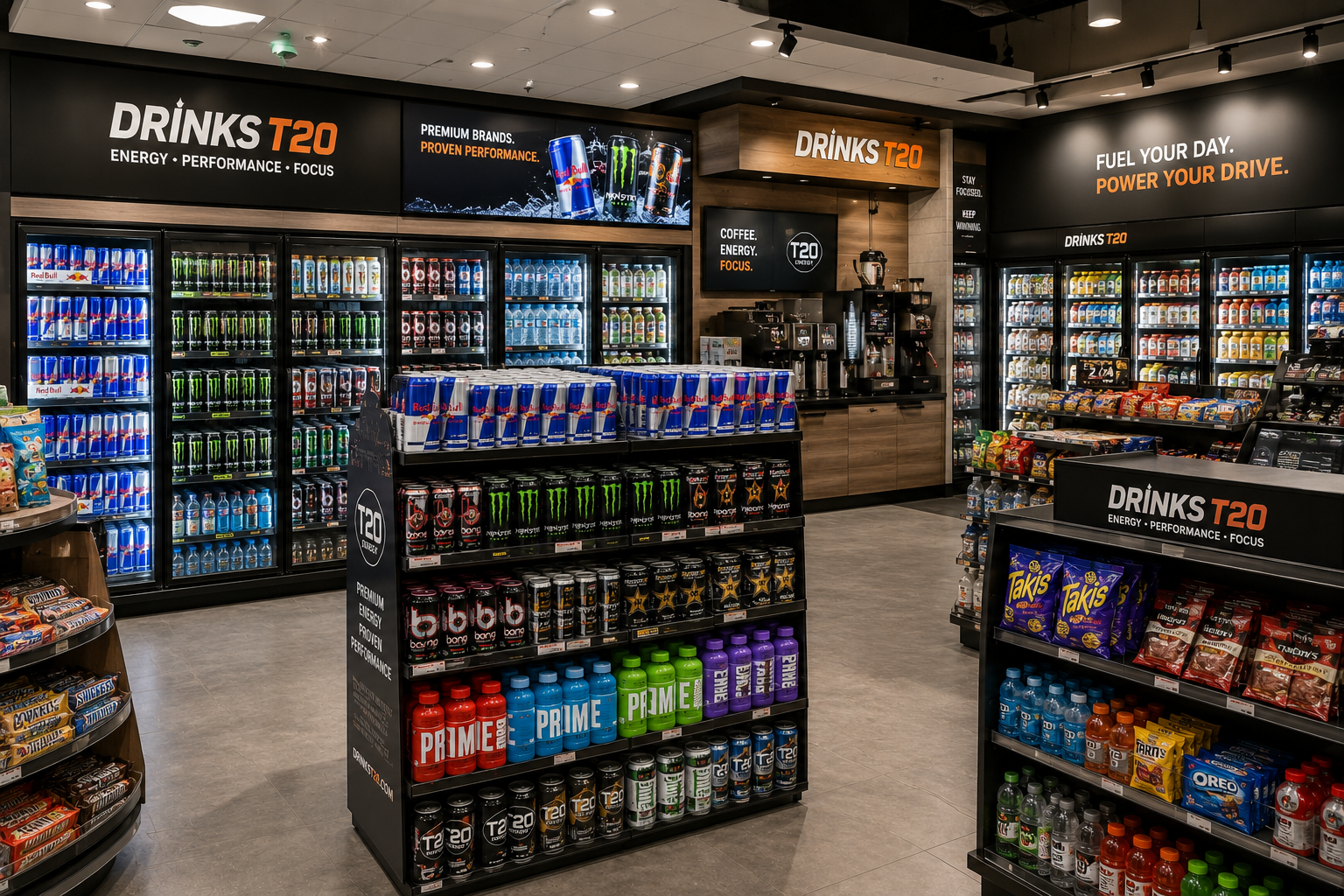
Why Energy Drinks Dominate Convenience Store Beverage Revenue
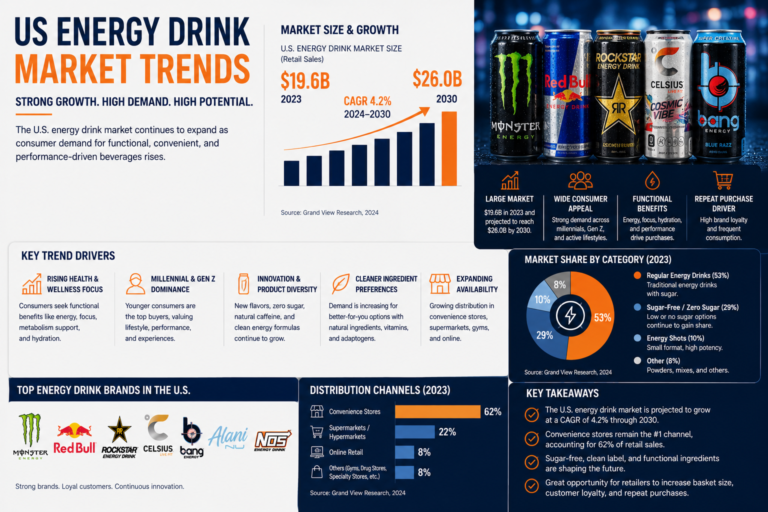
The National Association of Convenience Stores reported that energy drinks accounted for 27.8% of all packaged beverage category dollars in U.S. convenience stores in 2024. That is the single largest packaged beverage segment in the channel by a significant margin, outperforming water, carbonated soft drinks, sports drinks and coffee as standalone categories. For convenience store operators, that number is not abstract market data. It is a direct signal about where cooler space should be prioritized.
The reason energy drinks generate this level of convenience store revenue comes down to purchase behavior alignment. Convenience store customers are in transit, on a schedule, or making a quick stop for a specific reason. They are not browsing. They respond to what they recognize, they make decisions quickly and they repeat purchase behavior that satisfies them. Energy drinks fit all three of those behavioral patterns better than almost any other packaged beverage category.
According to Grand View Research, the U.S. energy drink market reached approximately $25 billion in 2024 with consistent growth projected through 2030. For convenience store operators, that sustained market growth means energy drink category management is a long-term investment with a confirmed demand trajectory, not a trend to hedge against.
Best Energy Drinks for Convenience Stores
The brands below are the most consistently stocked and commercially significant energy drink products in U.S. convenience retail. Each section explains not just that a brand performs well but why it performs well and what that means for stocking decisions at a specific convenience store location.
Monster Energy
Monster Energy is the highest-revenue energy drink brand in U.S. convenience stores by volume and generates habitual repeat purchases from one of the most loyal consumer bases in the packaged beverage category. Commuters who buy Monster Original every weekday morning, shift workers who grab a Monster before every shift and road-trippers who stop for Monster at every fuel break are all contributing to a purchase pattern that creates predictable daily revenue for operators who keep the product in stock.
The Monster product range covers the full consumer spectrum within the energy drink category. The Original green-label 16oz drives the core volume. Monster Ultra White and other Ultra SKUs serve the sugar-free consumer who will not buy the original formula. Monster Juice blends serve the fruit-flavored preference. A convenience store carrying Monster Original, one or two Ultra SKUs and one Juice variant has coverage across three distinct Monster consumer segments without overcomplicating the cooler set.
The Monster Energy wholesale guide covers commercial purchasing considerations for convenience store buyers sourcing Monster in volume.
Red Bull
Red Bull’s commercial position in convenience stores is built on premium brand equity that translates into stronger margin per unit than most competing energy drink brands. Its compact 8.4oz slim can commands a higher per-ounce retail price than the standard 16oz formats used by Monster and most other competitors, which means Red Bull contributes disproportionately to category revenue relative to its physical shelf footprint.
Red Bull performs particularly strongly at urban commuter convenience stores, higher-income suburban locations and any convenience format where the customer base includes professional adults with established daily purchase routines. The Red Bull buyer and the Monster buyer are largely separate consumer populations with limited substitution. Running out of Red Bull does not redirect those sales to Monster. It loses them.
The Red Bull wholesale guide covers format-specific purchasing considerations including the pallet configuration differences that Red Bull’s slim can format creates.
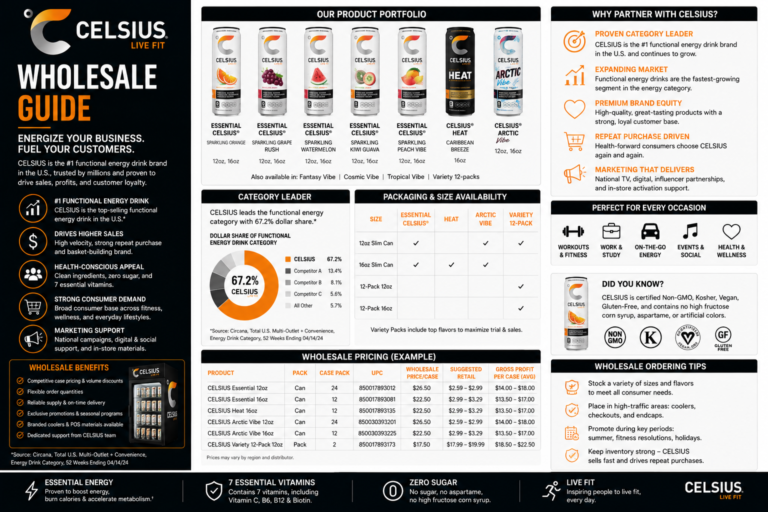
Celsius
Celsius has established itself as the most commercially significant functional energy drink in mainstream convenience retail. Its addition to a convenience store cooler set generates incremental revenue from consumers who were previously not purchasing energy drinks at that location, health-conscious shoppers, fitness-oriented commuters and calorie-aware buyers who find traditional formats incompatible with their preferences.
That additive dynamic is the key commercial argument for stocking Celsius. It does not compete with Monster or Red Bull for the same purchase. It captures a consumer who would otherwise buy water, a sports drink or nothing at all from the energy drink cooler. For convenience store operators, the practical implication is that two to three Celsius SKUs alongside the core Monster and Red Bull assortment can increase total category revenue from the same cooler space without reducing the performance of existing SKUs.
Celsius performs best at urban, suburban professional and campus-adjacent locations. At highway trucking and industrial locations it tends to underperform relative to traditional formats. The Celsius wholesale guide covers commercial purchasing and location-specific stocking guidance.
Rockstar Energy
Rockstar Energy’s role in the convenience store cooler is to provide value-tier variety that serves price-sensitive consumers and flavor-exploratory buyers who want something different from the Monster and Red Bull dominant assortment. Its broad national distribution and long retail track record give it reliable consumer recognition across most demographic segments.
Rockstar is not a primary revenue driver at most convenience store locations in the way Monster and Red Bull are. It is a productive secondary brand that improves total cooler performance by filling the price-sensitive consumer slot and reducing the chance that a consumer who does not want to spend three dollars on a Red Bull leaves without making a beverage purchase.
Alani Nu
Alani Nu has grown its convenience retail presence by targeting female consumers and lifestyle-oriented buyers who respond to the brand’s clean-label positioning, appealing flavor profiles and health-conscious marketing. Its performance is strongest at suburban convenience stores serving demographics that include fitness-oriented women, younger health-conscious consumers and shoppers who follow wellness and lifestyle content.
For operators at these location types, Alani Nu serves a consumer segment that Celsius partially addresses but does not fully capture. The brands appeal to overlapping demographics with different product identities, and carrying both in limited representation allows the cooler to serve a broader range of health-conscious consumers than either brand alone would cover.
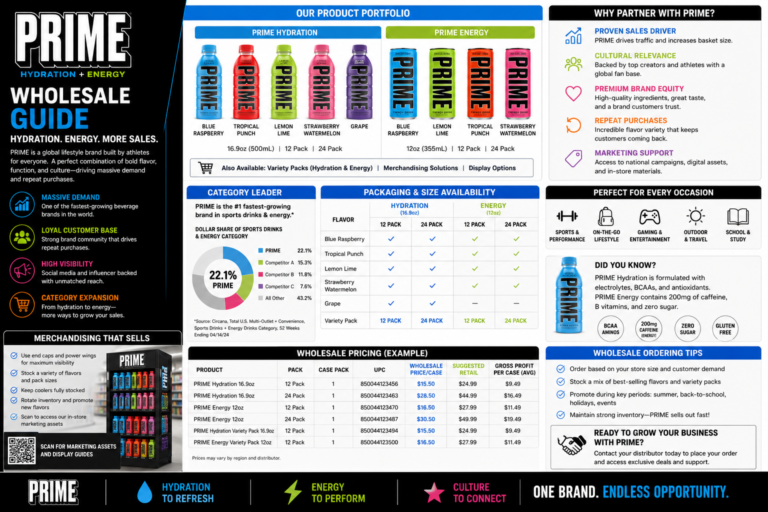
Prime Energy
Prime Energy generates strong consumer demand at convenience stores serving younger demographics, campus-adjacent communities and locations where the brand’s cultural visibility has created genuine consumer recognition. At locations with older professional or industrial consumer bases, Prime Energy velocity tends to be lower relative to the category leaders.
For convenience store buyers, the right approach to Prime Energy is selective stocking based on the specific location’s demographic profile rather than uniform assortment across all stores. Two to three SKU representation is typically appropriate at locations where fit is confirmed. The Prime Energy wholesale guide covers commercial purchasing and demographic fit evaluation for fuel and convenience retail buyers.
Ghost Energy
Ghost Energy has expanded into convenience retail from specialty fitness and gaming culture origins, building recognition through distinctive flavor collaborations and brand identity. Its consumer base skews toward younger adults and enthusiast demographics who follow the brand’s cultural associations. Ghost is most productively positioned as a variety and trial brand in convenience stores, with limited SKU representation at locations where its consumer demographic is active rather than broad shelf allocation at all locations.
NOS Energy
NOS Energy has maintained a steady convenience retail presence, particularly at locations serving working-class consumers, automotive enthusiasts and customers who associate the brand with its motorsport and performance cultural positioning. It is a reliable secondary brand at traditional convenience formats without the demographic concentration that limits brands like Prime Energy or Alani Nu to specific location types.
Bang Energy
Bang Energy built its consumer following in the fitness and high-caffeine segment and continues to serve that consumer in convenience stores where performance-focused buyers are active. Its zero-sugar positioning across the full product line is a commercial advantage in locations where sugar-free demand is strong. Buyers should verify current Bang distribution availability with their wholesale supplier before making stocking commitments, as the brand has experienced some distribution changes in recent years.
Comparing the Best Energy Drinks for Convenience Stores
The table below compares the most commonly stocked convenience store energy drink brands by retail demand, sugar-free availability and the consumer types they most consistently serve. Use this as a reference for cooler planning rather than a universal ranking, since performance varies by location demographic.
| Brand | Retail Demand | Zero-Sugar Options | Typical Convenience Store Customers |
|---|---|---|---|
| Monster Energy | Very High | Yes | Commuters, shift workers, general consumers |
| Red Bull | Very High | Yes | Professionals, travelers, commuters |
| Celsius | High | Yes | Fitness-minded and health-conscious shoppers |
| Prime Energy | Growing | Yes | Younger consumers and trend-driven shoppers |
| Rockstar Energy | High | Yes | Everyday convenience store customers |
| Ghost Energy | Growing | Yes | Young adults and fitness enthusiasts |
| Alani Nu | Growing | Yes | Lifestyle-focused and health-conscious consumers |
| Bang Energy | Moderate | Yes | Performance-focused consumers |
| NOS Energy | High | Limited | Traditional energy drink buyers |
How to Build the Right Energy Drink Mix for Your Convenience Store
The most commercially effective convenience store energy drink assortment is not the ten most popular brands stocked equally. It is a deliberate allocation of cooler space to brands that serve the full range of consumer demand at a specific location, with allocation proportional to confirmed velocity rather than general market popularity.
A practical three-tier framework for convenience store energy drink cooler planning:
The first tier is core volume drivers. Monster Energy and Red Bull belong here at every location. Together they generate the majority of energy drink cooler revenue at virtually every convenience store format. They should receive the most cooler door allocation, the best eye-level positioning and the most consistent restocking priority. Stockouts on these two brands cause the most direct revenue loss of any cooler management failure.
The second tier is consumer segment coverage. Celsius belongs here at most locations to serve the health-conscious and functional beverage consumer. Rockstar fills the value-tier slot for price-sensitive buyers. A third brand should be chosen based on the specific location demographics: Alani Nu for suburban lifestyle locations, Prime Energy for campus or youth-oriented locations, NOS for working-class or automotive-oriented locations.
The third tier is variety and trial. One or two emerging or specialty brands in limited SKU representation serve consumers who want something new. Ghost, Bang and new market entrants fit here. These brands should have minimal cooler allocation until local demand is confirmed through actual sell-through data at that specific location.
According to Statista, per-capita energy drink consumption in the United States has grown consistently over the past decade, which means the category’s total consumer base is expanding. A tiered cooler strategy that covers all three consumer segments, traditional, functional and variety, positions a convenience store to capture that expanding demand rather than serving only the consumers already purchasing at that location.
How Convenience Stores Choose Which Energy Drinks to Stock
Experienced convenience store category managers treat product selection as an ongoing decision rather than a periodic reset. Consumer preferences, brand velocities and local demographics all shift over time, and the cooler that performed optimally 12 months ago may not reflect current demand.
Key factors in convenience store energy drink stocking decisions:
- Weekly sell-through velocity data by SKU from point-of-sale reporting, not general market estimates
- Consumer demographic profile of the location’s regular traffic and whether it has shifted
- Brand recognition among the location’s primary customer segments, since recognition drives fast purchase decisions
- Inventory turnover rate to confirm sell-through is keeping pace with ordering cycles without creating stockout gaps
- Profit margin per cooler door to identify which brands generate the strongest revenue per unit of shelf space
- Supplier reliability for the brands generating the highest volume, since stockouts on top sellers cause the most revenue damage
- New product trial performance tracked separately for the first 60 days after introduction
Merchandising That Increases Convenience Store Energy Drink Sales
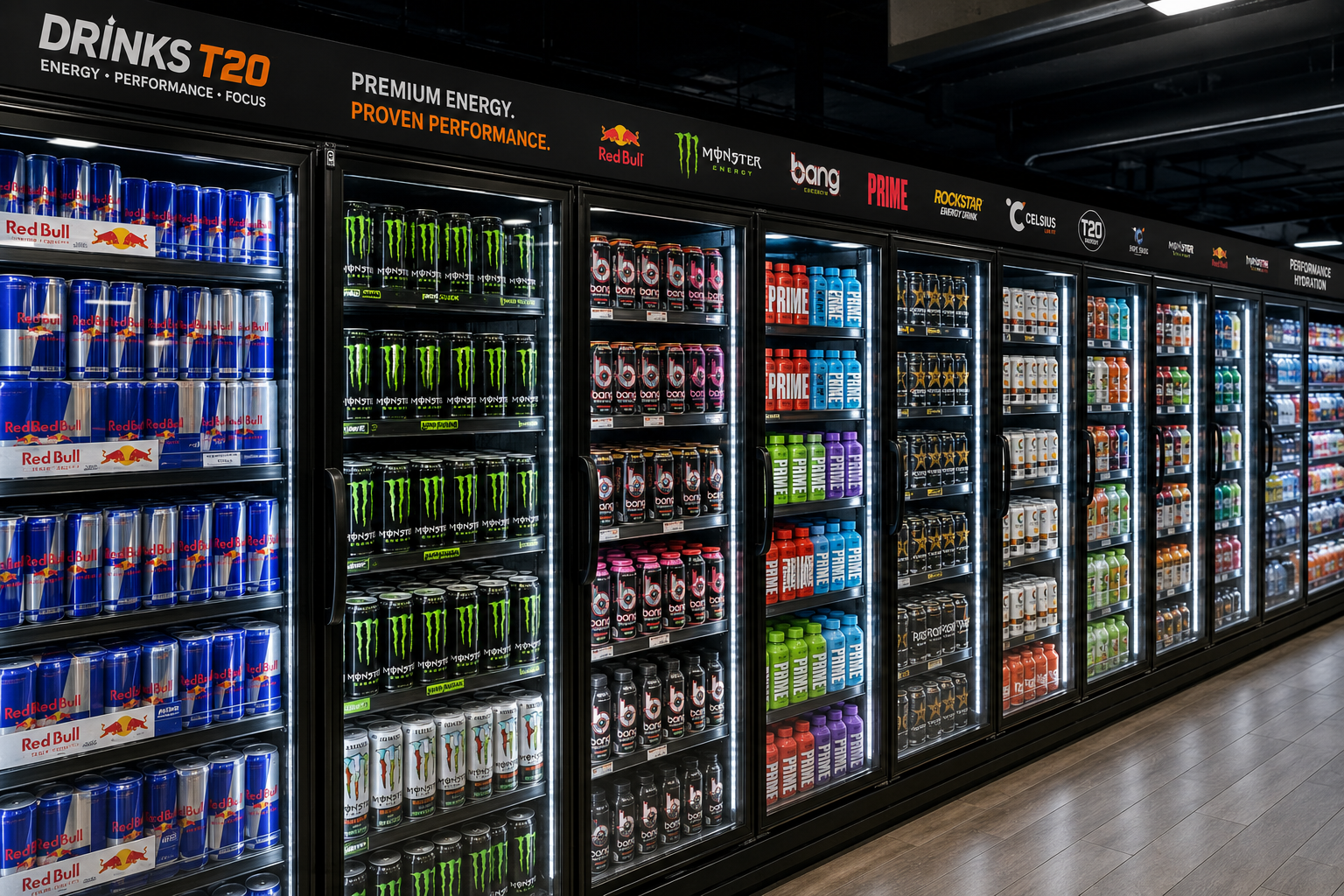
A well-planned product mix generates its maximum revenue only when the cooler is organized and stocked to convert the traffic that walks past it. Merchandising is where the ceiling set by product selection is either reached or left uncaptured.
The most commercially impactful convenience store energy drink merchandising practices:
- Place Monster and Red Bull at eye level in the most visible cooler door positions, since these are the products habitual buyers are looking for first and the products impulse buyers recognize most quickly
- Group products by brand within the cooler so brand-loyal consumers can find their preferred flavor without scanning an unorganized mix
- Maintain full cooler facing at all times by pulling product forward during the day, not only during scheduled restocking shifts
- Position a secondary single-door or countertop display near the checkout counter to capture last-minute energy drink purchases from customers who did not interact with the main cooler during their visit
- Review cooler position assignments quarterly against sell-through data and move faster-moving SKUs into better positions as velocity data confirms their performance
- Introduce new SKUs into secondary cooler positions before deciding whether they warrant primary placement based on local sell-through
Why Wholesale Supply Reliability Supports Convenience Store Category Performance
A convenience store that runs short on Monster or Red Bull during morning commuter hours loses sales from its highest-frequency buyers. The commuter who cannot get their usual drink may buy a substitute, but they are also forming an impression of the store’s reliability that affects their next visit decision. For stores dependent on daily commuter traffic, supply continuity is not a logistical preference. It is a customer retention requirement.
The U.S. Small Business Administration identifies supply chain reliability as one of the primary operational challenges for small retailers, particularly in high-frequency consumable categories where stockouts affect repeat visit behavior. Energy drinks are precisely this type of category in convenience retail, which is why supplier selection should prioritize delivery reliability and communication quality alongside pricing.
Most convenience store operators improve energy drink purchasing efficiency by progressing through these formats as volume grows:
- Bulk energy drink orders for independent retailers establishing their wholesale relationship or managing moderate confirmed demand
- Pallet shipments for established operators with confirmed consistent velocity and freight receiving capability
- Truckload deliveries for multi-location convenience store groups with central warehouse operations
Working with an experienced energy drink distributor can also simplify procurement, improve inventory planning and provide the commercial supply relationship that convenience store category management requires.
Why Businesses Choose T20 Energy Drink USA LLC
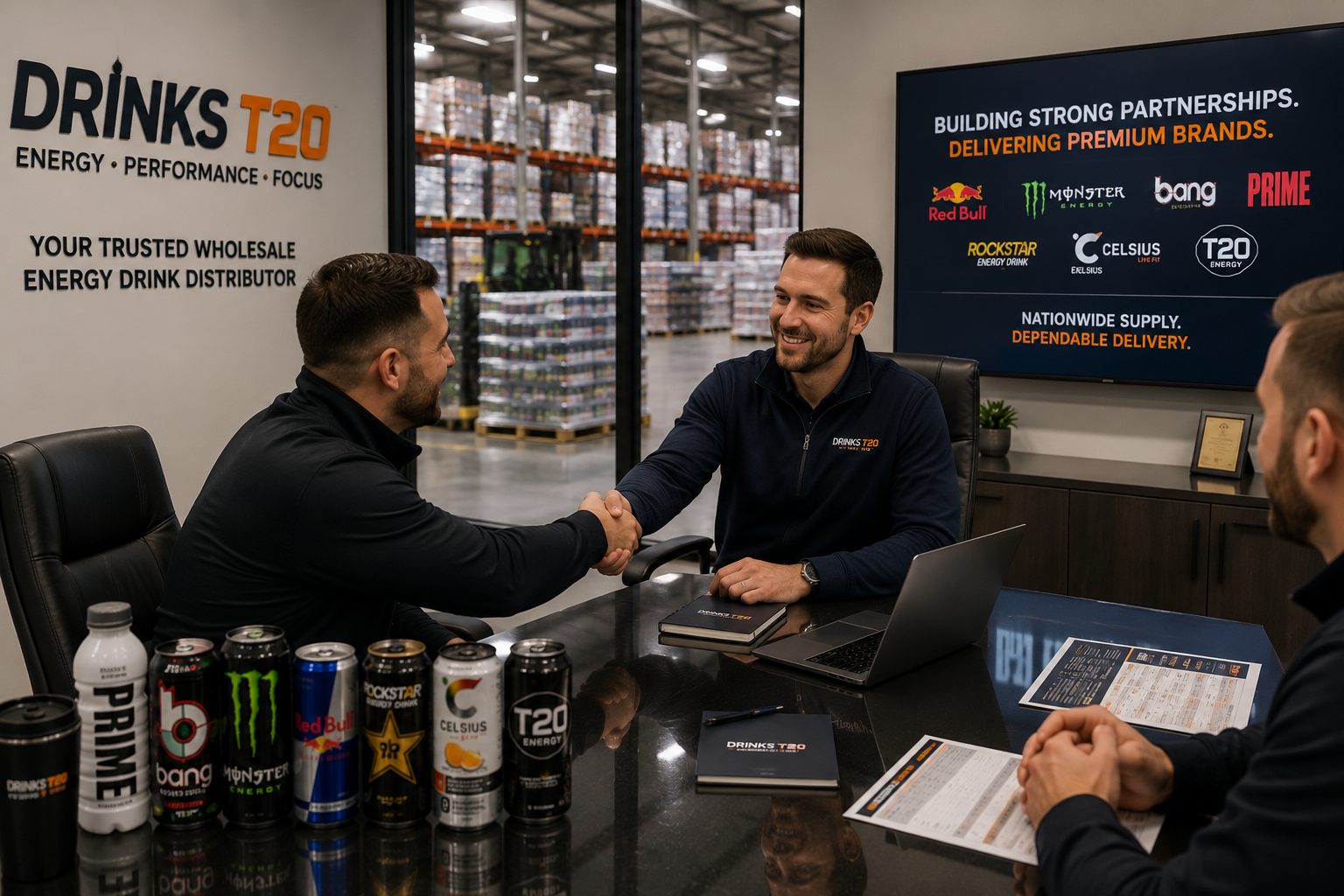
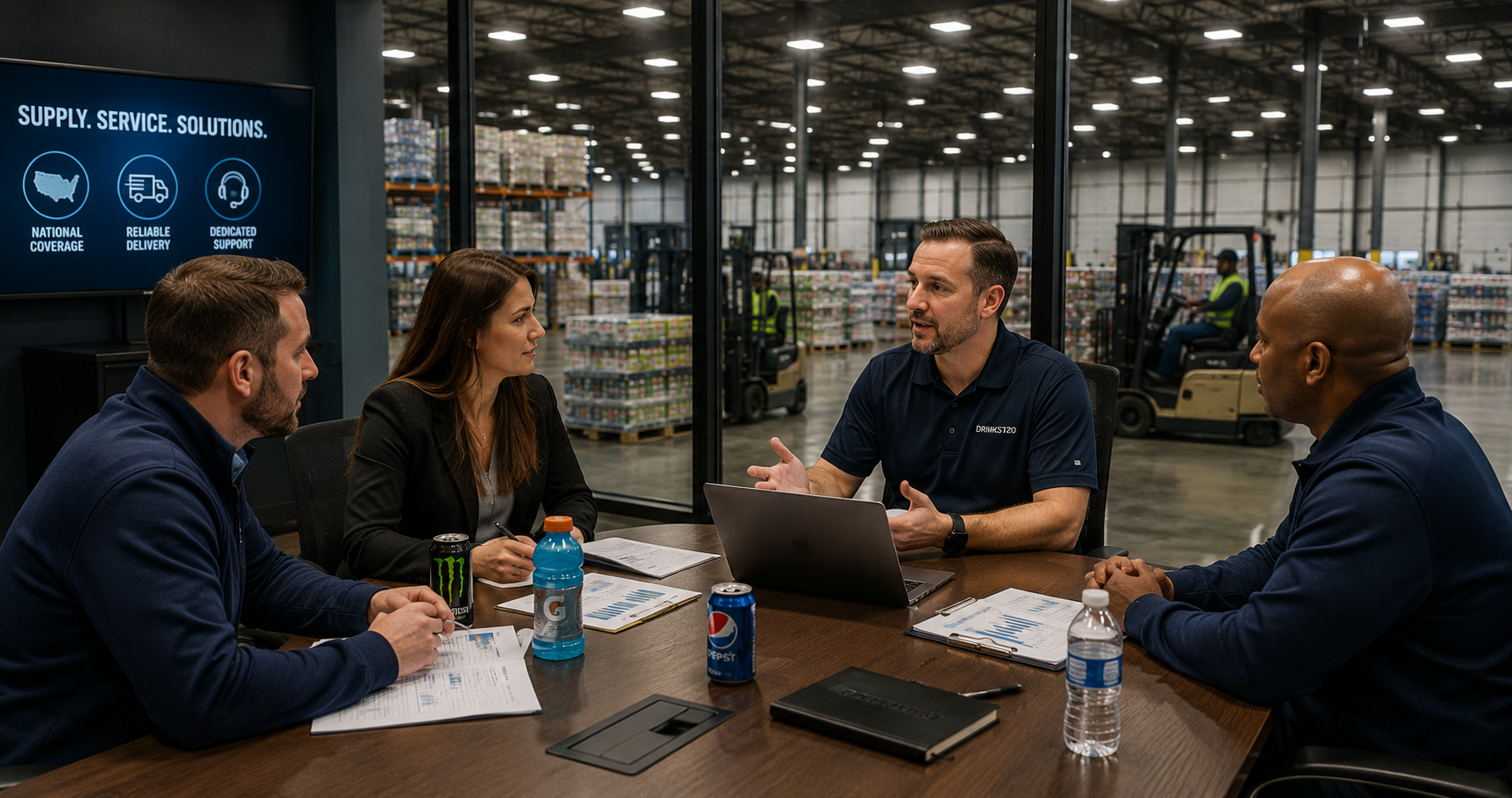
T20 Energy Drink USA LLC is a Margate, Florida-based wholesale energy drink supplier serving convenience stores, supermarkets, vending operators, beverage distributors and commercial buyers across the United States. The company’s supply model is built for B2B commercial accounts, which means convenience store operators interact with a purchasing process designed for business requirements rather than consumer retail.
T20 supplies major energy drink brands including Monster Energy, Red Bull, Celsius and Prime Energy alongside other leading brands through bulk orders, pallet supply and truckload purchasing within the same commercial relationship. Convenience store operators can begin with bulk purchasing to confirm demand data before progressing to pallet or truckload supply as volume justifies it.
Each pricing request is reviewed against the buyer’s product requirements, preferred brands, order volume and delivery destination. Convenience store operators receive a quotation that reflects their actual purchasing situation, not a generic rate that may not apply to their specific location, consumer profile or receiving setup.
How the Wholesale Ordering Process Works
The T20 purchasing process is built for commercial buyers, not consumer transactions:
- Submit a wholesale pricing request through the Request Pricing page
- Specify your preferred energy drink brands, SKUs and formats
- Provide your estimated purchasing volume and order frequency
- Share your delivery location and receiving requirements
- Receive a customized wholesale quotation reflecting your specific commercial requirements
- Review, confirm and coordinate delivery timing
- Establish ongoing supply requirements for future replenishment orders
Stock the Energy Drink Brands Your Customers Want
T20 Energy Drink USA LLC helps convenience stores and commercial buyers source leading energy drink brands through flexible wholesale purchasing programs. Submit your preferred brands, estimated volume, delivery location and business type to receive a customized wholesale quotation from the T20 team.
Frequently Asked Questions About the Best Energy Drinks for Convenience Stores
What are the best energy drinks for convenience stores?
Monster Energy and Red Bull generate the highest consistent revenue at most convenience store locations and should anchor every cooler set. Celsius has grown into mainstream convenience distribution and adds incremental revenue from health-conscious consumers. Rockstar provides value-tier variety. Alani Nu, Prime Energy and Ghost Energy each serve specific demographic segments most effectively at locations that match their consumer profiles. The best mix for any specific store depends on the location’s customer demographic rather than a universal brand ranking.
Why do Monster Energy and Red Bull consistently outperform other brands?
Both brands benefit from the strongest consumer recognition in the category, which drives fast purchase decisions in the time-pressured convenience store environment. Monster wins on volume and SKU breadth across consumer segments. Red Bull wins on brand loyalty and premium margin contribution. Both generate habitual repeat purchasing from consumers who buy the same product multiple times per week, creating predictable daily revenue independent of promotional activity.
How should a convenience store operator decide which energy drinks to stock?
Build around the location’s specific consumer demographic rather than general market rankings. Start with Monster and Red Bull as core volume drivers at every location. Add Celsius for the sugar-free and functional consumer segment. Select one or two additional brands based on confirmed local demand from the specific demographic that visits that location. Use weekly sell-through data rather than intuition or supplier recommendations to make those decisions.
Should convenience stores stock multiple energy drink brands?
Yes. Monster and Red Bull buyers largely do not substitute for each other when one is unavailable. Celsius buyers are a distinct consumer population from traditional format buyers. Adding variety brands in limited representation serves consumers who want something different. A single-brand or two-brand cooler misses the full range of consumer demand present in most convenience store traffic patterns.
What wholesale purchasing options are available for convenience stores?
Convenience stores can source energy drinks through bulk orders for moderate confirmed demand, pallet shipments for established consistent velocity with freight receiving capability, or truckload deliveries for multi-location operators with central warehouse infrastructure. Most operators begin with bulk purchasing to establish demand data before progressing to pallet supply as volume and supply relationship confidence grows.
How do I request wholesale energy drink pricing for my convenience store?
Submit your preferred brands, estimated order volume, delivery location and business type through the Request Pricing page. The T20 team reviews each submission and responds with a customized wholesale quotation based on the specific commercial requirements of your convenience store operation.