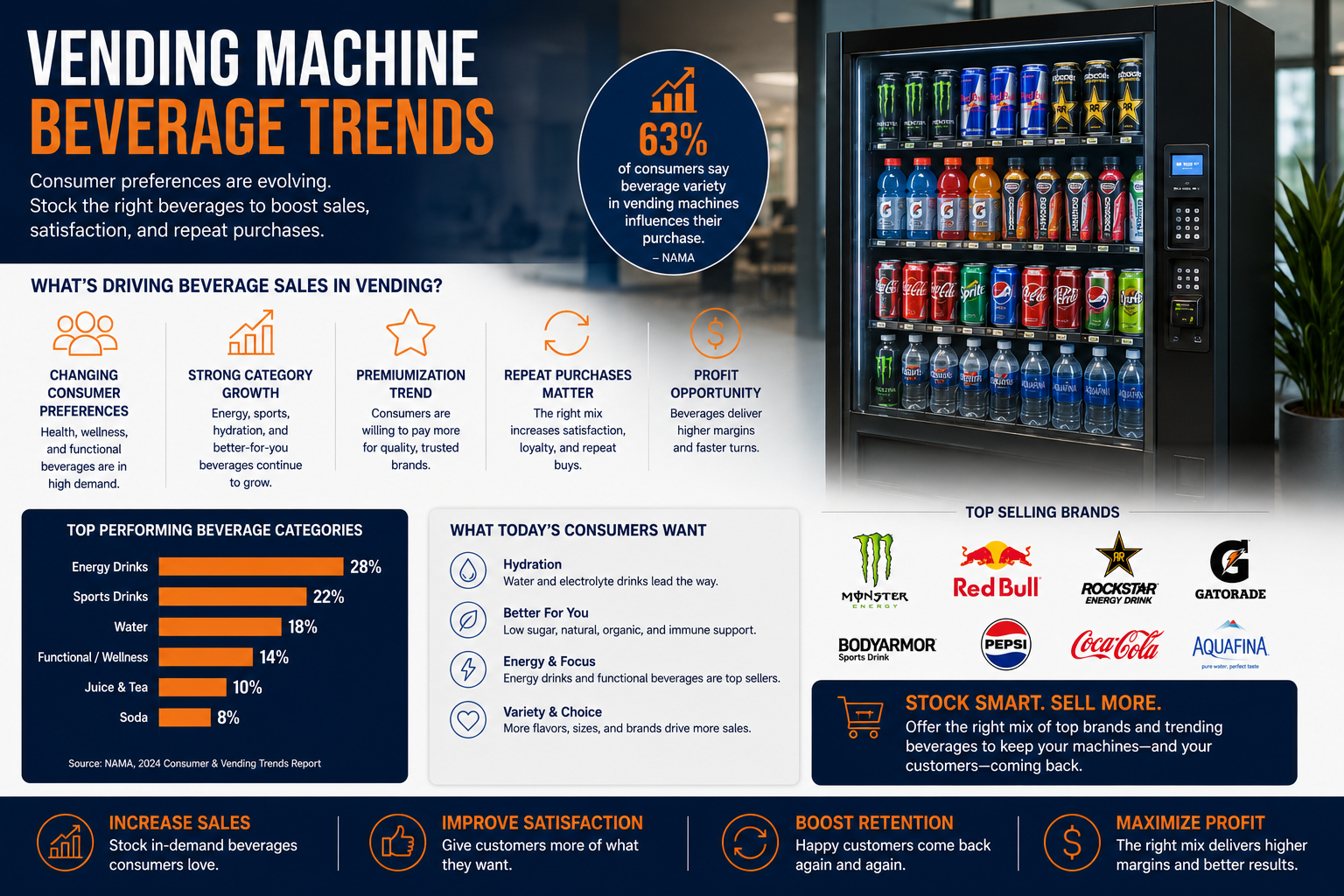

Vending machines are a distribution channel with one significant operational constraint: the machine cannot sell what it does not contain. Every empty spiral, every slow-moving SKU occupying a slot that a faster product should fill, every stockout on a top performer during peak hours represents revenue that does not come back. Unlike a convenience store where a customer can ask an employee for a product or find it in a secondary location, a vending machine customer who does not see what they want either buys something they did not choose or walks away without purchasing. That dynamic makes product selection and inventory management more consequential in vending than in almost any other retail format.
Energy drinks have become one of the strongest-performing beverage categories across vending locations precisely because they match the vending machine’s core use case. The purchase is quick, the product is single-serve, the consumer’s need is immediate and the brand recognition is strong enough that the decision is made in seconds. For vending operators, that combination makes energy drinks a reliable revenue driver when the right brands are stocked in the right machines at the right depth of inventory.
This guide covers vending machine beverage trends from the consumer behavior level through product selection strategy, location-based inventory planning, wholesale purchasing and supplier selection. Operators who want broader market context can review the energy drink wholesale USA overview alongside this channel-specific guide.
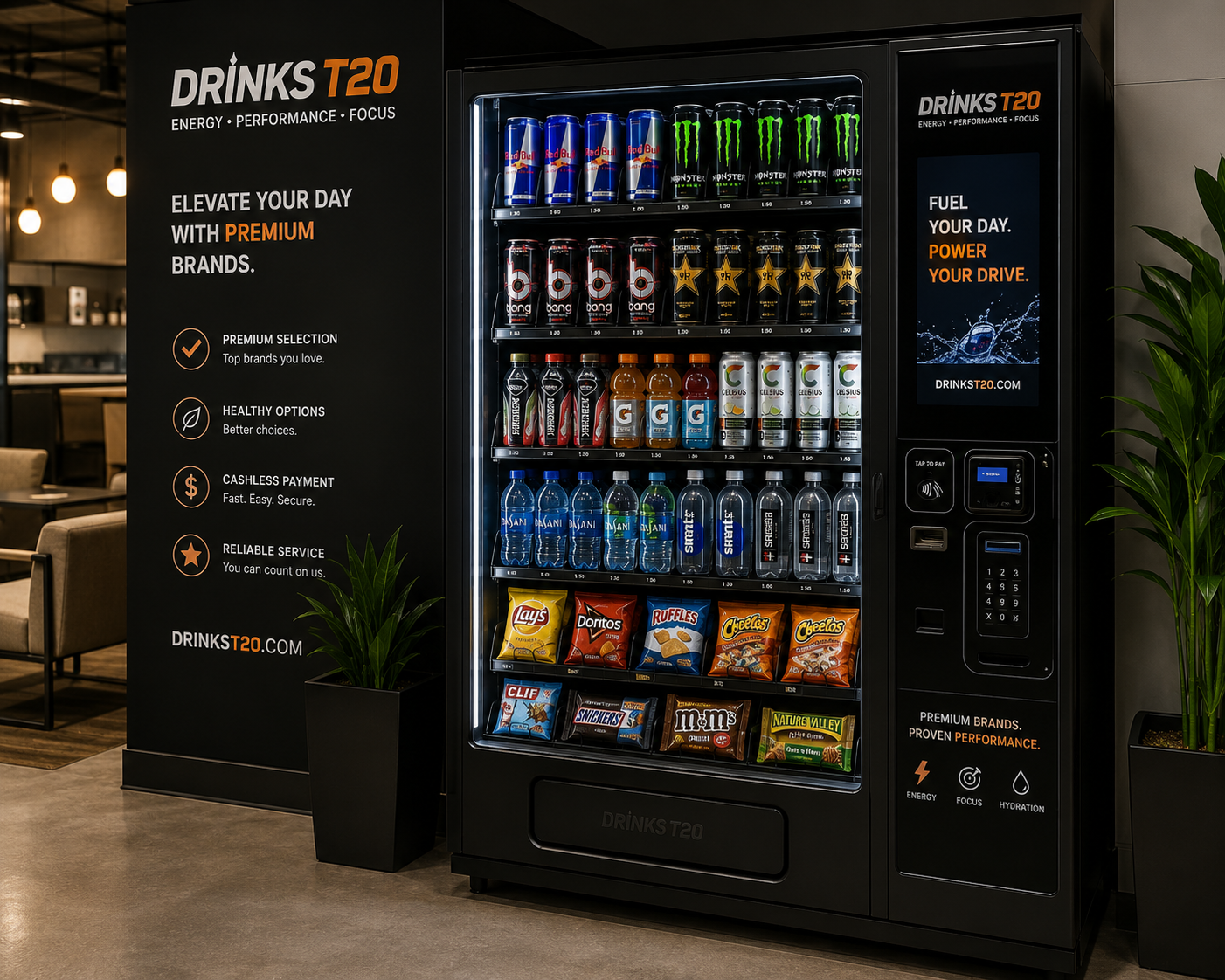
Why Energy Drinks Have Become a Core Vending Category
The vending machine environment favors products with three characteristics: strong brand recognition that enables fast purchase decisions, a single-serve format that fits standard machine slots, and consumer demand that is not tied to a specific season or occasion. Energy drinks satisfy all three better than almost any other packaged beverage category.
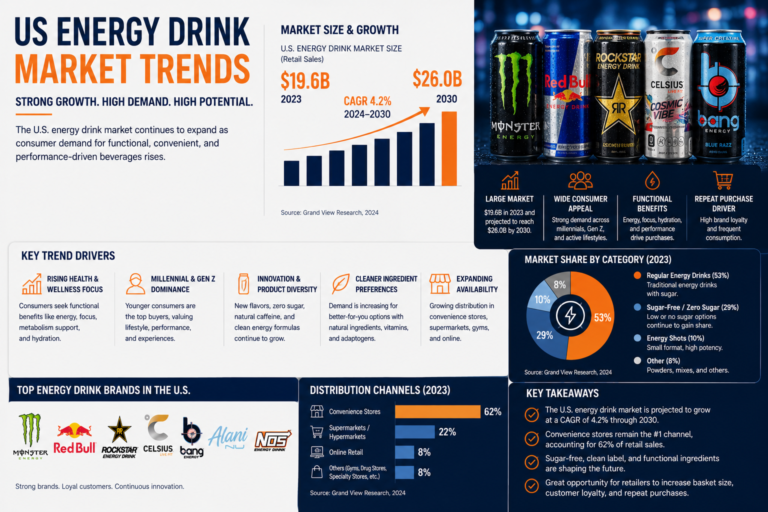
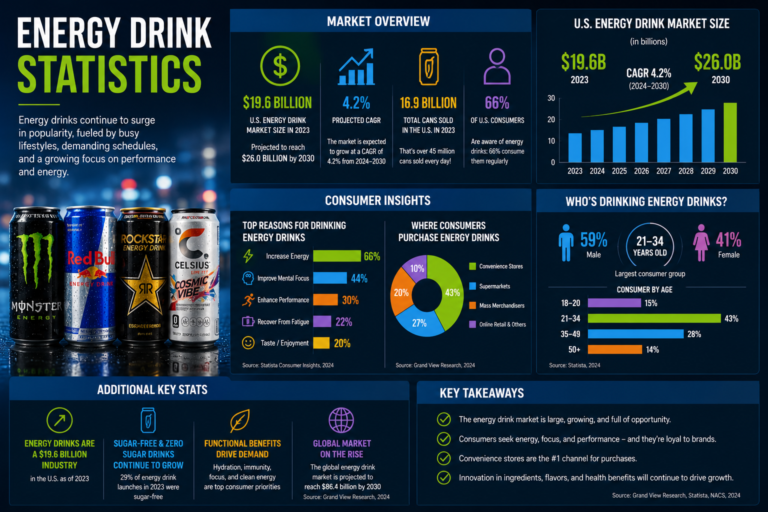
According to Grand View Research, the U.S. energy drink market was valued at approximately $25 billion in 2024 with consistent growth projected through 2030. That growth is being driven in part by expanding distribution into non-traditional channels, including vending, workplace refreshment programs and fitness facilities, where the convenience format makes energy drinks a natural fit.
The consumer motivation for purchasing energy drinks from a vending machine is functional and often time-pressured. An office worker heading into an afternoon meeting, a warehouse employee on a 15-minute break, a nursing student between clinical rotations and a gym member finishing a morning workout all have an immediate need that a cold energy drink from a nearby machine satisfies efficiently. That need does not follow a weekly shopping pattern or require a retail visit. It arises in the moment and is fulfilled at the point of presence, which is exactly what vending machines are designed to support.
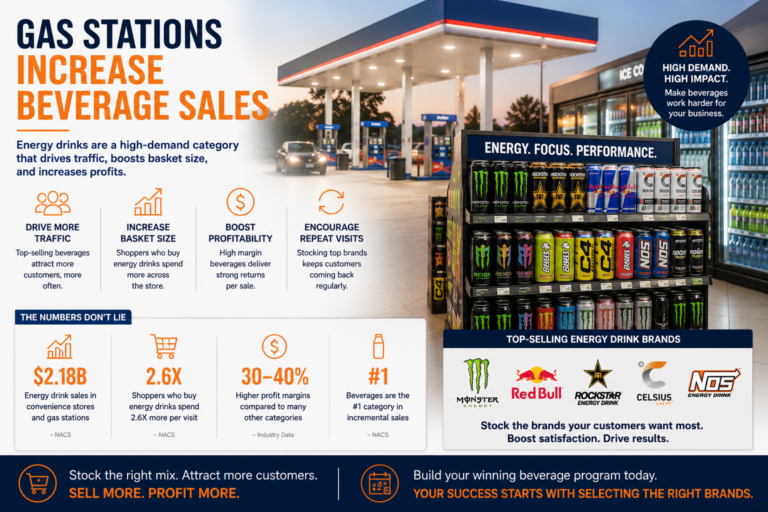
For vending operators, the commercial case is straightforward. Energy drinks are among the highest revenue-per-slot beverage categories available in most vending environments because they combine higher unit price points than water or soft drinks with consistent purchase frequency and strong brand pull that reduces the friction of the buying decision.
Who Buys Energy Drinks From Vending Machines?
The consumer segments that purchase energy drinks from vending machines vary by location type, which is why location-specific product selection matters more in vending than in almost any other retail format. Understanding who is using each machine is the starting point for every product mix and inventory depth decision.
Office and Corporate Environment Employees
Office workers are one of the most consistent energy drink buyers in workplace vending. The mid-morning and post-lunch purchase occasions are particularly strong because they coincide with natural energy dips during the workday. Corporate environment consumers tend to favor established premium brands and are more likely to purchase sugar-free or functional formats than consumers at industrial or transit vending locations. Red Bull, Monster Ultra and Celsius all perform above their national averages in well-managed corporate workplace vending.
The purchase decision in a corporate vending location is typically fast, brand-driven and habitual. Employees who buy the same product from the same machine multiple times per week do not deliberate. They insert payment, select their usual choice and move on. This behavioral pattern makes stocking continuity critical. A machine that runs out of the most popular SKU mid-week loses those habitual purchases to a competing machine or a nearby convenience store.
University and College Students
Campus vending is one of the highest-velocity energy drink environments in the vending channel. Students purchase energy drinks throughout the day, with peaks during morning classes, late-afternoon study sessions and evening exam preparation. The campus consumer is more willing to try new brands and flavors than most other vending demographics and is more influenced by social visibility and brand culture than older consumer segments.
Campus vending should carry a broader variety than most other location types. Core high-caffeine formats from Monster and Red Bull, functional options like Celsius, and emerging or culturally relevant brands like Prime Energy all earn slot allocation at well-managed campus vending locations. The variety itself is part of the value proposition for student consumers who want options, not just availability.
Healthcare and Hospital Workers
Hospitals and healthcare facilities operate 24 hours a day with rotating shift schedules that create energy drink demand at every hour of the day and night. Nurses, physicians, emergency responders, support staff and administrative employees all have purchase occasions tied to shift schedules rather than consumer shopping patterns. A 3am vending machine purchase by a nurse starting a night shift is as commercially valuable as a lunchtime purchase in a corporate office.
Healthcare vending requires consistent availability across all hours. Machines that are restocked only during standard business hours may run short during high-demand overnight periods when cafeteria services are limited or unavailable. Operators managing hospital accounts should consider restocking frequency carefully and maintain deeper inventory positions at these locations to cover the full 24-hour demand cycle.
Manufacturing, Warehouse and Industrial Workers
Industrial and manufacturing environments are among the highest-volume energy drink vending locations per machine. Workers in physically demanding jobs on rotating shift schedules purchase energy drinks as a functional work tool, often multiple times per week and in larger can formats that deliver more caffeine per transaction. These consumers have strong brand loyalty and high sensitivity to stockouts. A machine that consistently runs out of their preferred brand teaches them to buy elsewhere before the machine can be restocked.
Product mix at industrial vending locations should be weighted toward proven core SKUs in large formats, with minimal space allocated to variety or trial products. These consumers know what they want, buy it regularly and are not in an exploratory purchasing mindset during a break from physical labor.
Gym and Fitness Facility Members
Fitness center vending serves a consumer who is more health-conscious than the average energy drink buyer. This consumer responds strongly to functional positioning, sugar-free formats and clean-label or performance-oriented products. Celsius has driven significant vending revenue growth in gym environments because its functional positioning and lifestyle branding resonate with fitness consumers in a way that traditional high-sugar energy formats do not.
Gym vending should carry a higher proportion of functional and sugar-free energy options relative to traditional formats than most other location types. Celsius, Monster Ultra, Red Bull Sugarfree and similar products should have strong representation alongside or instead of higher-sugar traditional energy drinks.
Current Beverage Trends Shaping Vending Machine Performance
Consumer expectations in vending have changed significantly over the past decade. The default assumption that vending machines carry whatever fits in the slots has been replaced by consumer expectations for variety, brand quality and product relevance. Operators who treat vending as a passive distribution channel lose revenue to operators who manage it actively.
Sugar-Free Formats Are Now a Vending Necessity
Sugar-free and zero-calorie energy drink formats have moved from a niche preference into a mainstream consumer expectation across most vending environments. A machine that carries only traditional high-sugar energy drinks is missing a growing segment of consumers who will purchase water or nothing rather than a product that does not meet their nutritional preferences. Statista data consistently shows sugar-free formats as one of the primary growth drivers within the U.S. energy drink category.
Monster Ultra, Red Bull Sugarfree and Celsius in its various formats are the three most commercially significant sugar-free energy drink options for vending operators. At minimum, one or two sugar-free slots should be allocated in any energy drink vending machine, with higher allocation at locations serving health-conscious or fitness-oriented consumer bases.
Brand Recognition Drives Fast Purchase Decisions
Vending machine transactions happen in under 60 seconds for most consumers. The purchase decision is made by visual recognition, not extended deliberation. Consumers who see a brand they recognize complete the transaction quickly and with confidence. Consumers who see a brand they do not recognize pause, hesitate or abandon the purchase. This behavioral dynamic makes established brand presence in the machine more important in vending than in almost any other retail format.
Monster Energy, Red Bull and Celsius are the three most broadly recognized energy drink brands in U.S. vending because their packaging, brand identity and product positioning are familiar to consumers across demographic groups and location types. These brands should form the core of any energy drink vending assortment before variety or emerging options are considered.
Functional Energy Drinks Have Expanded the Vending Category
Celsius has demonstrated that functional energy drinks with clean-label positioning and fitness-oriented branding can drive vending revenue at locations where traditional high-caffeine formats underperformed. Its success in corporate, campus and fitness vending environments has expanded the total category opportunity for operators who previously thought only Monster and Red Bull could carry energy drink slots effectively.
The practical implication for vending operators is that the energy drink section of their machines should now be planned as two distinct consumer segments: traditional energy drink buyers who want high-caffeine familiar formats, and functional or wellness-oriented buyers who want performance benefits without traditional energy drink ingredients or sugar levels. Serving both segments requires at least one functional option alongside the core traditional brands.
Cashless and Mobile Payment Expansion
Machines equipped with cashless payment options consistently outperform cash-only machines in most commercial locations because they remove a purchase barrier for consumers who do not carry cash. For energy drink purchases specifically, where the price point is typically between two and four dollars, cashless payment eliminates the most common reason a consumer who wants to purchase does not complete the transaction. Operators managing machines without cashless capability should prioritize upgrades at their highest-traffic locations.
Choosing the Right Product Mix by Location Type
The single most impactful inventory decision a vending operator makes is choosing which products to stock in each specific machine. A product mix that performs well at a manufacturing facility will underperform at a university library. A mix optimized for a corporate headquarters will leave revenue on the table at a truck stop vending location. Location-specific product selection is not a refinement of good vending management. It is the foundation of it.
A practical product mix framework by location type for energy drink vending slots:
Corporate offices and professional workplaces: Weight toward premium brands, sugar-free formats and functional options. Red Bull slim cans and Celsius perform above average. Reduce allocation for large-format high-caffeine traditional energy drinks which tend to underperform in professional settings.
Universities and campuses: Broadest variety allocation of any location type. Core traditional brands, sugar-free options, functional drinks and at least one emerging or culturally relevant brand. Exam periods drive velocity spikes across all energy drink slots. Inventory depth matters more during these periods than at any other time in the campus vending calendar.
Hospitals and healthcare facilities: Reliable availability of core traditional formats and at least one sugar-free option across 24 hours. Restocking frequency matters more than variety at these locations. A machine with fewer SKUs but consistently full slots outperforms one with more variety but regular stockouts.
Manufacturing, warehouse and industrial locations: Heavy weighting toward core traditional high-caffeine formats in large can sizes. Minimal variety allocation. Stocking depth over SKU count. These consumers know what they want and come back for it consistently.
Gyms and fitness facilities: Higher allocation to functional and sugar-free options than any other location type. Celsius and Monster Ultra are the primary drivers. Traditional high-sugar formats should have reduced allocation relative to the operator’s other locations.
Transportation and transit hubs: Similar to gas station travel consumer profile. Core traditional brands, large format options and reliable availability. Impulse purchase environment where brand recognition and product visibility drive conversion.
Inventory Planning for Vending Operators
Vending inventory management has a direct and measurable effect on machine revenue. Every empty slot during a peak demand period is a sale that did not happen. Every slow-moving SKU occupying a slot for weeks is a slot that a faster product could have filled multiple times in the same period. The objective is to keep high-demand products consistently available while continuously evaluating whether every product in every slot is earning its place.
The foundation of good vending inventory planning is route data. Modern vending management systems provide sales by machine, by product, by time of day and by day of week. This data eliminates guesswork from restocking decisions. An operator who knows that a specific machine sells through Monster Original every Tuesday and Thursday can schedule restocking accordingly and maintain the inventory depth to cover that demand without running short mid-week.
Key inventory management practices for vending operators managing energy drink categories:
- Set par levels for each product slot based on confirmed sales velocity data from each specific machine, not averages across the route
- Schedule restocking frequency based on sell-through rate at each location rather than a fixed calendar cycle that may not align with actual demand
- Track stockout frequency by product and machine to identify which slots run short most often and adjust par levels or restocking timing accordingly
- Review new product performance separately for the first 60 days after introduction before making slot allocation decisions based on actual local demand
- Rotate underperforming products out of slots at a defined review cycle rather than leaving slow movers in place indefinitely
- Maintain deeper inventory positions at 24-hour locations, high-traffic industrial accounts and university machines during exam periods when demand exceeds standard route patterns
Operators managing larger vending networks often find that transitioning from frequent small purchases to bulk wholesale orders or pallet shipments significantly reduces the administrative burden of managing inventory across multiple routes while improving supply consistency at the warehouse level.
Choosing the Right Wholesale Supplier for Your Vending Business
The wholesale supply relationship for a vending business has a different operational character than it does for a single-location retailer. A vending operator managing 40 machines across a territory is not buying inventory for one point of sale. They are buying to support a distributed network of purchase points, each with its own demand pattern and restocking requirement. A supply disruption at the warehouse level does not affect one machine. It affects every route that runs through that warehouse until the supply is restored.
That operational reality makes supplier reliability more important for vending operators than for most other commercial buyer types. A gas station that runs out of Monster for two days loses some sales and recovers when the next delivery arrives. A vending operator whose warehouse runs short during a restocking cycle may send route drivers out with incomplete loads, leaving multiple machines short across the entire route territory.
When evaluating a wholesale energy drink supplier for a vending operation, these are the questions that determine whether the relationship will actually support the business:
- Does the supplier carry the specific brands and can formats that fit the operator’s machine specifications?
- Can they fulfill orders on a schedule that supports the operator’s route replenishment cycle?
- Are they structured for commercial B2B purchasing or are they primarily a consumer-facing retailer selling in larger quantities?
- Can they support bulk, pallet and truckload ordering as the machine network grows?
- How do they communicate when supply constraints, brand availability issues or delivery changes arise?
- What are their realistic lead times for delivery to the operator’s warehouse or central storage location?
- Can they accommodate mixed-brand orders that cover the full range of SKUs across a vending route?
Can size compatibility is a specific technical consideration that vending operators must verify before committing to a supply relationship. Not every energy drink format fits every vending machine slot. A 16oz can and a 12oz can require different slot configurations. A slim can and a standard cylindrical can have different dimensions. Operators should confirm that the brands and formats they intend to stock are compatible with their machine configurations before placing a first order.

Bulk, Pallet or Truckload: Choosing the Right Format for Vending Operations
Bulk orders suit vending operators who are building their wholesale purchasing relationship and managing a smaller machine count where warehouse inventory needs are moderate and confirmed demand has not yet justified pallet-level commitment. Bulk purchasing provides commercial pricing and broader product access with the flexibility to adjust quantities as machine performance data accumulates.
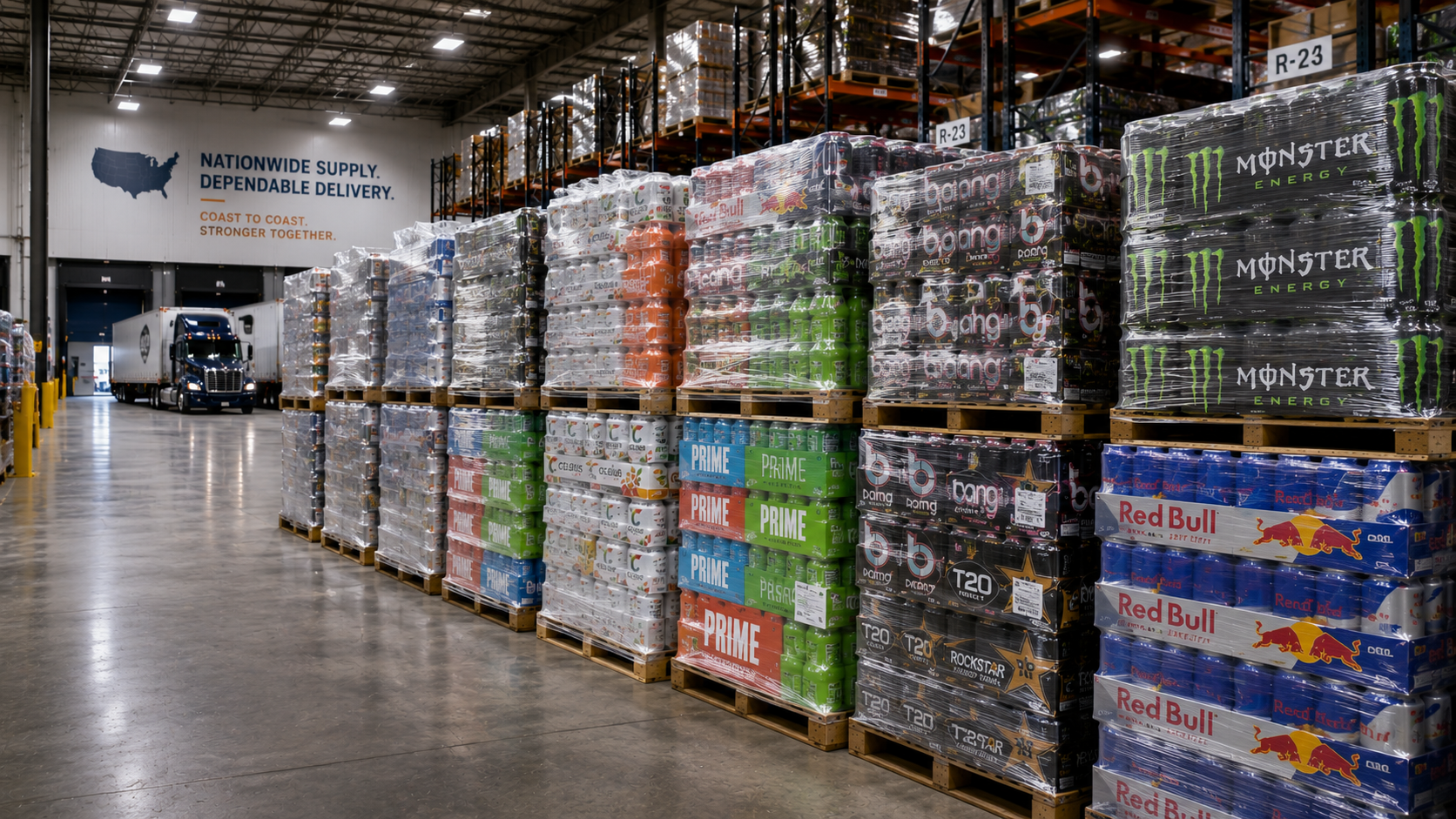
Pallet orders become practical for operators managing 20 or more machines across a route territory where the warehouse needs to maintain meaningful stock of core SKUs between supplier deliveries. Pallet purchasing reduces ordering frequency, provides better per-unit economics than bulk case buying and simplifies warehouse organization because product arrives in a defined, organized format rather than as individual case deliveries across multiple orders.
Truckload supply suits large regional vending operators managing 100 or more machines across a significant territory, or operators with central warehouse infrastructure who purchase for multiple route territories simultaneously. Truckload purchasing provides the strongest per-unit economics and simplifies inbound logistics at the warehouse level, but requires the storage capacity, forklift infrastructure and cash flow to support a large upfront inventory commitment.
Most vending operators progress through these formats as their machine network grows. The transition from bulk to pallet purchasing is typically the first significant efficiency gain, reducing ordering frequency and improving warehouse organization without requiring the full operational infrastructure that truckload purchasing demands.
Common Mistakes Vending Operators Make With Energy Drink Inventory
The inventory and purchasing errors that most consistently reduce vending profitability are predictable and preventable. These are the mistakes that cost vending operators the most in lost revenue and wasted slot allocation.
Using Identical Product Mixes Across Every Machine
This is the most widespread vending management error. A corporate office machine and a manufacturing facility machine serve fundamentally different consumers with different brand preferences, format preferences and purchase motivations. Applying the same product mix to both machines underserves both. The operator leaves revenue on the table at every machine that is not optimized for its specific consumer base.
Allowing High-Demand Slots to Run Empty
An empty spiral in a top-selling position is the most direct form of vending revenue loss available. Consumers who want that product either buy a substitute they did not choose or leave without purchasing. Setting par levels based on actual velocity data and scheduling restocking before slots run out, not after, is the operational practice that prevents this.
Keeping Slow-Moving Products in Premium Slots
A product that has occupied a machine slot for three weeks without selling is not finding its consumer. Leaving it in place any longer displaces a product that might perform better. Defining a performance review cycle, for example evaluating any SKU that has not met a minimum velocity threshold within 45 days, creates the discipline to rotate underperformers out before they become a long-term drag on machine revenue.
Ignoring Route Sales Data
Modern vending management technology provides detailed sales data by machine, by product and by time period. Operators who make inventory decisions based on intuition, habit or supplier recommendations rather than their own route data are consistently making worse decisions than the data would support. Weekly review of machine-level sales reports is the single most impactful operational practice for improving vending profitability.
Choosing Suppliers Based on Price Alone
A supplier who quotes the lowest case price but runs short on core SKUs during a restock cycle, communicates poorly about delivery changes or cannot support the operator’s route schedule is not a good supply partner at any price. For a vending operator, supply reliability affects every machine on every route. Total supply value, availability, delivery consistency, communication quality and brand range, is the correct evaluation framework.
Using Technology to Improve Vending Beverage Performance
Modern vending management systems have transformed the ability of operators to make data-informed decisions about inventory, restocking and product selection. Remote monitoring technology allows operators to check inventory levels in real time without a physical route visit. Sales reporting shows which products are moving and when, which enables route planning that is based on actual demand rather than fixed schedules.
The metrics that matter most for vending energy drink category management:
- Sales by product and machine location to identify top performers and underperformers at each specific site
- Stockout frequency by slot to quantify how often the machine is losing sales due to empty positions
- Sales by time of day and day of week to optimize restocking timing around actual demand peaks
- Turnover rate by SKU to identify which products earn their slot allocation and which should be replaced
- Seasonal variance compared to prior periods to plan inventory increases ahead of demand spikes at campus, gym and transit locations
Operators who review these metrics weekly make better purchasing and route planning decisions than those who rely on periodic physical checks or general market intuition. The compounding effect of data-driven adjustments over a 12-month period is measurable in route profitability.
Why Long-Term Wholesale Partnerships Matter for Vending Operators
A wholesale supplier who understands the operational requirements of a vending business is a more valuable partner than one who simply processes orders. Route planning cycles, machine-specific can format requirements, the need for mixed-brand orders across a wide SKU range, the warehouse logistics of receiving product that will be distributed across a large machine network: these are operational specifics that a supplier experienced with vending accounts understands and accommodates. A supplier without that experience creates friction at every stage of the purchasing and fulfillment process.
Long-term supplier relationships also provide more resilience when supply conditions tighten. An operator with an established relationship and a track record of consistent purchasing is better positioned to maintain product availability when a high-demand brand faces supply pressure than a transactional buyer with no relationship equity. For a vending operator whose revenue depends on keeping machines stocked with specific brands, that supply continuity has real commercial value.
Working with a supplier who can support bulk orders, pallet shipments and truckload supply within the same relationship allows operators to scale their purchasing format as the machine network grows without changing supply partners at each stage.
Why Vending Operators Choose T20 Energy Drink USA LLC
T20 Energy Drink USA LLC is a Margate, Florida-based wholesale energy drink supplier operating as a B2B commercial supply partner for vending operators across the United States. The company’s purchasing process is built for commercial accounts, not consumer-level transactions, which means vending operators interact with a supply process designed for businesses rather than one adapted from a retail model.
T20 supports vending operators at every purchasing scale. Smaller operators building their first wholesale relationship can begin with bulk energy drink orders. Growing operators managing expanding machine networks can progress to pallet supply. Large regional operators with warehouse infrastructure can access truckload purchasing. The distributor program supports operators who supply multiple downstream accounts or manage vending for multiple client organizations.
Operators can also explore the guides on choosing an energy drink distributor, buying energy drinks in bulk and truckload energy drink supply for additional purchasing strategy guidance relevant to vending operations at different scales.
Request Wholesale Pricing for Your Vending Business
T20 Energy Drink USA LLC supplies commercial vending operators across the United States with wholesale energy drinks through flexible purchasing programs designed for businesses of every size. Submit your preferred brands, machine format requirements, estimated purchasing volume and delivery location to receive a customized wholesale quotation from the T20 team.
Frequently Asked Questions About Vending Machine Beverage Trends
Why are energy drinks one of the strongest-performing beverage categories in vending machines?
Energy drinks match the vending machine’s core use case precisely. The purchase is fast, the product is single-serve, the consumer’s need is immediate and brand recognition is strong enough that the buying decision is made in seconds. The consumer demographic that uses vending machines most frequently, office workers, students, industrial employees and healthcare staff, overlaps significantly with the primary energy drink buyer segments.
Should every vending machine carry the same energy drink products?
No. Product selection should be customized to the specific consumer base at each machine location. A corporate office machine warrants different product allocation than a manufacturing facility or university campus machine. Using the same mix across every machine in a route network consistently underserves every location and leaves revenue on the table at each one.
Which energy drink brands perform best in vending machines?
Monster Energy and Red Bull are the volume drivers across most vending locations because their brand recognition enables fast purchase decisions. Celsius has grown significantly at corporate, campus and fitness facility vending locations. Prime Energy performs well at campus vending. The right brand mix at any specific machine depends on the consumer profile at that location.
How important are sugar-free energy drink options in vending machines?
Sugar-free formats are now a necessity in most vending environments, not an optional addition. A machine that carries only traditional high-sugar energy drinks misses a growing consumer segment that will purchase water or nothing rather than a product that does not meet their preferences. At minimum, one or two sugar-free slots should be allocated in any energy drink vending machine.
How should vending operators manage inventory to prevent stockouts?
Set par levels based on confirmed sales velocity data from each specific machine. Schedule restocking based on sell-through rate rather than a fixed calendar. Track stockout frequency to identify which slots run short most often. Maintain deeper inventory positions at high-demand locations like hospitals, manufacturing facilities and campus machines during exam periods.
When should vending operators transition from bulk to pallet purchasing?
Pallet purchasing becomes practical when a vending operator is managing 20 or more machines and the warehouse needs to maintain meaningful stock of core SKUs between supplier deliveries. Pallet orders reduce ordering frequency, provide better per-unit economics and simplify warehouse organization compared with frequent small bulk purchases.
Does can size matter when choosing energy drink products for vending machines?
Yes. Can size compatibility with machine slot configurations is a practical requirement that vending operators must verify before committing to a supply relationship. A 16oz can, a 12oz can and a slim can all have different dimensions that require different slot configurations. Operators should confirm format compatibility with their specific machine models before placing orders for any energy drink SKU.
How do I request wholesale energy drink pricing for my vending business?
Submit your preferred brands, machine format requirements, estimated purchasing volume and delivery location through the Request Pricing page. The T20 team reviews each submission and responds with a customized wholesale quotation based on the specific operational requirements of your vending business.