
Fuel brings customers onto a gas station property. Everything else is the operator’s opportunity to capture. Beverages are consistently among the highest-converting in-store categories because the purchase motivation is immediate: the customer is often thirsty, tired, in transit or on a schedule, and a cold drink from a well-stocked cooler is exactly what they need right now. Energy drinks sit at the center of that dynamic because they serve a specific functional need that no other beverage category addresses as directly. The driver who has been on the road for four hours, the warehouse worker heading into a night shift, the commuter running late on a Monday morning are not choosing between Monster and sparkling water. They are buying the one product that delivers what they came in for.
For gas station operators, the commercial case for managing energy drinks well is straightforward. The category generates consistent non-fuel revenue across every daypart, from early morning commuter stops through late-night travel center purchases. It does not require complex preparation, extensive staff training or significant floor space. It requires the right brands in stock, a well-organized cooler and a wholesale supply relationship that keeps product available without gaps.
This guide covers gas station beverage sales from the consumer behavior level through to merchandising strategy, inventory planning and wholesale purchasing. Operators who want broader wholesale context alongside this guide can review the energy drink wholesale USA overview.
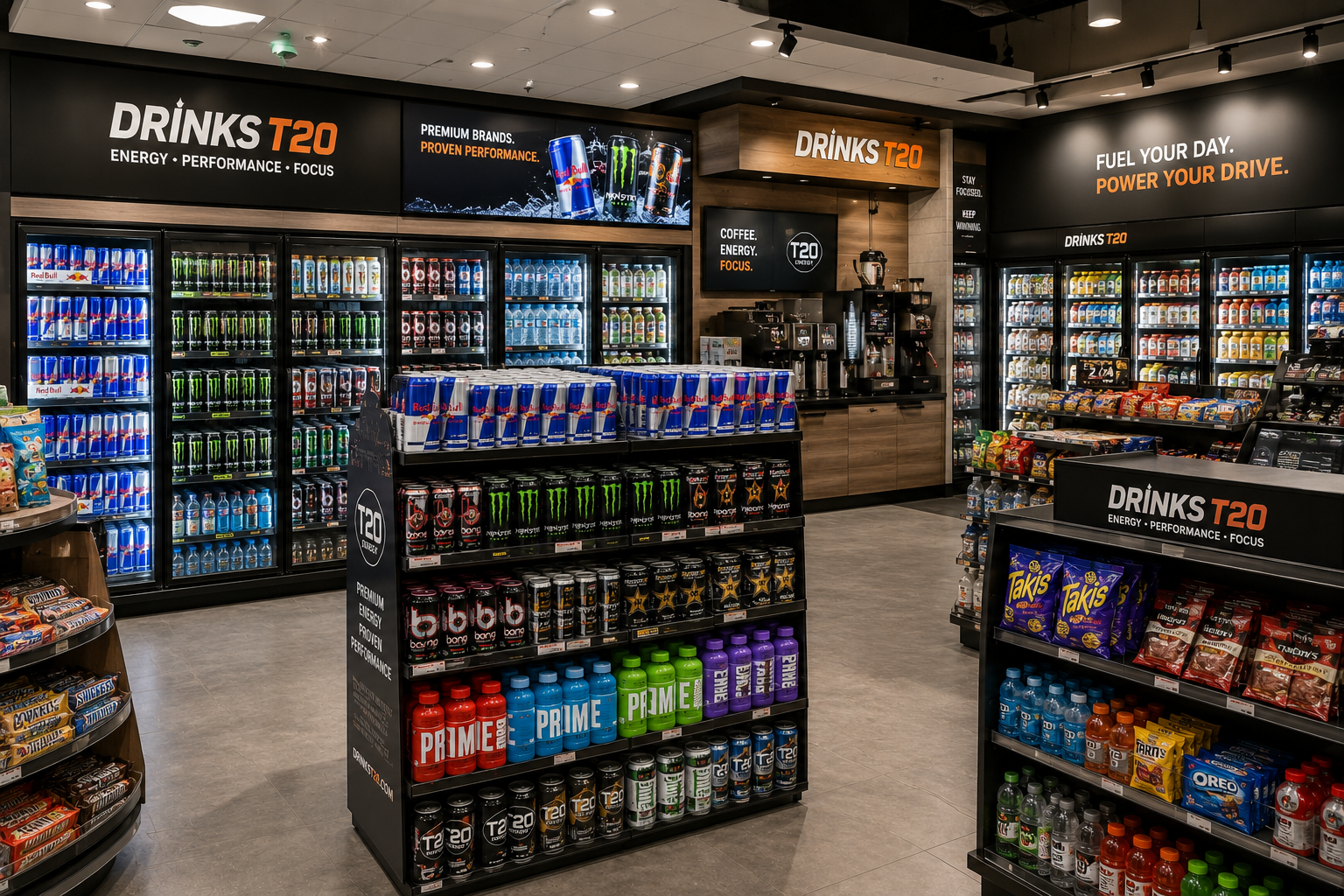
Why Beverage Sales Define Gas Station In-Store Revenue
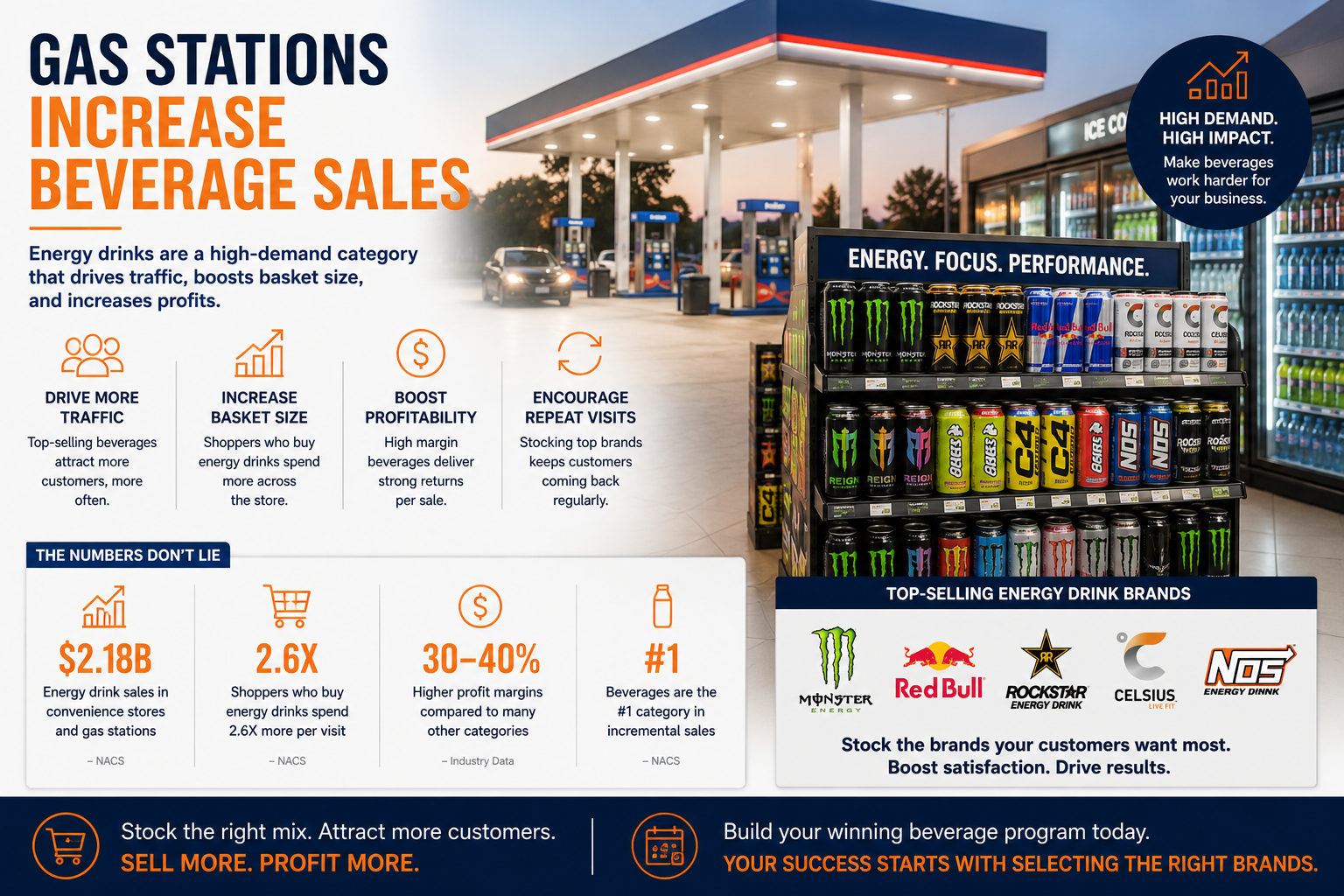
Fuel margin compression has been a long-term reality for gas station operators across the United States. The National Association of Convenience Stores has consistently reported that in-store sales, not fuel, generate the majority of gross profit for convenience and fuel retail locations. Within in-store categories, beverages are one of the highest-performing segments because they combine high purchase frequency, impulse conversion and strong repeat buying behavior.
The gas station environment is particularly well suited to beverage sales because it creates multiple purchase triggers simultaneously. A customer stopping to fuel is already on the property. They are often standing outside for two to five minutes while the tank fills. Walking inside afterward, even for a moment, exposes them to the entire in-store offer. A cold energy drink visible in a well-lit cooler near the checkout counter converts a significant share of those walk-ins, especially when the customer is already in a transit mindset where beverages feel like a natural companion to the journey.
Energy drinks have become one of the most commercially important packaged beverage categories in fuel retail because they serve a disproportionate share of the customers who stop at gas stations. Commuters, truck drivers, delivery workers and long-distance travelers are not incidental energy drink buyers. They are the core consumer of the category, and they stop at gas stations regularly. For operators, that alignment between location type and consumer profile is a significant commercial advantage that is worth managing actively.
The Consumer Profile at Gas Stations by Location Type
Gas station locations vary significantly in the consumer profile they serve, and the right energy drink product mix varies with it. An operator who stocks the same product set at a highway travel center, an urban commuter stop and a rural fuel station is almost certainly leaving money on the table at all three locations.
Highway and Interstate Corridor Locations
These locations serve long-haul truck drivers, road-trippers, interstate commuters and travelers covering significant distances. The energy drink purchase at a highway location is functional and often habitual. These consumers know what they want, they buy it regularly and they expect it to be in stock. Core high-caffeine formats in large can sizes perform disproportionately well here. Monster Original in 16oz, Red Bull in 12oz and 20oz formats and value multi-packs that let a driver stock up for a long haul all fit this consumer’s purchasing behavior.
Stockouts at highway locations are particularly costly because the next option may be 30 miles down the road. A driver who cannot get their preferred brand at your location remembers that failure on the return trip.
Urban Commuter and City-Fringe Locations
Urban gas stations near office districts, transit hubs, dense residential areas or business parks serve a morning-heavy commuter traffic pattern. These consumers are time-pressured, brand-conscious and increasingly interested in functional and sugar-free options alongside traditional formats. Red Bull slim cans, Celsius, Monster Ultra and premium energy formats perform well in this environment. The purchase is quick, the decision is often pre-made based on daily routine and the key operational requirement is that the product is in stock and easy to grab.
Suburban and Residential Locations
Suburban gas stations serve a broader demographic mix across the day. Morning commuters, school-run parents, weekend errand shoppers and local residents all pass through. The energy drink mix at these locations benefits from broader variety, including functional options for health-conscious consumers, sugar-free formats for calorie-aware shoppers and the established core brands for traditional energy drink buyers. Celsius and Monster Ultra tend to outperform their national averages at suburban locations near gyms, fitness centers or residential areas with higher health-consciousness levels.
Industrial and Logistics Area Locations
Gas stations near warehouses, distribution centers, manufacturing facilities, construction sites and logistics parks serve a shift worker and commercial driver customer base with high purchase frequency and strong brand loyalty. These consumers buy the same product repeatedly, value availability above all else and tend to purchase in larger formats or multiple units per transaction. The product mix at these locations should be heavily weighted toward proven high-velocity core SKUs with reliable stock levels, rather than variety and novelty.
Travel Centers and Truck Stop Locations
Full-service travel centers serving the trucking industry represent the highest-volume energy drink opportunity in fuel retail. Professional truck drivers purchase energy drinks as a work tool. Their purchase frequency is high, their brand preferences are established and their spend per visit on beverages tends to exceed the average fuel stop customer. Large format cans, high-caffeine formulas and multi-unit purchasing are the norm. These locations should maintain the deepest inventory position of any gas station format and treat energy drink stockouts as a serious operational failure.
Who Buys Energy Drinks at Gas Stations?
Understanding the specific buyer segments that generate energy drink revenue at gas stations helps operators make better decisions about product selection, cooler positioning and inventory depth at each location.
Morning Commuters
The morning commuter stop is one of the highest-value transactions at most gas stations. Customers arrive before or during their commute, often purchase fuel, and many add a beverage to the transaction. Energy drinks compete with coffee and ready-to-drink tea in this daypart, and they win when the consumer wants caffeine with more functional impact than a standard coffee, a specific brand they trust or a cold beverage rather than a hot one. Fast transaction, immediate cooler access and reliable stock of core brands are the three operational requirements for capturing this consumer.
Professional and Commercial Drivers
Delivery drivers, truck operators, rideshare and taxi drivers, field service technicians and sales representatives spend large portions of their working day in vehicles. Gas stations are part of their daily route, and energy drinks are part of their daily work routine. These consumers are among the most loyal and most frequent energy drink buyers in any retail format, and they respond poorly to stockouts. Losing a commercial driver’s repeat business because a preferred brand was not in stock is a recurring revenue loss, not a one-time miss.
Long-Distance Travelers
Road-trippers, leisure travelers, families on vacation and weekend travelers stop at gas stations along their route. These consumers want recognizable brands they trust because they are in an unfamiliar area and do not want to experiment with an unknown product at a rest stop. Stocking the major brands, Monster, Red Bull, Celsius and Rockstar, ensures that travelers find something they recognize and purchase with confidence.
Shift Workers
Healthcare workers, emergency responders, hospitality staff, security personnel, manufacturing workers and warehouse employees purchase energy drinks at non-traditional hours, often before an overnight shift or after a late shift ends. Gas stations with extended or 24-hour operation are frequently the only retail option available at these hours, which makes energy drink availability at late-night and early-morning hours particularly important for this consumer segment.
Impulse Buyers
A meaningful share of energy drink purchases at gas stations are not pre-planned. A customer who came in for a snack, a car item or to pay for fuel sees a well-stocked cooler near the checkout and adds a drink to the transaction. This impulse conversion is driven entirely by visibility, product placement and cooler organization. An energy drink cooler that is hard to see, partially empty or disorganized fails this consumer before they even make a decision.
Current Gas Station Beverage Trends
The beverage category inside gas stations reflects broader consumer trends that are reshaping packaged beverage purchasing across all retail formats. Operators who understand these trends are better positioned to stock ahead of demand rather than react to it after competitors have already captured the sales.
Sugar-Free and Zero-Sugar Formats Are Now Mainstream
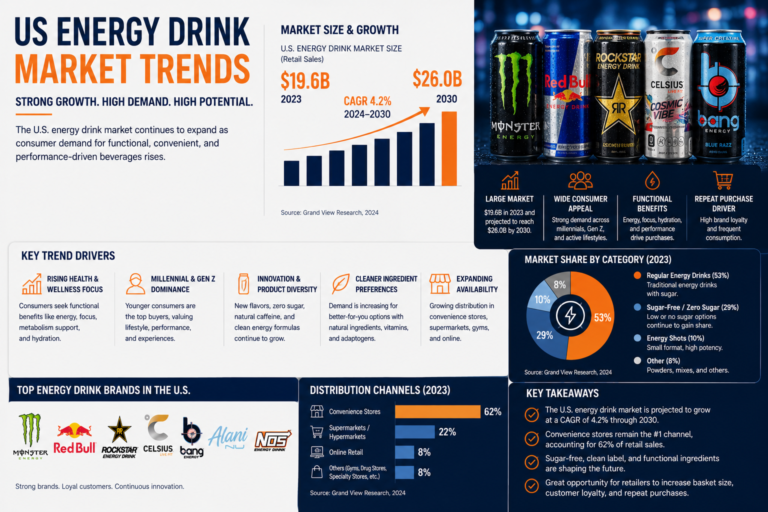
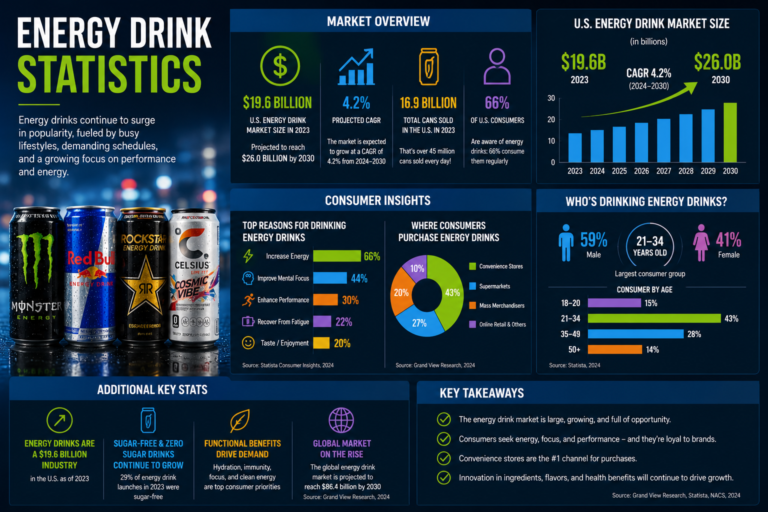
Consumer interest in reducing sugar intake has moved from a health niche into mainstream purchasing behavior. The Grand View Research analysis of the U.S. energy drink market identifies sugar-free and low-calorie formats as one of the primary growth drivers in the category. For gas station operators, this means that a cooler stocked only with traditional high-sugar energy drinks is missing a growing consumer segment that will purchase elsewhere if the sugar-free option is not available.
Monster Ultra, Red Bull Sugarfree and the range of Celsius formats have all driven significant category growth by attracting consumers who previously did not purchase energy drinks at all. These products do not cannibalize traditional format sales in most gas station environments. They add incremental category revenue from a new consumer segment.
Functional Energy Drinks Have Entered Mainstream Fuel Retail
Celsius has made the clearest transition from specialty fitness channels into mainstream convenience and fuel retail. Its appeal to health-conscious, active-lifestyle and calorie-aware consumers creates purchase occasions that Monster Original and Red Bull classic do not capture. Gas stations near gyms, fitness facilities, running paths or health-oriented residential areas should evaluate Celsius stock levels as seriously as their core brand inventory.
Product Variety Drives Category Revenue
Consumers within the energy drink category are not homogeneous. A gas station that stocks three or four distinct products from different brand and format tiers captures more of the potential category revenue at the location than one that stocks only the two most popular SKUs. Variety serves different consumer preferences without requiring more cooler doors, just better SKU selection within the existing cooler space.
A practical four-tier approach for most gas station locations: core high-caffeine traditional format, sugar-free traditional format, functional energy option, and at least one variety or emerging brand that creates trial opportunity for consumers open to something new.
Large Format and Multi-Unit Purchasing
Truck drivers, road-trippers and commercial drivers frequently purchase 24oz cans or buy multiple units in a single transaction at highway and travel center locations. Gas station operators at these location types should ensure large format SKUs are stocked and that multi-unit purchasing is easy, whether through bundled cooler placement, display positioning near checkout or promotional multi-unit pricing.
Cooler Merchandising That Drives Gas Station Beverage Sales
The cooler is the primary revenue-generating display for packaged beverages in a gas station. How it is organized, where it is positioned in the store and how consistently it is stocked directly affects how much revenue it generates. These are not secondary operational details. They are the primary levers available to an operator who wants to improve beverage category performance without adding floor space.
Cooler Positioning Within the Store
The energy drink cooler should be positioned along the natural traffic path between the store entrance and the checkout counter. Customers walking that path are the highest-conversion traffic in the store. A cooler positioned in a dead-end alcove, around a corner or behind other fixtures misses the impulse conversion opportunity that a well-trafficked position captures.
In gas stations with limited floor space, even a two-door or three-door refrigerated unit positioned near the checkout counter or along the main traffic path outperforms a larger cooler in a low-traffic area of the store.
Eye-Level Placement for Core SKUs
Eye-level positions in the cooler generate more visual engagement and higher conversion than top or bottom shelf positions. Monster Original, Red Bull 8.4oz and the location’s best-performing sugar-free SKU should occupy eye-level positions as the default configuration. Secondary SKUs, new products and slower-moving varieties can be placed above or below without displacing the proven performers from their most effective position.
Brand Grouping and Organized Layout
Grouping products by brand within the cooler creates a cleaner shopping experience and reduces decision friction for brand-loyal consumers. A commuter who buys Monster every morning should be able to find their preferred flavor in under five seconds. A consumer open to trying something new should be able to compare options without scanning a disorganized mix of brands and formats across the same door.
Clear organization also reduces restocking errors. Staff who are refilling coolers make fewer placement mistakes when the layout is logical and consistent across every replenishment cycle.
Full Cooler Presentation at All Times
A partially empty cooler signals poor inventory management to the consumer, even when the gap is temporary. Pulling product forward to fill the visible face of each shelf during the day, not only during scheduled restocking, maintains the visual impression of a well-stocked category. This practice takes a few minutes per shift and measurably affects how the cooler performs during peak traffic periods.
Secondary Placement Near Checkout
A small secondary display of core energy drink SKUs positioned near the checkout counter creates an additional conversion opportunity for customers who did not pass the main cooler during their visit. Single-serve formats in a floor display or a small refrigerated unit near the register capture last-minute purchase decisions that the main cooler does not reach.
Inventory Planning for Gas Station Beverage Operations
Inventory management is where gas station beverage performance is either protected or eroded. A well-stocked cooler cannot generate revenue if the back stock is empty. A full back stock is wasted if the cooler is not being replenished frequently enough to keep pace with demand during peak traffic periods.
The foundation of good inventory planning at a gas station is knowing actual sell-through velocity by SKU. How many units of Monster Original does the location sell on a typical Tuesday? How does that change on a Friday afternoon when commuter traffic increases? How much does Celsius move in the two hours after the nearby gym opens? These numbers exist in the point-of-sale system and are more reliable than any general market benchmark for planning inventory at a specific location.
Key inventory management practices for gas station beverage categories:
- Set reorder points for each SKU based on confirmed weekly sell-through velocity, not estimated demand
- Review sales data by product and daypart weekly to identify velocity changes before they create stockout situations
- Implement FIFO rotation as a standard cooler restocking procedure to ensure older product moves before newer arrivals
- Plan inventory increases ahead of confirmed high-demand periods, holiday travel weekends, summer travel season and local events, not reactively after demand has already peaked
- Track new product performance separately for the first 60 days after introduction before making stocking decisions based on local demand data
- Align reorder timing with supplier lead times so product arrives before inventory falls below the reorder threshold
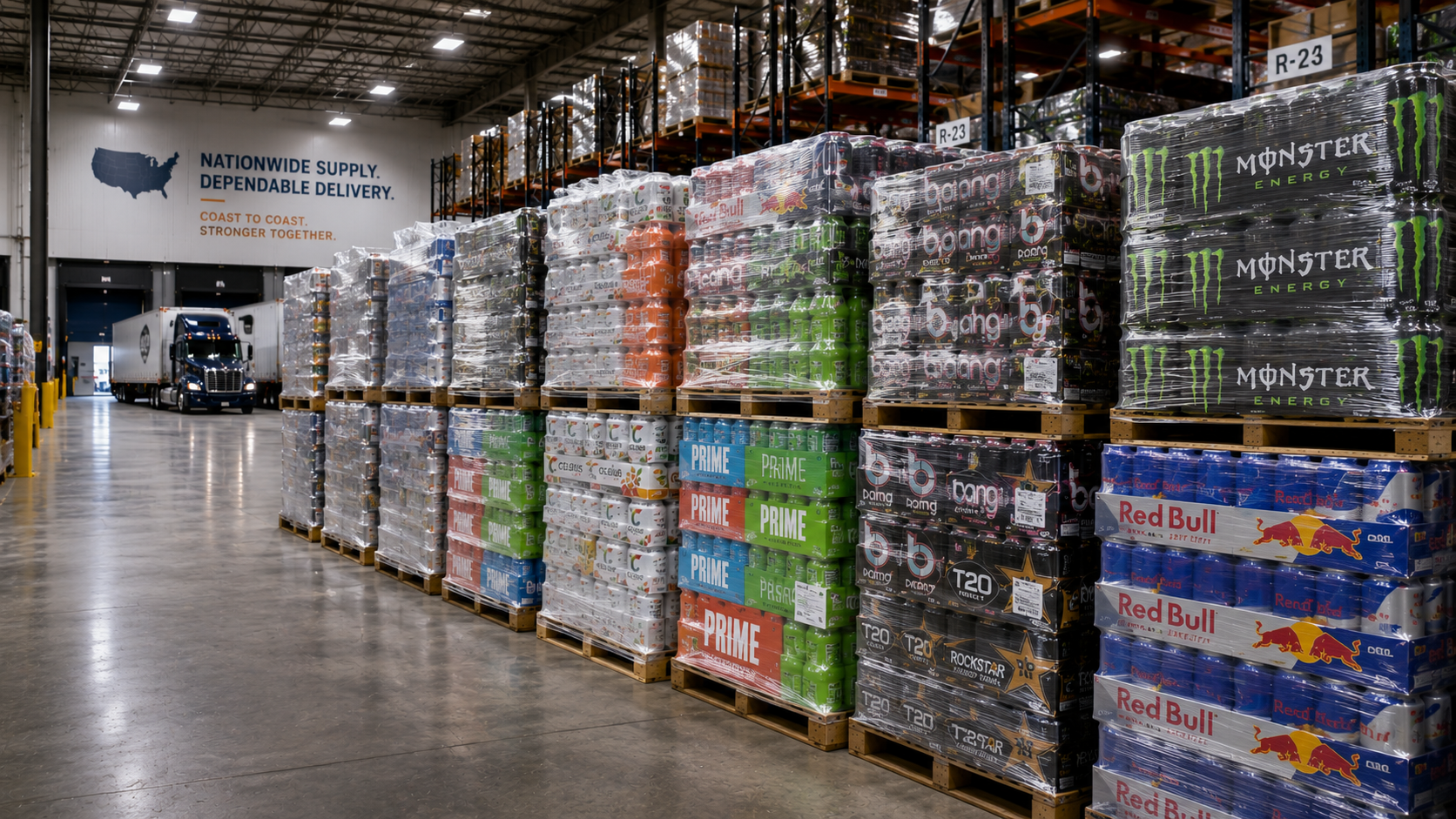
Operators experiencing consistent beverage demand growth often find that transitioning from frequent small orders to bulk energy drink orders or pallet purchasing reduces administrative overhead, improves inventory stability and lowers per-unit cost compared with reactive small-quantity purchasing.
Seasonal Demand Planning for Gas Station Beverages
Energy drink demand at gas stations follows seasonal patterns that operators can plan around rather than react to. Understanding these patterns allows buyers to build inventory positions ahead of demand spikes rather than scrambling for supply after they have already started selling through faster than usual.
Summer months drive the strongest overall beverage velocity at most gas station locations. Higher temperatures increase cold beverage demand across all categories. Travel activity increases significantly from Memorial Day through Labor Day, which drives stronger highway and travel center performance in particular. Operators at these location types should increase inventory positions in late April or early May, well before the peak travel season begins.
Holiday travel weekends, Memorial Day, Fourth of July, Labor Day and the Thanksgiving weekend, create predictable short-term demand spikes at highway corridor locations. An operator who increases inventory the week before a major travel weekend and maintains stock through the Monday return traffic captures that demand. One who waits until Thursday before a holiday weekend risks arriving at the supplier too late to receive product in time.
Back-to-school periods in August and September drive stronger functional energy drink performance at locations near universities and colleges, as students return and establish their routines. Celsius and functional formats tend to show velocity increases at these locations during this period.
Winter months typically sustain strong energy drink performance at 24-hour locations, highway travel centers and industrial area gas stations because the customer base at these locations, commercial drivers and shift workers, does not follow a seasonal consumption pattern tied to weather or vacation activity.
Choosing the Right Wholesale Energy Drink Supplier
The wholesale supply relationship for a gas station’s energy drink category is an operational dependency that affects daily revenue. A supplier who delivers reliably keeps the cooler stocked. One who does not creates stockouts that lose sales to the competitor down the street. At the gas station level, where consumer loyalty to a specific location is often conditional on having the right products available, supply reliability is not a secondary consideration. It is a core operational requirement.
When evaluating a wholesale energy drink supplier for a gas station account, these are the questions that matter:
- Does the supplier carry the specific brands and SKUs that generate the most revenue at this location?
- Can they deliver on a schedule that aligns with the store’s reorder cycle and lead time requirements?
- Are they structured for commercial B2B purchasing or primarily a consumer retailer offering larger quantities?
- Can they support bulk, pallet and truckload ordering within the same supply relationship as the business grows?
- How do they communicate when supply constraints, delivery changes or product availability issues arise?
- What are their realistic lead times for delivery to the specific location?
- Can they serve both single-location independents and multi-site operators?
The communication quality and response speed during the quotation process is the clearest available indicator of what post-order service will look like. Suppliers who are slow to respond, vague about specifications or unable to answer practical commercial questions before the first sale consistently deliver the same experience after it.
Bulk, Pallet or Truckload: Choosing the Right Format
The right purchasing format depends on the location’s confirmed sell-through velocity, available storage space, receiving infrastructure and whether the operator manages one location or multiple sites.
Bulk orders are the practical starting point for independent single-location gas stations that are building their wholesale purchasing relationship and have not yet confirmed the demand volume to justify a full pallet commitment. Bulk purchasing provides commercial pricing and broader product access without the storage requirement or inventory commitment of pallet supply.
Pallet orders suit gas stations with confirmed consistent demand and adequate back-stock space to receive a pallet delivery. For a well-run gas station moving 60 to 100 energy drink units daily, pallet purchasing simplifies the replenishment cycle, reduces ordering frequency and provides better per-unit economics than bulk case buying. The key requirement is confirming receiving infrastructure, pallet jack access, back-stock space and delivery vehicle access before placing the first pallet order.
Truckload supply is appropriate for multi-location gas station groups, travel center operators with central warehouse infrastructure and fuel retail chains that centralize purchasing and distribute inventory internally across sites. Truckload purchasing provides the strongest per-unit economics and simplifies inbound logistics for large-scale operations, but requires warehouse capacity, forklift infrastructure and cash flow to support a large upfront inventory position.
Most gas station operators progress through these formats as their business grows. Starting with bulk purchasing establishes the supply relationship. Moving to pallet supply once demand is confirmed improves efficiency. Truckload supply becomes appropriate when multi-location volume and warehouse infrastructure justify the commitment.
Common Mistakes Gas Station Operators Make With Beverage Categories
The operational errors that most consistently hurt gas station energy drink performance are not about making wrong brand choices. They are about managing the category reactively instead of proactively, and optimizing for the wrong purchasing variables.
Allowing Core SKU Stockouts
Running out of Monster Original or Red Bull at a busy gas station during morning commuter hours is a direct revenue loss and a customer experience failure. Commuters who rely on a specific product expect it to be available every time they stop. A stockout pushes them to a competitor and may shift their morning fuel stop pattern permanently. Setting reorder points based on confirmed velocity data prevents this.
Carrying Too Narrow a Product Mix
Stocking only one or two energy drink brands serves the buyer who wants those brands but misses everyone else. A gas station that adds Celsius alongside Monster and Red Bull does not reduce Monster or Red Bull sales. It captures incremental revenue from Celsius buyers who previously left without purchasing an energy drink.
Ignoring Sales Data in Favor of Habit
Ordering the same products in the same quantities because that is what has always been ordered is a purchasing approach that does not respond to demand changes. A SKU that was a slow mover six months ago may be a fast mover now. A product that drove strong sales last summer may underperform this year because a new competitor product has captured its consumer. Weekly sales data review prevents stale purchasing decisions.
Poor Cooler Organization and Restocking Discipline
A disorganized or partially empty cooler reduces purchase conversion from every customer who walks past it. This is a preventable revenue loss that costs nothing to fix beyond consistent restocking discipline and a logical cooler layout maintained across every shift.
Selecting Suppliers Based on Price Alone
A supplier who quotes the lowest price but cannot deliver reliably creates stockouts that cost more in lost revenue than any per-unit saving. Total supply value, product availability, delivery reliability and communication quality, is the correct evaluation framework, not headline pricing alone.
Using Sales Data to Manage Gas Station Beverage Performance
Point-of-sale data is the most reliable guide to beverage category decisions at any gas station location. According to Statista, U.S. energy drink market growth has been driven in part by data-informed retail expansion that identified and responded to consumer demand signals faster than competitors. For gas station operators, the same principle applies at the store level.
The metrics that matter most for gas station beverage management:
- Weekly unit sales by brand and SKU to track velocity and trend direction
- Sales by time of day and day of week to understand when demand peaks and align restocking accordingly
- Inventory turnover rate by SKU to identify fast movers that warrant more facings and slow movers that should be replaced
- Stockout frequency to quantify how often the location is losing sales due to unavailability
- Seasonal variance compared to prior-year periods to identify whether demand is tracking above or below historical patterns
Operators who review these metrics weekly make better purchasing decisions than those who review annually or not at all. The compounding effect of incremental monthly improvements to product mix, inventory depth and cooler organization is measurable in category revenue over a 12-month period.
Why Gas Station Operators Partner With T20 Energy Drink USA LLC
T20 Energy Drink USA LLC is a Margate, Florida-based wholesale energy drink supplier serving commercial buyers across the United States. The company’s supply model is built for B2B commercial accounts, including gas stations, travel centers and fuel retail operators at every scale from single-location independents to multi-site networks.
Gas station operators working with T20 access wholesale purchasing across major energy drink brands through a commercial process that does not require navigating consumer-level retail barriers. Buyers submit product requirements, preferred brands, estimated volume and delivery location through the Request Pricing page and receive a quotation that reflects their specific commercial situation.
T20 supports gas station buyers at every purchasing stage. Single-location operators can begin with bulk energy drink orders. Operators with confirmed demand and receiving infrastructure can move to pallet supply. Multi-location operators and travel center groups can access truckload purchasing for centralized inventory management. The distributor program supports buyers who supply multiple downstream accounts.
Operators exploring broader purchasing strategy can also review the guides on choosing an energy drink distributor, energy drink pallet orders and truckload energy drink supply for channel-specific purchasing guidance.
Request Wholesale Pricing for Your Gas Station
T20 Energy Drink USA LLC works with independent fuel retailers, travel centers and multi-location gas station operators throughout the United States. Submit your product requirements, preferred brands, estimated volume and delivery location to receive a customized wholesale quotation from the T20 team.
Frequently Asked Questions About Gas Station Beverage Sales
Why are beverages one of the most important in-store categories at gas stations?
Beverages combine high purchase frequency, impulse conversion and consistent year-round demand in an environment where customers are already on-site for fuel. The National Association of Convenience Stores reports that in-store sales, not fuel, generate the majority of gross profit at convenience and fuel retail locations. Beverages are among the highest-performing in-store categories because the purchase motivation is immediate and the transaction is fast.
Why do energy drinks sell particularly well at gas stations?
Gas stations disproportionately serve the consumer segments that purchase energy drinks most frequently: commuters, professional drivers, long-distance travelers, shift workers and commercial transport operators. The functional purchase motivation at a fuel stop, staying alert, managing fatigue, powering through a long shift, aligns directly with what energy drinks deliver. No other beverage category serves that need as specifically.
Which energy drink brands perform best at gas stations?
Monster Energy and Red Bull are the volume drivers at most gas station locations because their consumer base is broad and their brand recognition is strong enough that travelers and occasional buyers purchase them without deliberation. Celsius has grown significantly at urban commuter and suburban locations. Rockstar and Bang serve value-oriented and variety-seeking segments. The right brand mix for any specific location depends on the consumer profile that location serves.
Should gas stations carry sugar-free energy drink options?
Yes. Sugar-free formats have moved from a niche preference to a mainstream expectation among a significant portion of energy drink consumers. Monster Ultra, Red Bull Sugarfree and Celsius serve consumers who will not purchase traditional high-sugar formats. Adding sugar-free options does not reduce traditional format sales at most gas station locations. It captures incremental revenue from consumers who were previously leaving without a purchase.
How should a gas station manage energy drink inventory to avoid stockouts?
Set reorder points based on confirmed weekly sell-through velocity by SKU. Review sales data weekly by product and daypart. Plan inventory increases ahead of seasonal demand peaks and holiday travel periods rather than reacting after demand has already spiked. Implement FIFO rotation as a standard restocking procedure. Align reorder timing with supplier lead times so product arrives before inventory falls to critically low levels.
When should a gas station operator switch to wholesale energy drink purchasing?
Any gas station with consistent, predictable energy drink demand benefits from wholesale purchasing because it improves inventory stability, reduces per-unit cost and simplifies the ordering process. The appropriate format, bulk, pallet or truckload, depends on the location’s confirmed sales velocity, available storage space and whether the operator manages one site or multiple locations.
What is the difference between bulk, pallet and truckload energy drink purchasing for gas stations?
Bulk orders suit single-location operators building a wholesale relationship with moderate confirmed demand. Pallet orders suit gas stations with consistent daily energy drink velocity and adequate back-stock space to receive freight delivery. Truckload supply suits multi-location operators and travel center groups with central warehouse infrastructure and confirmed high-volume demand across multiple sites. Most operators progress through these formats as their business grows.
How do I request wholesale energy drink pricing for my gas station?
Submit your product requirements, preferred brands, estimated order volume and delivery location through the Request Pricing page. The T20 team reviews each submission and responds with a customized wholesale quotation based on the specific commercial requirements of your fuel retail operation.