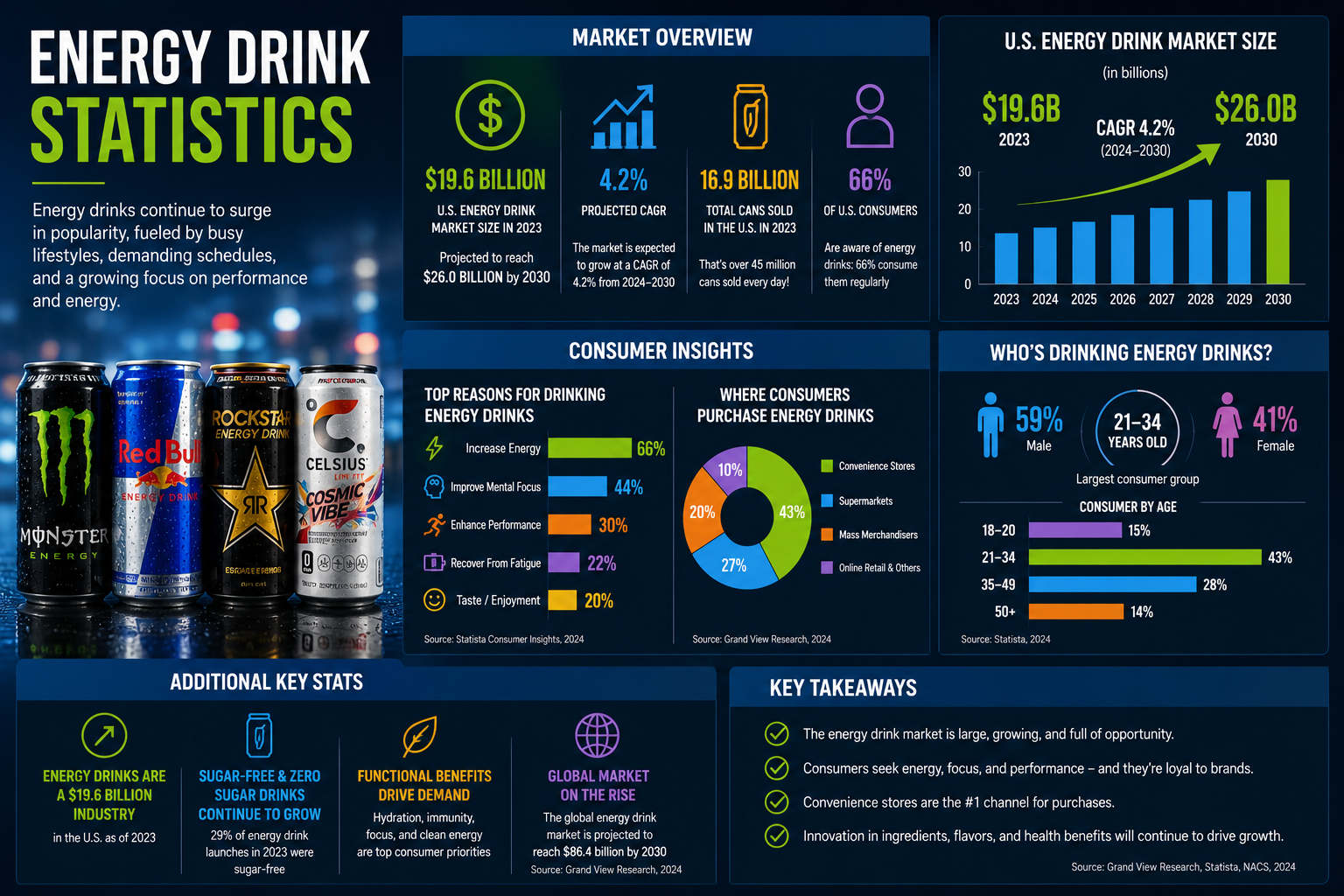

Statistics about the energy drink market are useful in direct proportion to how well they are explained. A market size figure without context tells a commercial buyer very little. Knowing that the U.S. energy drink market generates roughly $25 billion in annual retail sales is interesting. Understanding what that means for which channels are growing, which consumer segments are driving volume, which product formats are gaining share and how wholesale purchasing is evolving is actually useful for making purchasing, stocking and supplier decisions.
This page compiles the most commercially relevant energy drink statistics available for 2026, drawn from publicly available industry research, retail channel data and wholesale market observations. Each section explains what the numbers mean for retailers, distributors and commercial buyers, not just what they say. For broader analysis of the forces shaping the category, the U.S. energy drink market trends report covers the strategic picture in depth. For purchasing-specific guidance, the energy drink wholesale USA overview explains how commercial buyers source through wholesale channels.
U.S. Energy Drink Market Size Statistics
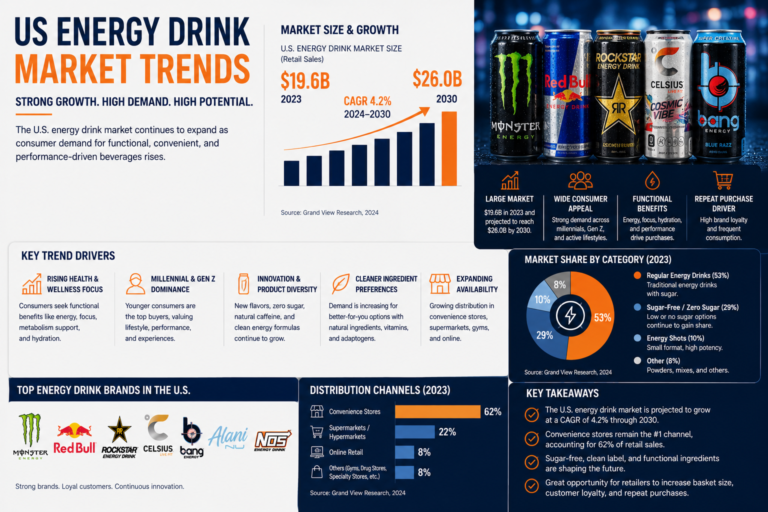
The U.S. energy drink market reached approximately $25.01 billion in retail sales in 2024, according to Grand View Research. The same research projected continued compound annual growth through 2030, placing energy drinks among the strongest-performing categories in the broader ready-to-drink beverage market. Multiple research firms have produced similar estimates, and while methodology differences create some variation in the specific figures cited, the directional consensus is consistent: the U.S. energy drink market is large, established and still growing.
For commercial buyers, the aggregate market size number is less useful than understanding where within the market that value is concentrated. The channel and segment breakdown tells the more actionable story.
The National Association of Convenience Stores reported that energy drinks accounted for 27.8% of all packaged beverage category dollars in U.S. convenience stores in 2024. That is the largest share of any single packaged beverage segment in the channel that generates more retail transactions per square foot than any other U.S. retail format. The commercial implication is that energy drinks are not performing as one category among many. They are the dominant packaged beverage category in the most important immediate-consumption retail format in the country.
Per-capita energy drink consumption in the United States has increased consistently over the past decade, according to Statista, with growth coming from both existing consumers increasing purchase frequency and new demographic segments entering the category who previously did not purchase energy drinks. This demographic expansion is one of the structural reasons market growth has consistently outpaced earlier forecasts.
Key U.S. market size data points:
- U.S. retail market value approximately $25 billion in 2024, with continued growth projected through 2030
- Energy drinks represent 27.8% of packaged beverage category dollars in U.S. convenience stores
- Per-capita consumption has grown consistently for over a decade
- The U.S. remains one of the two largest energy drink markets globally by retail value
- Market growth has been driven by both volume increases from existing consumers and new consumer segment entry
Why These Market Size Numbers Matter for Commercial Buyers
A $25 billion market generating 27.8% of convenience store beverage dollars is not a category that retailers and distributors can afford to manage as a secondary priority. The commercial buyers who treat energy drink purchasing as a core operational function, with structured wholesale programs, active inventory management and data-driven product mix decisions, consistently outperform those who manage it reactively.
The market size also signals category resilience. A category generating this level of sustained retail value across this many distribution channels is not vulnerable to the same cyclical demand risks that affect more occasion-specific beverage categories. Energy drink demand is tied to daily functional consumption patterns, not seasonal occasions or discretionary indulgence, which makes it a commercially stable category to build purchasing programs around.
Energy Drink Consumer Demographic Statistics
The consumer profile for energy drinks in 2026 is substantially broader than it was a decade ago, and understanding that evolution is directly relevant to product mix and channel strategy decisions at the retail and wholesale level.
The original energy drink consumer base was heavily concentrated among younger male consumers, primarily ages 18 to 34. That demographic remains an important segment, but the category has expanded significantly beyond it. Current energy drink buyers include office professionals in their 30s and 40s, healthcare workers managing rotating shift schedules, commercial truck drivers covering interstate routes, warehouse and manufacturing employees working physically demanding jobs, fitness enthusiasts across multiple age groups and university students managing academic workloads.
This demographic broadening has occurred alongside, not instead of, growth in the original consumer base. The total addressable market for energy drinks has expanded because the category now serves consumer needs that it did not effectively address in its earlier form. Sugar-free formats appealed to health-conscious consumers who avoided traditional high-sugar energy drinks. Functional positioning attracted wellness-oriented consumers who did not identify with the original category marketing. Premium packaging and cleaner ingredient panels have made energy drinks acceptable to higher-income professional consumers who previously associated the category with a demographic that did not include them.
Consumer demographic segments purchasing energy drinks in 2026:
- Office professionals seeking afternoon energy support and functional beverage alternatives to coffee
- University and college students managing study, commuting and social schedules
- Healthcare workers on rotating shift schedules including overnight and early morning rotations
- Manufacturing and warehouse employees in physically demanding roles with break-time vending access
- Commercial and long-haul truck drivers on extended interstate routes
- Delivery drivers and field service technicians spending the majority of their workday in vehicles
- Fitness enthusiasts purchasing pre-workout or active lifestyle-oriented energy formats
- Commuters incorporating energy drinks into morning or evening travel routines
- Construction workers and tradespeople seeking convenient worksite refreshment
For commercial buyers, the demographic breadth means that energy drink demand is present across virtually every commercial environment where beverages are sold or dispensed. A vending operator serving a hospital, a gas station serving a freight corridor and a convenience store serving a residential commuter neighborhood are all serving active energy drink consumers, just different segments of them.
Retail Channel Statistics
One of the defining commercial characteristics of the U.S. energy drink market is the diversity of its retail distribution. Unlike categories that depend on a primary channel, energy drinks generate meaningful volume across multiple distinct retail formats, each serving different consumer segments and purchase occasions.
Convenience Store Statistics
Convenience stores are the dominant retail channel for energy drink sales in the United States. The NACS 27.8% category dollar share figure represents the single strongest position any packaged beverage has held in convenience retail in recent measured periods. The purchase occasion at convenience stores is primarily immediate consumption, driven by commuter traffic, impulse buying and routine daily stops.
The convenience store energy drink purchase is characterized by high frequency among loyal consumers, strong brand recognition that enables fast purchase decisions, consistent year-round demand and significant impulse conversion from consumers who enter the store for other products. These behavioral characteristics make the convenience channel the highest-velocity retail environment for energy drink volume on a per-door basis.
Key convenience store energy drink observations:
- Energy drinks generate 27.8% of packaged beverage category dollars in U.S. convenience stores
- The category outperforms water, carbonated soft drinks, sports drinks and coffee in the convenience channel by packaged beverage dollar share
- Morning commuter and professional driver segments drive disproportionate daily volume at many locations
- Cooler placement and product visibility directly affect purchase conversion rates
- Sugar-free and functional formats have grown their convenience store share significantly
The dedicated convenience store energy drink trends guide provides channel-specific purchasing, merchandising and inventory planning analysis.
Gas Station and Travel Center Statistics
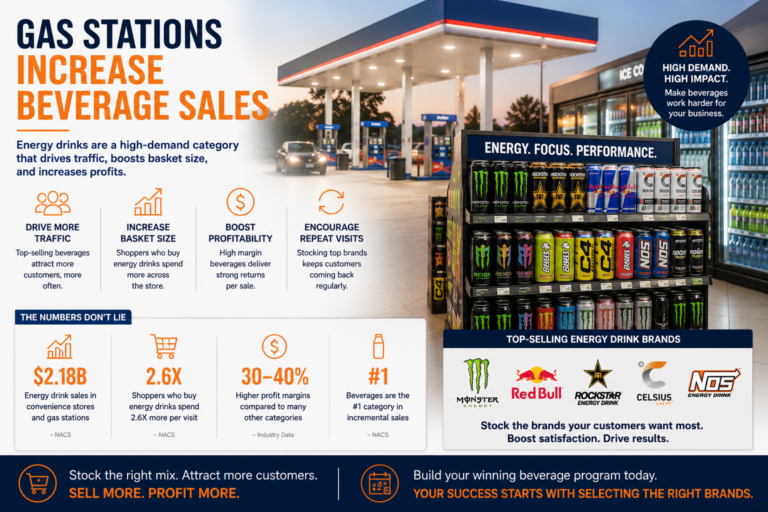
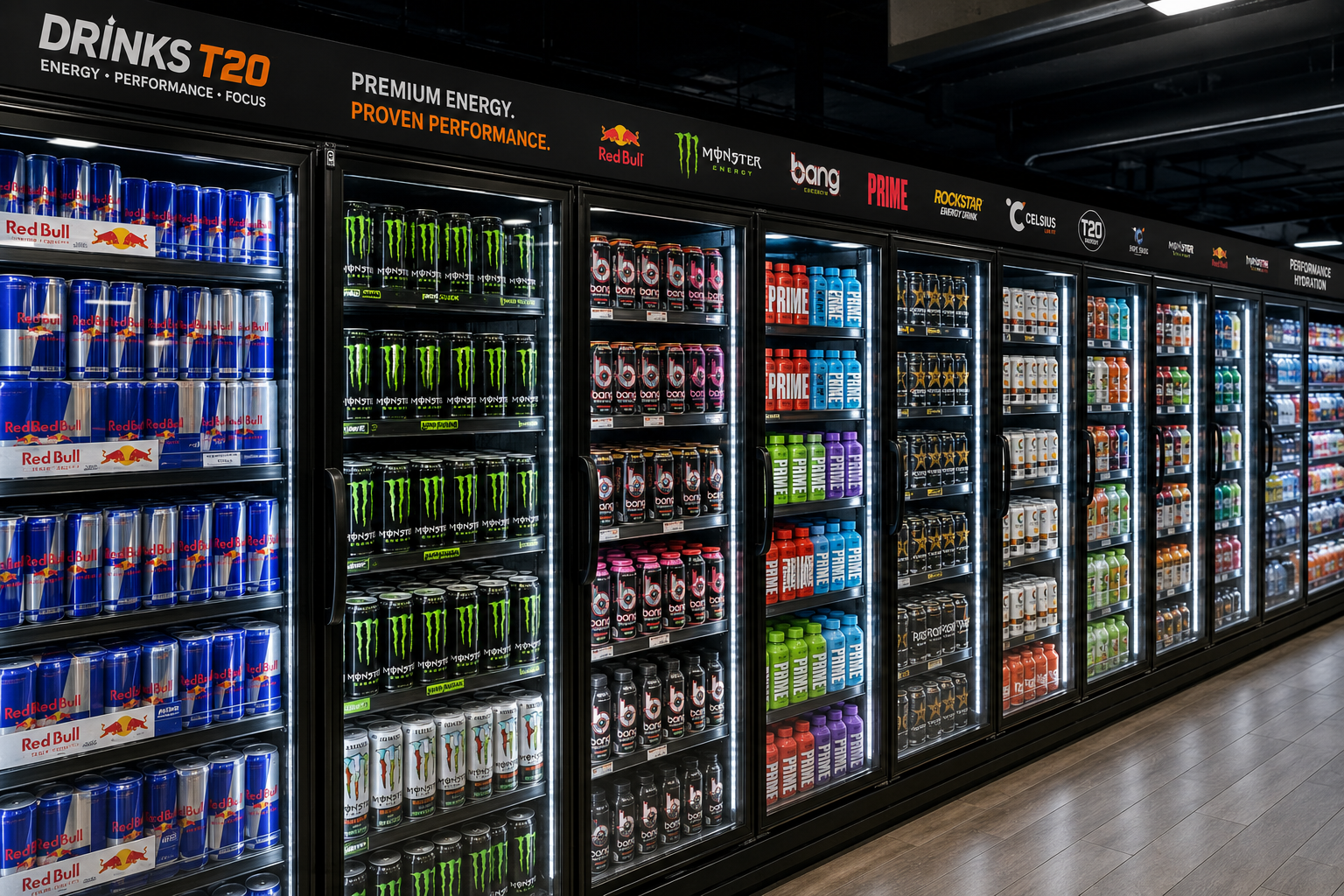
Gas stations and travel centers serve consumer segments with among the highest energy drink purchase frequency of any retail format. The alignment between the fuel stop consumer profile, commuters, commercial drivers, long-distance travelers and delivery workers, and the energy drink buyer profile is direct and commercially significant. These consumers are purchasing for functional reasons tied to alertness and work schedule, not for recreational consumption or social occasions.
Highway corridor and travel center locations generate particularly strong energy drink velocity because their consumer base is weighted toward long-haul and professional drivers who purchase consistently and in larger formats. A 24oz Monster or a Red Bull 20oz performs differently at a highway truck stop than at a suburban gas station, and operators who understand their specific traffic profile make better stocking decisions as a result.
Key gas station energy drink observations:
- Gas stations serve among the highest-frequency energy drink buyer segments: professional drivers, commuters and shift workers
- Travel centers and highway corridor locations generate strong large-format can and multi-unit purchase behavior
- Consistent traffic patterns throughout the day create multiple daily purchase windows
- Non-fuel gross profit has become the primary financial focus for most fuel retail operators, elevating the commercial importance of beverage category management
The gas station beverage sales guide covers channel-specific data and purchasing strategy for fuel retailers.
Vending Machine Statistics
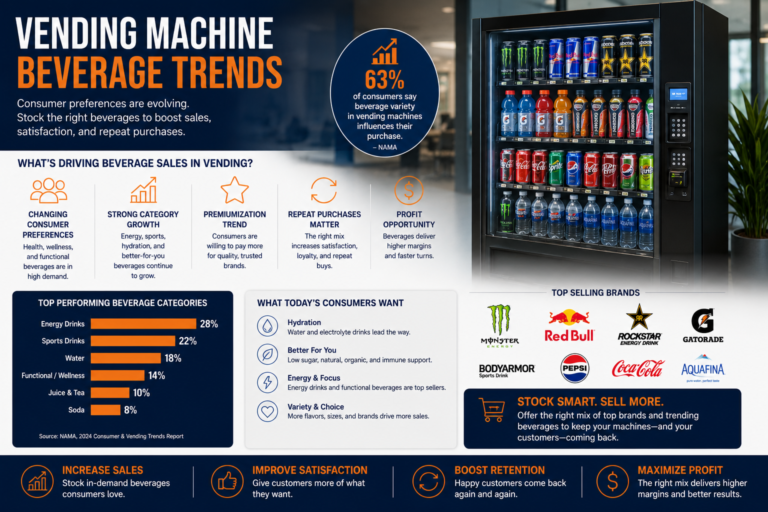
The vending channel has been one of the quieter but commercially meaningful growth areas for energy drink distribution. Workplace vending modernization, cashless payment adoption and the broadening of the energy drink consumer base into office, healthcare and educational environments have all contributed to category growth in vending over the past five years.
Modern vending management technology has improved operator ability to track inventory in real time, optimize product mix by location and schedule restocking based on confirmed demand data rather than fixed calendar cycles. These operational improvements have made energy drink vending more profitable per machine than it was in the previous generation of equipment.
Key vending channel energy drink observations:
- Corporate offices, hospitals, universities and manufacturing facilities represent the four strongest energy drink vending environments by volume
- Cashless payment adoption has increased machine revenue at locations where it previously required exact change
- Location-specific product selection produces measurably better results than uniform product mixes across all machines
- Sugar-free and functional formats have driven incremental category revenue at corporate and fitness facility vending locations
The vending machine beverage trends guide provides detailed analysis for operators managing energy drink assortments across distributed machine networks.
Supermarket Statistics
Supermarkets contribute significant energy drink volume through multi-pack purchasing, promotional endcap activity and planned home consumption shopping behavior. The supermarket purchase occasion differs from convenience retail in that the consumer is typically buying for household stocking rather than immediate consumption, which affects package format preferences and promotional response.
Supermarkets have expanded refrigerated beverage sections and energy drink shelf allocations in response to consumer demand. The functional energy drink segment, led by Celsius, has gained mainstream supermarket distribution across most major grocery chains, which reflects broader consumer interest in functional beverage options that go beyond traditional energy drink formats.
Sugar-Free and Functional Energy Drink Statistics
The sugar-free and functional energy drink segments represent the most significant structural shift in the category over the past five years. What began as a niche consumer preference has become a mainstream commercial expectation that affects product mix decisions at every level of the retail and wholesale supply chain.
Most major energy drink brands now offer substantial sugar-free product lines. Monster Ultra, Red Bull Sugarfree and the full Celsius range have all demonstrated that zero-sugar energy drinks are not a secondary category within energy drinks. They are a parallel segment with their own loyal consumer base, their own purchase occasions and their own growth trajectory.
The commercial implication for retailers and distributors is direct: a product assortment that does not include adequate sugar-free representation is missing a significant and growing share of potential category revenue. These consumers do not switch to traditional formats when their preferred sugar-free option is unavailable. They either purchase a different product category or leave without buying anything.
Key sugar-free and functional energy drink observations:
- Sugar-free formats now represent a mainstream segment within the energy drink category, not a niche extension
- All major energy drink brands have invested significantly in zero-sugar and reduced-calorie product development
- Celsius has driven the functional positioning segment from specialty fitness channels into mainstream convenience, supermarket and vending distribution
- Health-conscious consumers, office professionals and fitness enthusiasts are the primary functional and sugar-free energy drink buyers
- Sugar-free purchases are largely additive to category revenue rather than substitutional for traditional format sales
- Retailers who carry both traditional and sugar-free formats consistently generate higher total category revenue than those stocking only one segment
Energy Drink Brand Market Position Statistics
The U.S. energy drink market is competitive at the brand level, with several established names maintaining strong consumer recognition while facing both internal competition from their own line extensions and external competition from emerging brands.
Monster Energy and Red Bull have maintained dominant market positions for over a decade, together accounting for the majority of category dollar share in most measured retail channels. Both brands continue to invest heavily in product innovation, flavor extensions and format development while defending their core SKU positions.
Celsius has established the most commercially significant third-position brand presence in recent years, growing from minimal convenience distribution to mainstream shelf presence in convenience, supermarket and vending channels on the strength of functional positioning and fitness-oriented consumer demand.
Leading energy drink brands commonly stocked by commercial buyers:
- Monster Energy: Broadest SKU range, strongest convenience and gas retail performance, dominant volume driver across most commercial channels
- Red Bull: Premium brand equity, strongest performance in urban and corporate environments, consistent margin driver for retailers
- Celsius: Fastest growth trajectory among major brands, functional positioning, strongest in fitness, campus and corporate channels
- Prime Energy: Strong performance in youth-oriented and campus retail environments
- Rockstar Energy: Value-accessible positioning suited to price-sensitive accounts and variety-oriented retail sets
- Bang Energy: High-caffeine positioning with a fitness-oriented consumer base
- T20 Energy Drink: Available through T20 Energy Drink USA LLC for commercial wholesale buyers
Wholesale Energy Drink Market Statistics
The wholesale layer of the energy drink supply chain has become more strategically important as retail demand has grown and commercial buyers have professionalized their purchasing approach. Retailers, vending operators and distributors that previously managed energy drink purchasing on an ad-hoc basis have increasingly moved to structured wholesale programs that provide better inventory predictability, more favorable per-unit economics and more reliable supply continuity.
This shift toward structured wholesale purchasing reflects a broader operational maturation among commercial energy drink buyers. The category has grown large enough and consistent enough in most retail environments that managing it reactively, ordering when the cooler is nearly empty and shopping for the best available price each time, creates more operational problems than it solves. Planned purchasing with reliable supply partners is now the operational norm among well-run commercial buyers at every scale.
Key wholesale energy drink market observations:
- Commercial buyers are placing larger, more structured inventory orders rather than frequent small purchases
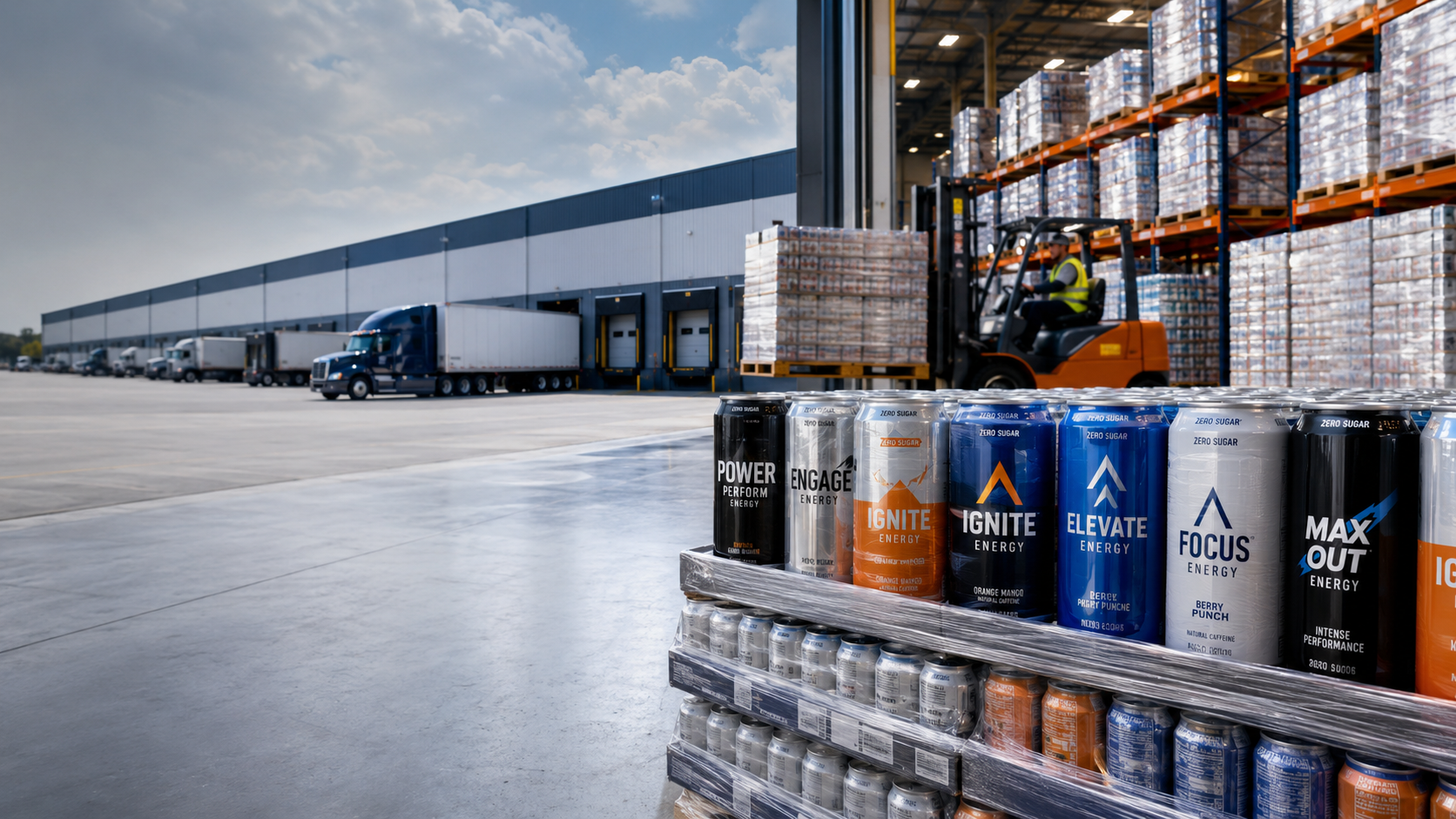
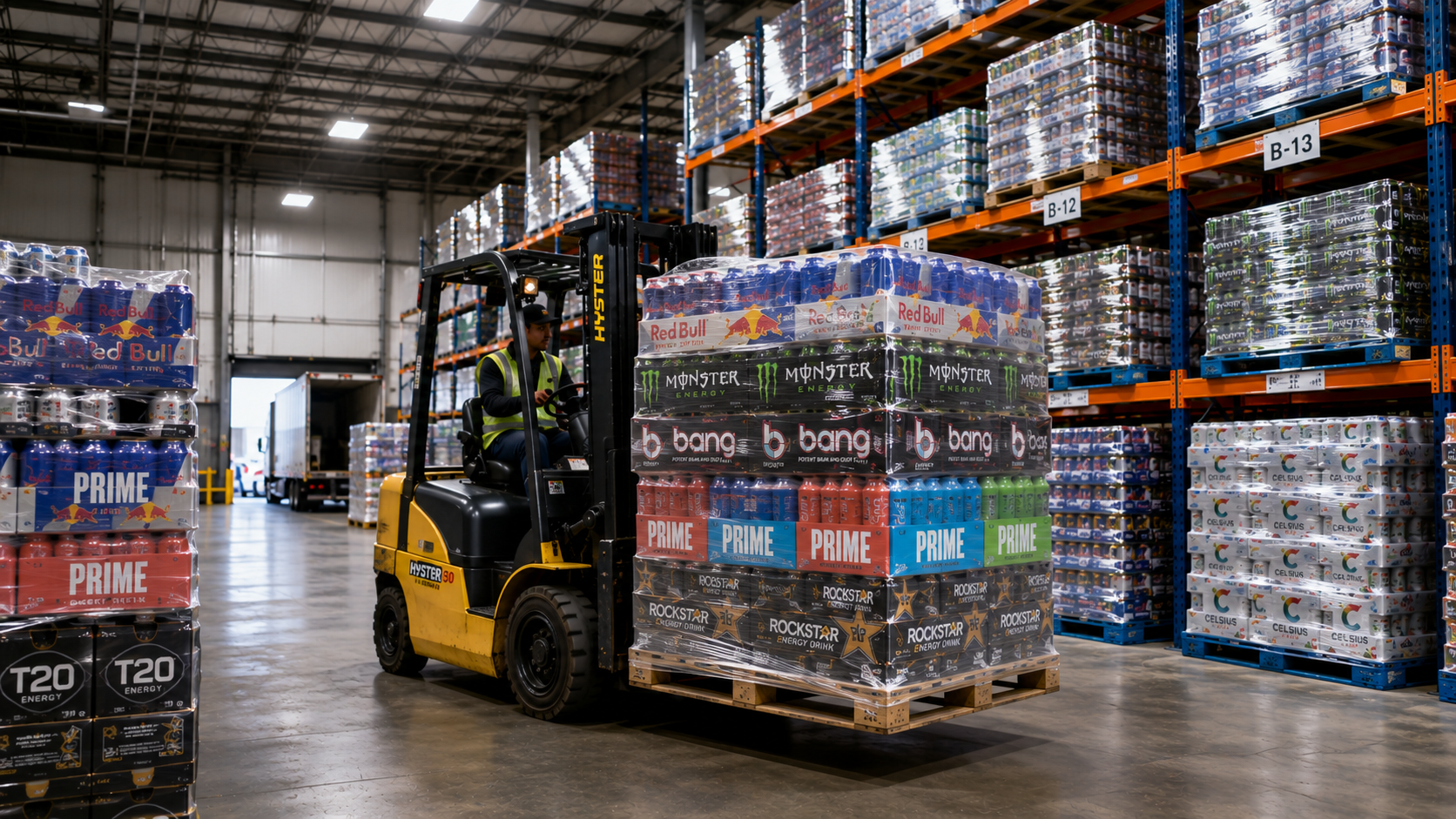
- Pallet purchasing has grown significantly as mid-volume retailers and distributors have formalized their wholesale programs
- Truckload supply is the standard format for regional distributors and multi-location retail operators with central warehouse infrastructure
- Supply reliability and communication quality have become primary supplier evaluation criteria alongside price
- Multi-location retailers increasingly centralize purchasing decisions to standardize product mix and improve per-unit economics
- Data-driven demand forecasting has improved inventory efficiency among buyers who have adopted point-of-sale analytics
Commercial buyers at different purchasing scales can review the dedicated guides on buying energy drinks in bulk, energy drink pallet orders and truckload energy drink supply for format-specific purchasing guidance.
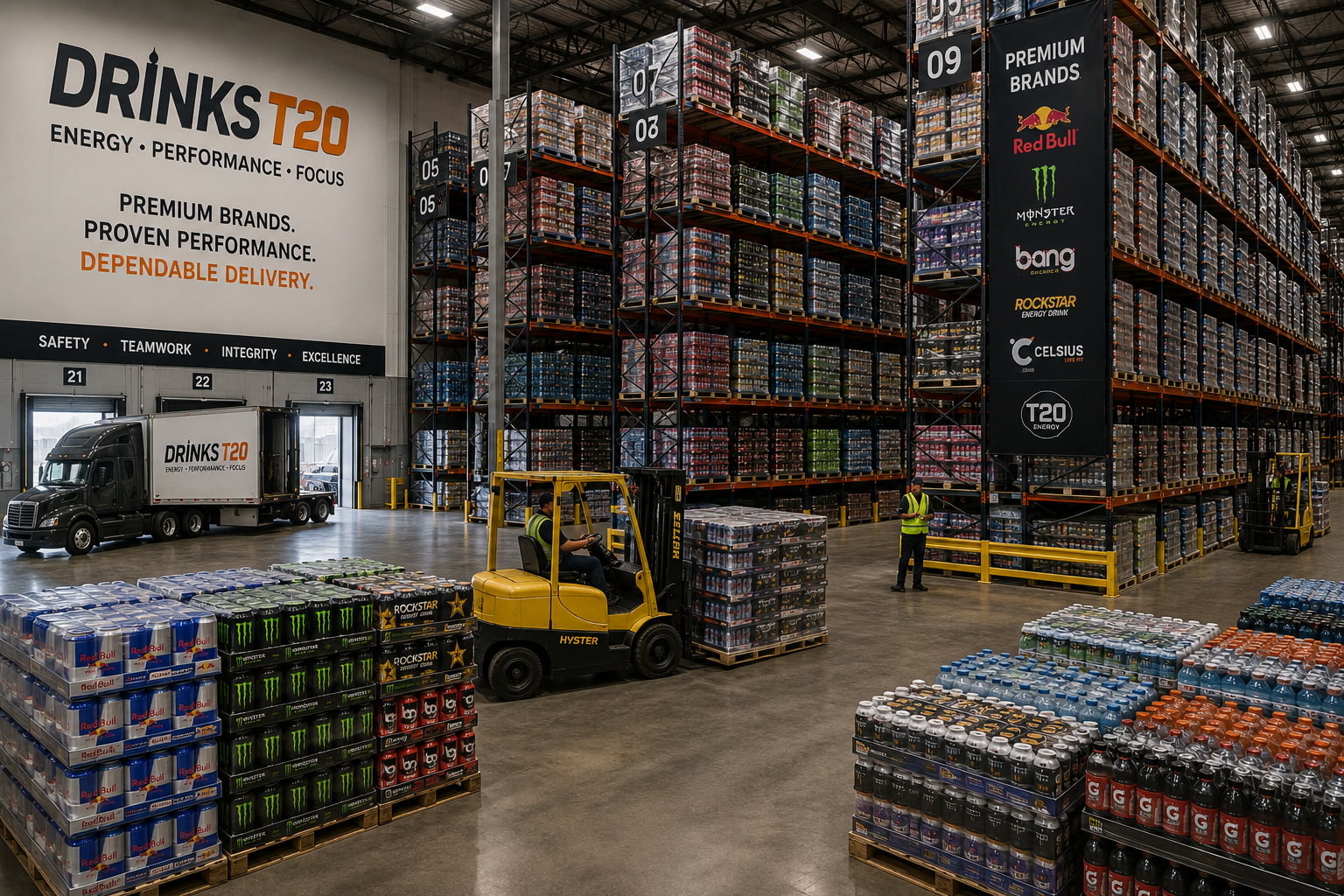
Distribution Statistics Across Commercial Sectors
Wholesale energy drink demand is distributed across a wide range of commercial industries, which contributes to the category’s year-round demand stability. Unlike categories tied to a single retail format or consumption occasion, energy drink wholesale volume is generated across multiple distinct buyer types with different purchasing cycles, different operational requirements and different seasonal demand patterns.
This distribution breadth means that a wholesale supplier serving multiple buyer types, convenience stores, gas stations, vending operators and beverage distributors simultaneously, has more stable total demand than one serving a single sector. It also means that commercial buyers who understand their specific sector’s demand patterns can make more accurate inventory forecasting decisions by focusing on their own channel data rather than aggregate market statistics.
Commercial sectors generating wholesale energy drink demand:
- Convenience stores: Highest per-door velocity of any retail format, daily replenishment requirement at high-traffic locations
- Gas stations and travel centers: Consistent functional purchase demand from commuter, driver and traveler segments
- Supermarkets: Multi-pack and promotional volume, home consumption purchasing behavior
- Vending companies: Distributed machine network demand across office, healthcare, campus and industrial environments
- Beverage distributors: Aggregated downstream retail demand requiring pallet or truckload purchasing formats
- Hospitality and foodservice: Supplementary demand from hotels, restaurants and entertainment venues
- Corporate refreshment programs: Growing workplace vending and office break room demand
- Educational institutions: Campus vending and retail demand concentrated in academic term periods
Future Energy Drink Market Outlook: What the Statistics Point Toward
Forward-looking market projections carry inherent uncertainty, but the structural trends visible in current statistics provide a reasonably clear picture of the direction the U.S. energy drink market is heading over the next three to five years.
The sugar-free and functional segment will continue growing as a share of total category volume. The consumer behavior driving this shift is not reversing. Health consciousness, calorie awareness and clean-label ingredient interest are deepening across demographics, and the product innovation from major brands is responding to that demand. Retailers and distributors who build their assortments around a balanced mix of traditional and functional formats are better positioned for this trajectory than those maintaining traditional-only selections.
Distribution will continue expanding into non-traditional channels. Corporate workplace programs, institutional vending, healthcare facility retail and direct-to-consumer e-commerce all represent incremental volume opportunities that do not compete directly with convenience or grocery channel sales. Each new distribution point adds category volume without cannibalizing existing channel performance.
Data-driven purchasing will become standard practice across commercial buyer types. The technology required to track sell-through by SKU, set data-based reorder points and optimize product mix by location is increasingly accessible to independent operators and smaller commercial buyers, not just large retail chains. Buyers who adopt these practices earlier gain a competitive advantage in inventory efficiency that compounds over time.
Key market outlook observations for commercial buyers:
- Sugar-free and functional format share of total category volume projected to continue increasing
- Distribution expansion into non-traditional channels adding incremental wholesale volume
- Data-driven purchasing and inventory management becoming standard across commercial buyer types
- Continued brand competition driving product innovation and consumer engagement with the category
- Premium positioning gaining traction in channels serving higher-income consumer demographics
- Wholesale purchasing program adoption continuing to grow as buyers professionalize procurement
How Commercial Buyers Can Apply These Statistics
Statistics provide the most value when they inform specific operational decisions rather than serving as background reading. For commercial buyers operating in the U.S. energy drink market, the data in this report points toward several actionable conclusions.
The channel performance data confirms that energy drink purchasing deserves a structured wholesale approach at any meaningful retail scale. A convenience store, gas station or vending operator managing energy drink inventory as a secondary category using reactive purchasing is leaving revenue on the table that a more structured approach would capture.
The demographic breadth data confirms that product mix should reflect the specific consumer segments at each location rather than general market averages. The statistical reality that energy drink buyers now span from 18-year-old students to 55-year-old professionals means that a one-size product selection serves none of them optimally. Location-specific assortment planning is not a refinement of good retail management. It is the baseline standard.
The sugar-free growth data confirms that any retail or vending assortment without adequate zero-sugar and functional representation is structurally incomplete. The consumers who prefer these formats are not marginal. They represent a growing share of total category spend, and retailers who do not serve them are directing that spend to competitors who do.
The wholesale purchasing evolution data confirms that planned procurement with reliable supply partners produces better operational outcomes than reactive spot purchasing. Per-unit costs, inventory predictability, supply continuity and administrative efficiency all improve as buyers move from casual purchasing to structured wholesale programs.
About T20 Energy Drink USA LLC
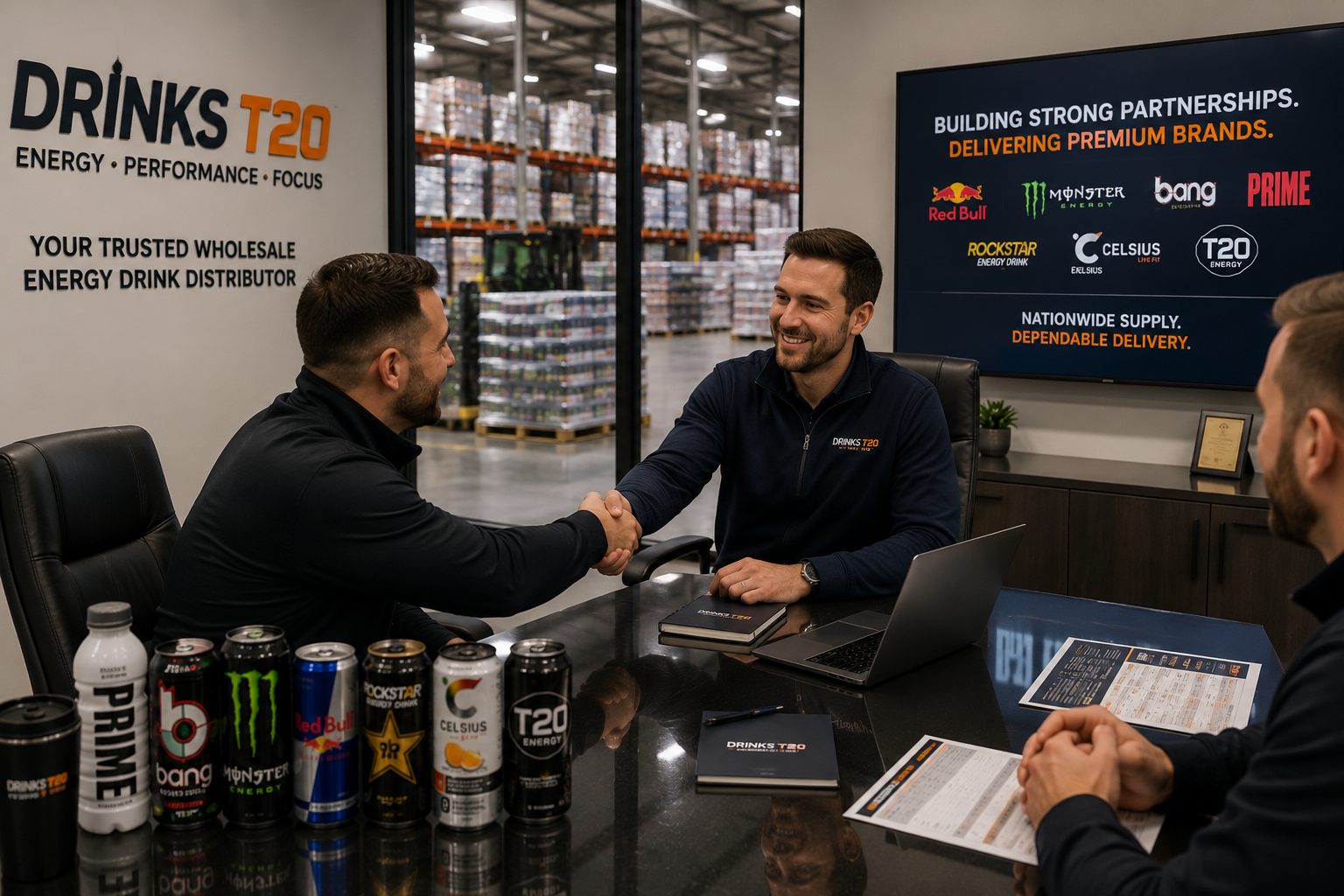
T20 Energy Drink USA LLC is a Margate, Florida-based wholesale energy drink supplier serving commercial buyers across the United States. The company operates as a B2B supply partner for convenience stores, gas stations, supermarkets, vending operators, beverage distributors, retail chains and commercial purchasing organizations that need dependable wholesale energy drink supply structured for business accounts.
T20 supports buyers at every purchasing scale: bulk orders for buyers establishing their wholesale relationship or managing moderate confirmed demand, pallet supply for established commercial buyers with consistent weekly turnover, and truckload purchasing for high-volume buyers with warehouse infrastructure and confirmed downstream demand. The distributor program supports buyers managing multiple downstream retail accounts.
Request Wholesale Energy Drink Pricing
T20 Energy Drink USA LLC helps retailers, distributors and commercial buyers source wholesale energy drinks through flexible purchasing programs designed to support long-term operational growth. Submit your preferred brands, estimated purchasing volume and delivery location to receive a customized wholesale quotation from the T20 team.
Frequently Asked Questions About Energy Drink Statistics
What is the size of the U.S. energy drink market in 2026?
The U.S. energy drink market was valued at approximately $25 billion in retail sales in 2024 according to Grand View Research, with consistent growth projected through 2030. Energy drinks account for 27.8% of packaged beverage category dollars in U.S. convenience stores, making them the largest single packaged beverage segment in the highest-frequency retail format in the country.
Which retail channel sells the most energy drinks in the United States?
Convenience stores are the dominant retail channel by packaged beverage dollar share, with energy drinks accounting for 27.8% of convenience store packaged beverage dollars in 2024. Gas stations and travel centers are the second most commercially significant channel by energy drink purchase frequency, driven by professional drivers, commuters and long-distance travelers.
What demographic groups purchase energy drinks most frequently?
The energy drink consumer base in 2026 spans office professionals, university students, healthcare workers, manufacturing and warehouse employees, commercial drivers, delivery workers, fitness enthusiasts, commuters and shift workers across multiple industries. The category has expanded well beyond its original younger male consumer base through product innovation and functional positioning.
How significant is the sugar-free energy drink segment?
Sugar-free and zero-calorie energy drink formats have moved from a niche preference into a mainstream commercial expectation. All major brands have invested significantly in sugar-free product development. Retailers who carry only traditional formats miss a growing consumer segment whose purchases are largely additive to, not substitutional for, traditional format sales.
Why are wholesale energy drink statistics important for commercial buyers?
Wholesale purchasing statistics help commercial buyers understand whether their procurement approach is aligned with how the broader market is evolving. The trend toward larger, more structured wholesale programs reflects the operational advantages of planned purchasing over reactive ordering in terms of per-unit cost, inventory predictability and supply continuity.
What purchasing formats are available for commercial energy drink buyers?
Commercial buyers typically purchase through bulk orders for moderate demand and purchasing flexibility, pallet orders for established consistent demand with freight delivery, or truckload supply for high-volume buyers with warehouse infrastructure. Most buyers progress through these formats as their business grows.
Which energy drink brands generate the most commercial wholesale demand?
Monster Energy and Red Bull generate the highest wholesale volume in most commercial channels. Celsius has become the most commercially significant functional energy drink in mainstream distribution. Rockstar, Bang and Prime Energy each serve specific consumer segments that complement the core brands in a well-planned commercial assortment.
How can I request wholesale pricing for my business?
Submit your preferred brands, estimated purchasing volume and delivery location through the Request Pricing page. The T20 team reviews each submission and responds with a customized wholesale quotation based on the specific commercial requirements of your business.