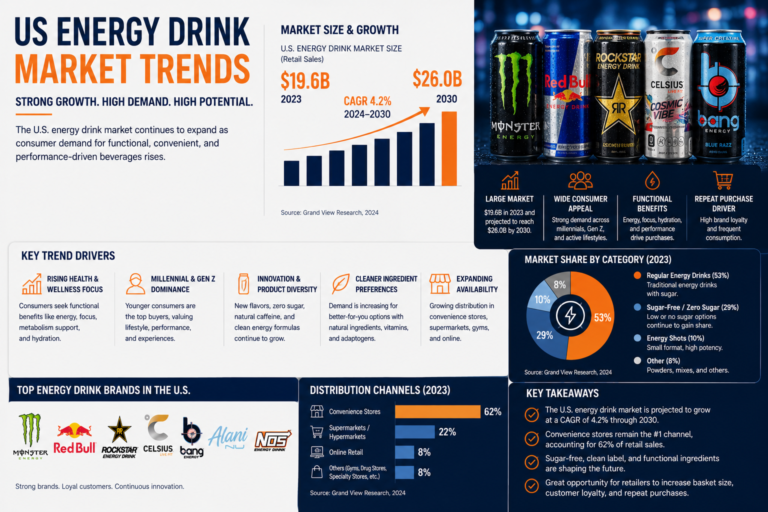
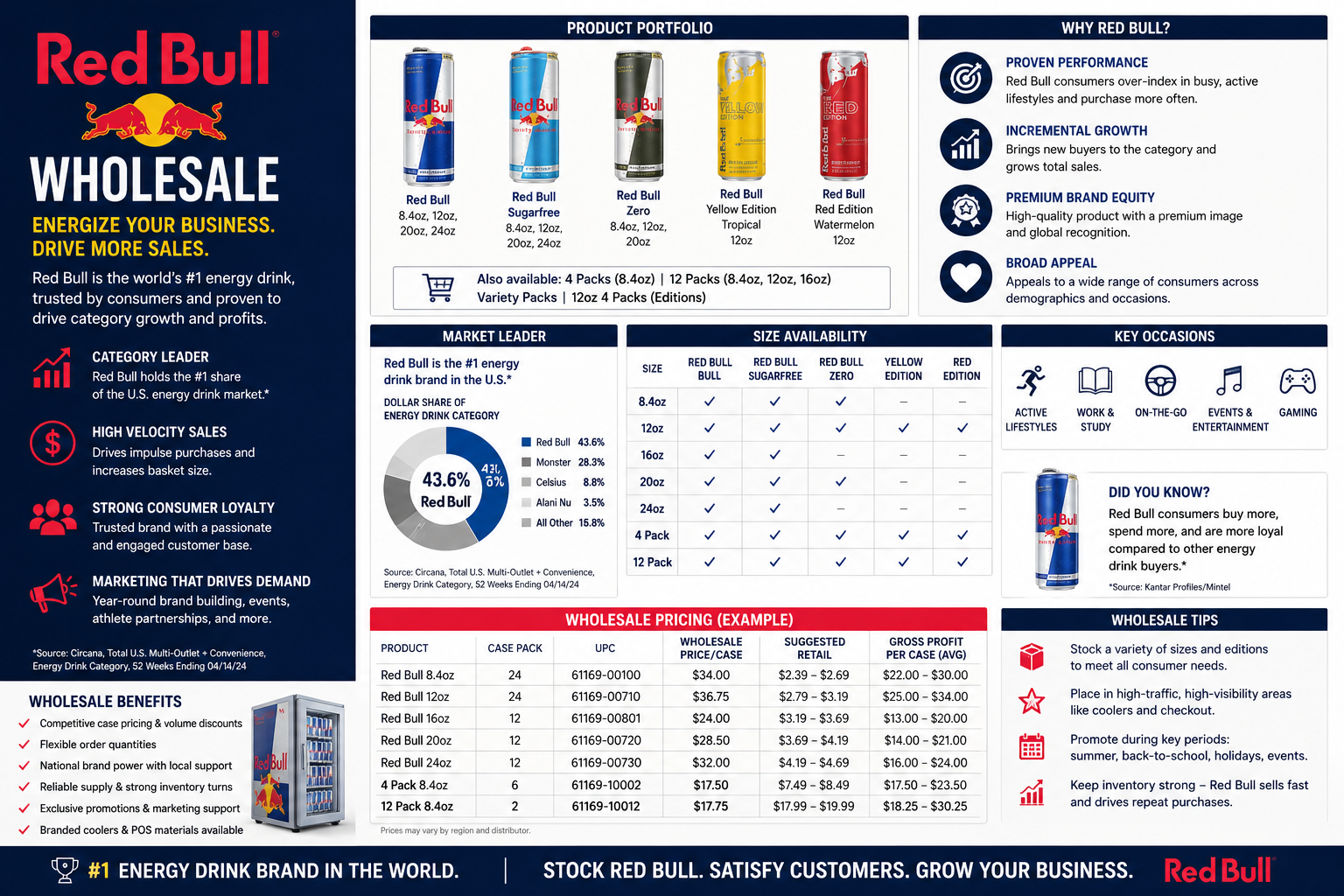

Red Bull carries some of the strongest brand equity in the global beverage market. Its 8.4oz original can is one of the most recognized single-serve beverage products sold in U.S. retail, and the brand’s premium positioning has held consistently for over two decades across convenience, gas, supermarket and vending channels. According to Grand View Research, the U.S. energy drink market reached approximately $25 billion in 2024, with Red Bull consistently holding one of the top brand positions by retail value. For commercial buyers, that positioning translates into a specific commercial reality: Red Bull moves at a higher retail price point than most competing energy drinks, supports stronger category margins and generates repeat purchasing from consumers who buy it by name rather than by category.
This guide covers Red Bull wholesale purchasing from a commercial buyer’s perspective. Which buyer types source Red Bull in volume, which product lines matter most for different retail environments, how the comparison table below helps buyers plan their SKU mix, how bulk, pallet and truckload formats compare and what to evaluate in a wholesale supplier. Buyers who want broader wholesale context can review the energy drink wholesale USA overview alongside this brand-specific guide.
Why Red Bull Is a Core Commercial Stocking Decision
Red Bull’s commercial position in U.S. retail is built on a combination of brand loyalty, premium pricing and broad demographic reach that makes it commercially distinct from most other energy drink brands. Where Monster Energy wins on volume and SKU breadth, Red Bull wins on brand equity per unit of shelf space and on premium margin contribution to the retailer’s beverage category.
A convenience store that stocks Red Bull Original alongside Monster is not simply offering variety. It is serving two distinct consumer types. The Monster buyer and the Red Bull buyer have overlapping demographics but different brand loyalties, and they tend not to substitute one for the other when their preferred product is unavailable. A Red Bull buyer who finds the shelf empty is as likely to leave without purchasing as they are to buy Monster instead. That loyalty dynamic is what makes Red Bull a non-negotiable stocking decision at most commercial retail locations, regardless of which other energy drink brands the operator carries.
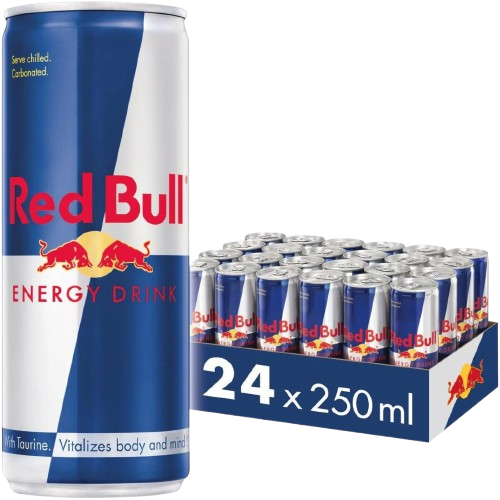
Red Bull’s compact 8.4oz slim can format is also commercially distinctive. It commands a higher per-ounce retail price than most 16oz competing formats, which contributes to stronger margin per transaction for the retailer. For vending operators in particular, Red Bull’s compact format fits standard machine slots efficiently and its premium price point improves revenue per vend compared with lower-priced alternatives.
Key commercial characteristics of Red Bull:
- Premium brand equity supporting stronger retail margins than most competing energy drink brands
- Strong consumer loyalty creating a buyer who does not substitute when the preferred product is unavailable
- Compact 8.4oz slim can format commanding a higher per-ounce price point than standard 16oz cans
- Broad demographic appeal spanning urban professionals, fitness consumers, students and habitual daily buyers
- Consistent year-round demand with particular strength in urban commuter, corporate and premium retail environments
- Growing portfolio of sugar-free and flavor editions serving consumer segments beyond the original formula
Who Buys Red Bull Wholesale?
Red Bull wholesale purchasing is concentrated among commercial buyers whose retail environments serve consumers with premium brand preferences and confirmed consistent Red Bull demand. Each buyer type has different operational requirements and different reasons for sourcing Red Bull in commercial volume.
Convenience Stores
Convenience stores are a primary commercial channel for Red Bull. The National Association of Convenience Stores reported that energy drinks led all packaged beverage categories in convenience retail dollar share in 2024, and Red Bull is consistently among the top-performing SKUs in that segment. The brand performs strongly in urban commuter locations, higher-income suburban stores and any convenience format where the customer base includes professional adults who associate Red Bull with their daily energy routine. Red Bull Original 8.4oz and Red Bull Sugarfree are typically the two baseline SKUs for any convenience store Red Bull assortment.
The convenience store energy drink trends guide covers channel-specific Red Bull purchasing and merchandising strategy in detail.
Gas Stations and Travel Centers
Gas stations serve commuters, professional drivers and travelers who purchase Red Bull as a functional beverage during fuel stops. Red Bull’s 12oz and 20oz formats tend to perform above the brand’s average at highway and travel center locations where consumers want more volume per purchase. The gas station beverage sales guide covers fuel retail Red Bull purchasing strategy specifically.
Supermarkets
Supermarkets carry Red Bull across refrigerated sections, multi-pack displays and promotional endcaps. The supermarket Red Bull purchase often involves multi-pack formats for home stocking, which affects which SKUs perform best in this channel. Red Bull Editions, the flavored line, tend to perform proportionally better in supermarket multi-pack formats than in single-serve convenience formats.
Vending Companies
Red Bull is among the strongest-performing energy drink brands in corporate workplace and university vending because its compact can format fits standard machine slots and its premium brand recognition enables fast purchase decisions. The vending machine beverage trends guide provides detailed guidance on Red Bull vending performance by location type.
Beverage Distributors
Regional beverage distributors source Red Bull to supply retail accounts across their territory. For distributors, Red Bull’s premium positioning creates margin opportunity at the distributor level because the higher retail price supports a pricing structure that works for both the distributor and the retailer. The T20 distributor program is designed for buyers managing multi-account distribution purchasing at this scale.
Popular Red Bull Product Lines
Red Bull’s product portfolio has expanded from a single SKU into a range covering original, sugar-free and flavored variants that serve different consumer segments within the energy drink category. Understanding which product lines serve which consumers helps commercial buyers build the right Red Bull assortment for their specific retail environment.
Common wholesale requests include:
- Red Bull Original (8.4oz, core volume driver across all commercial formats)
- Red Bull Sugarfree
- Red Bull Zero
- Red Bull Blue Edition
- Red Bull Red Edition
- Red Bull Yellow Edition
- Red Bull Green Edition
- Red Bull White Edition
- Red Bull Peach Edition
- Red Bull Purple Edition
Product availability may vary depending on market demand, seasonal editions and commercial inventory. Buyers should specify preferred SKUs and format requirements when requesting pricing.
Commercial buyers often stock multiple Red Bull product lines to serve the full range of customer preferences within their retail environment. The table below helps wholesale buyers compare the most common Red Bull variants by sugar content, typical retail channels and the commercial buyer types that most commonly source each line.
| Product | Sugar-Free | Typical Retail Channels | Common Commercial Buyers |
|---|---|---|---|
| Red Bull Original | No | Convenience Stores, Gas Stations, Supermarkets | Retailers, Distributors |
| Red Bull Sugarfree | Yes | Convenience Stores, Supermarkets, Vending | Retailers, Vending Operators |
| Red Bull Zero | Yes | Supermarkets, Convenience Stores | Retail Chains |
| Red Bull Editions | Varies | Convenience Stores, Supermarkets | Retailers, Beverage Distributors |
Benefits of Buying Red Bull Wholesale
Purchasing Red Bull through a wholesale program helps commercial buyers manage inventory more efficiently while supporting consistent product availability. Instead of placing frequent small orders, many retailers and distributors consolidate purchasing into scheduled wholesale orders that align with sales volume, storage capacity and replenishment cycles.
For businesses that sell Red Bull regularly, wholesale purchasing offers several operational advantages:
- Improved inventory planning with defined replenishment quantities tied to confirmed sell-through velocity
- More efficient procurement with fewer orders needed to maintain consistent stock levels
- Consistent product availability that supports habitual buyer retention at the retail level
- Scalable purchasing as business demand increases without changing supply partners
- Reduced ordering frequency freeing up administrative time for other operational priorities
- Better support for multi-location operations through centralized purchasing coordination
Whether supplying one store or an expanding retail network, structured Red Bull wholesale purchasing simplifies inventory management while supporting long-term operational efficiency. The U.S. Small Business Administration notes that small retailers who build consistent supplier relationships and manage inventory through planned purchasing cycles consistently outperform those who buy reactively. In the energy drink category, that principle applies directly to Red Bull, where supply consistency has a measurable effect on repeat customer retention.
Bulk, Pallet and Truckload Red Bull Orders
The right purchasing format depends on confirmed sales velocity, storage capacity, receiving infrastructure and whether the buyer manages one location or a multi-site operation. Most commercial buyers progress through these formats as their Red Bull volume grows.
Bulk Red Bull Orders
Bulk orders suit independent retailers, smaller convenience stores and buyers establishing their Red Bull wholesale relationship before committing to pallet quantities. Bulk purchasing allows a buyer to confirm Red Bull’s sell-through velocity at their specific location and build demand data before moving to the larger inventory commitment that pallet purchasing requires.
Bulk purchasing also suits seasonal demand management, where a buyer needs more Red Bull inventory than usual for a specific period but does not have the confirmed recurring demand to justify a standing pallet order.
Red Bull Pallet Orders
Pallet orders are the appropriate format for established commercial buyers with confirmed consistent Red Bull demand and the receiving infrastructure to handle a freight delivery. A convenience store with strong commuter traffic, a gas station on a busy transit route or a vending operator managing 20 or more machines in corporate environments are all candidates for Red Bull pallet purchasing once demand is confirmed.
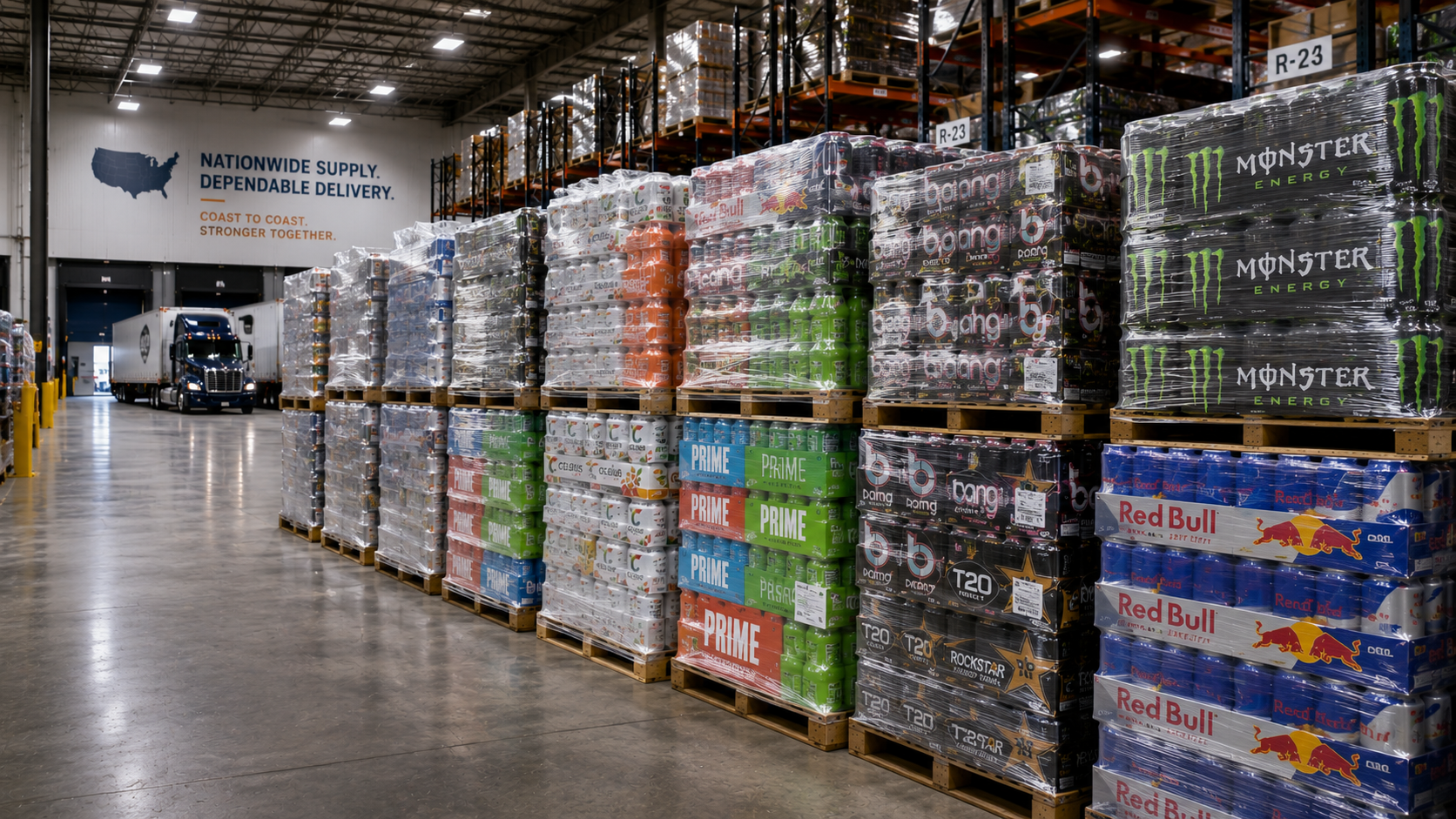
Buyers should note that Red Bull’s compact 8.4oz can format means pallet configurations may differ from standard 16oz energy drink pallets in terms of case count and unit count. Confirming the exact pallet specification before placing an order prevents surprises on delivery day. The energy drink pallet orders guide covers pallet receiving, logistics and planning considerations in detail.
Red Bull Truckload Supply
Truckload supply suits high-volume buyers with warehouse infrastructure, confirmed downstream demand and cash flow to support full trailer quantities. Regional distributors supplying Red Bull to multiple retail accounts, retail chains with central warehouse operations and large vending operators are the primary truckload Red Bull buyers. The per-unit economics at truckload volume are the most favorable available, but the planning and operational requirements are significantly greater than pallet purchasing.
How to Choose a Red Bull Wholesale Supplier
Red Bull’s premium positioning and strong consumer loyalty make supplier selection more consequential than it might be for a secondary or emerging brand. A consumer who specifically wants Red Bull and finds it unavailable at your location is likely to leave without purchasing rather than substitute. Supply disruptions on Red Bull have a measurable and direct impact on retail revenue and customer satisfaction.
When evaluating a wholesale supplier for Red Bull, these are the criteria that determine whether the relationship will actually support your business:
- Confirmed availability of Red Bull SKUs in the specific formats and can sizes your locations require
- Delivery capability to your location on a schedule that aligns with your reorder cycle and lead time requirements
- B2B commercial purchasing structure, not a consumer retailer offering bulk discounts on individual can orders
- Clear pallet specifications provided before orders are placed, including SKU composition, case count and total unit count
- Transparent communication about lead times, supply availability and any constraints affecting specific SKUs
- Ability to support bulk, pallet and truckload formats within the same supply relationship as your volume grows
- Experience supplying commercial buyers in your specific channel, whether convenience, vending, supermarket or distribution
Communication quality during the quotation process is the best predictor of service quality after the order is placed. A supplier who provides clear, specific answers to commercial questions before the first sale demonstrates the operational competence that matters most once inventory is in transit.
Inventory Planning for Red Bull
Red Bull’s premium price point and strong consumer loyalty make inventory management particularly important. A well-managed Red Bull inventory prevents the two most costly outcomes in commercial beverage retail: stockouts that drive loyal buyers to competitors, and excess inventory that ties up capital in product that moves more slowly than the reorder quantity assumed.
Effective Red Bull inventory planning for commercial buyers:
- Set reorder points based on confirmed weekly sell-through velocity by SKU and can size, not general market benchmarks or estimates
- Track Red Bull Original, Sugarfree and Editions separately since they serve different consumer segments and have different velocity profiles at most retail locations
- Implement FIFO rotation as a standard restocking procedure, placing new inventory behind existing stock so older product sells through first
- Plan inventory increases ahead of confirmed high-demand periods rather than reacting after demand has already peaked
- Review Red Bull Editions performance separately from core SKUs, since flavor editions have more variable sell-through rates that depend heavily on local consumer preference
- Align reorder timing with your supplier’s lead time so Red Bull inventory arrives before existing stock falls below the reorder threshold
According to Statista, per-capita energy drink consumption in the United States has grown consistently over the past decade, which means the demand underpinning a well-managed Red Bull inventory position is structural rather than cyclical. For multi-location operators, centralizing Red Bull purchasing across sites reduces administrative overhead, standardizes the product mix and typically improves per-unit economics through consolidated order volume.
Why Commercial Buyers Work With T20 Energy Drink USA LLC
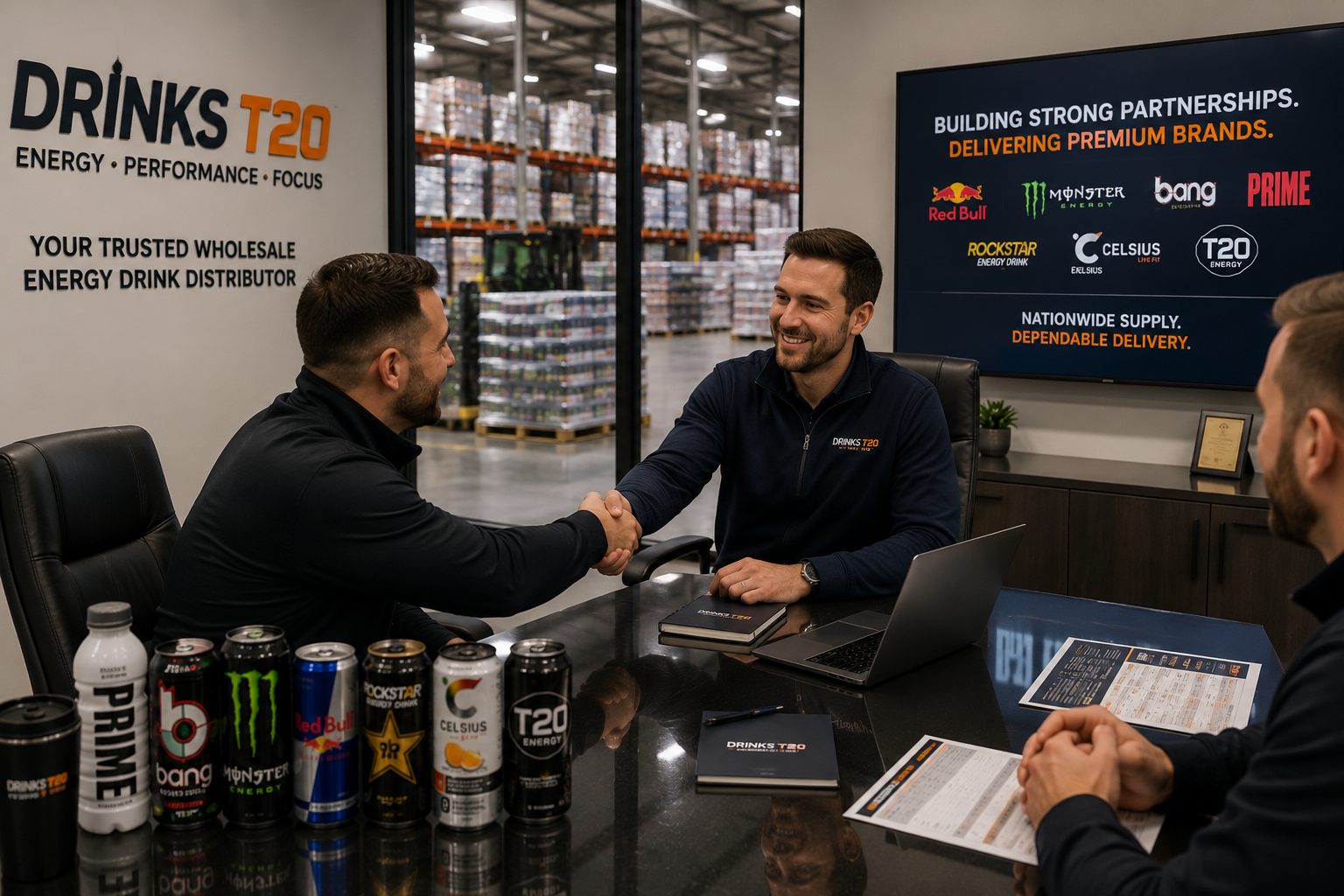
T20 Energy Drink USA LLC is a Margate, Florida-based wholesale energy drink supplier operating as a B2B commercial supply partner for buyers across the United States. The company’s purchasing process is structured for commercial accounts, which means Red Bull buyers interact with a supply process designed for business purchasing rather than one adapted from a consumer retail model.
T20 supports Red Bull buyers at every commercial purchasing scale. New accounts can begin with bulk orders to confirm demand and establish the supply relationship before committing to larger volume. Established buyers with confirmed Red Bull velocity can access pallet supply. High-volume distributors and multi-location operators can request truckload pricing. The distributor program supports buyers managing multiple downstream retail accounts.
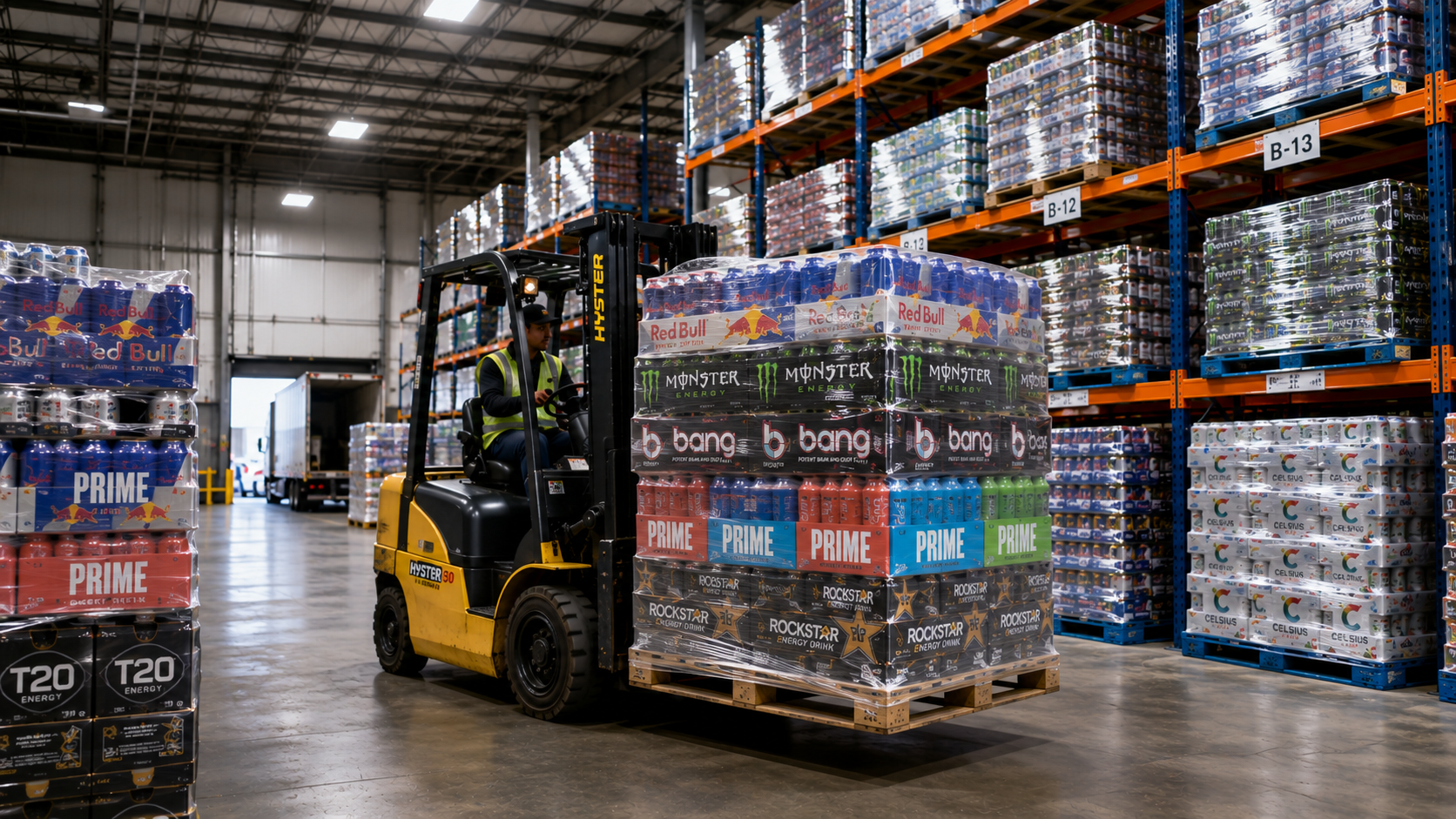
T20 also supplies a broad range of energy drink brands beyond Red Bull, including Monster Energy, Celsius, Prime Energy, Rockstar and Bang. Buyers who want to consolidate energy drink wholesale purchasing across multiple brands can explore the full energy drink wholesale offering.
Commercial customers T20 works with include convenience stores, gas stations, supermarkets, vending companies and beverage distributors. Each pricing request is reviewed against the buyer’s product requirements, order volume and delivery destination.
How the Wholesale Ordering Process Works
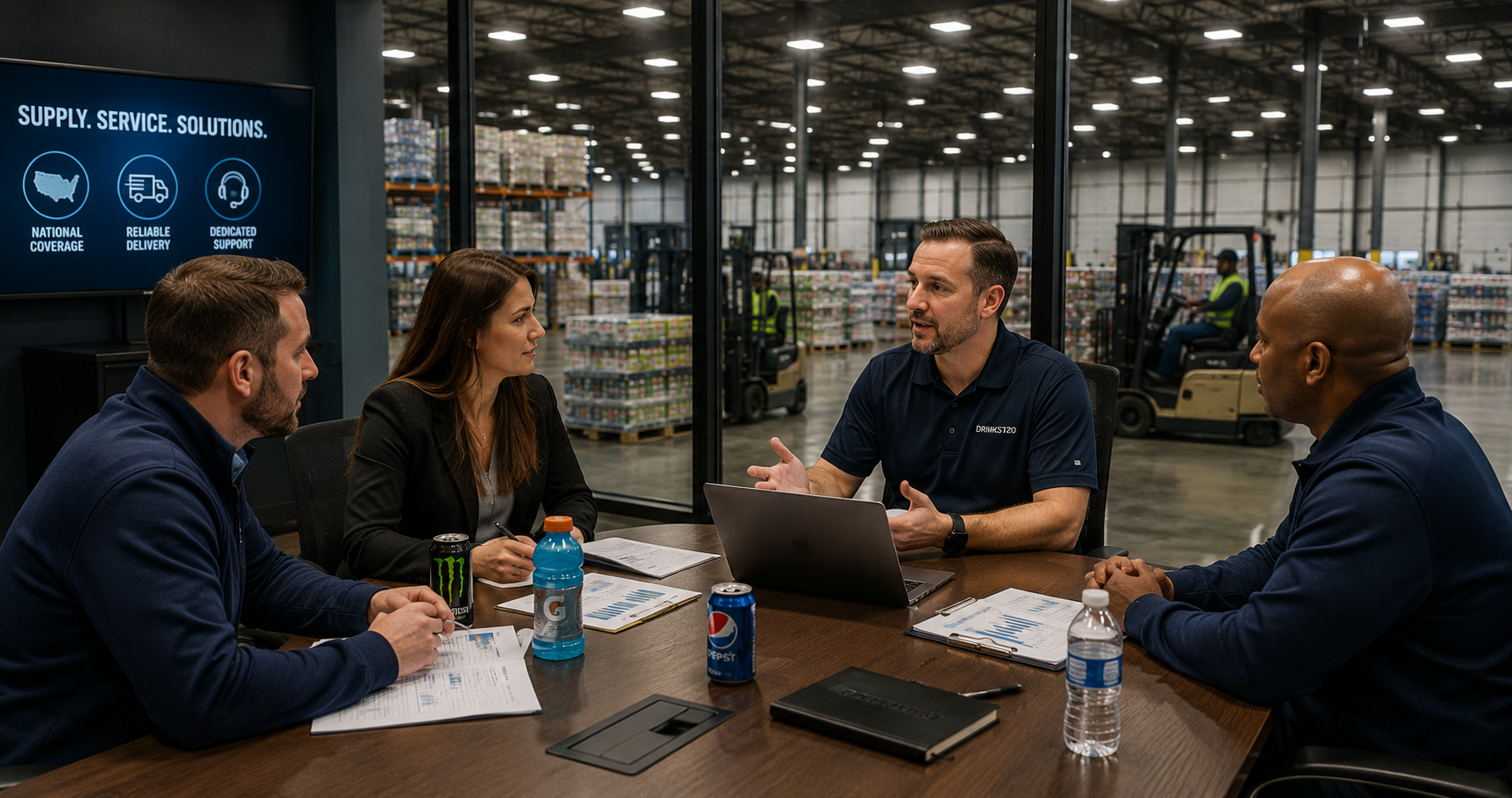
The T20 purchasing process is built for commercial buyers, not consumer transactions. Here is how it works:
- Submit a wholesale pricing request through the Request Pricing page
- Specify your preferred Red Bull products, SKUs and can formats
- Provide your estimated purchasing volume and order frequency
- Share your delivery location and receiving requirements
- Receive a customized wholesale quotation reflecting your specific commercial requirements
- Review, confirm and coordinate delivery timing
- Establish ongoing supply requirements for future orders
This process produces a quotation that reflects the buyer’s actual purchasing situation rather than a generic rate that may not apply to their order volume, product mix or delivery location.
Request Red Bull Wholesale Pricing
T20 Energy Drink USA LLC supplies Red Bull and other leading energy drink brands to commercial buyers across the United States. Submit your preferred SKUs, can formats, estimated order volume, delivery location and business type to receive a customized wholesale quotation from the T20 team.
Frequently Asked Questions About Red Bull Wholesale
Can commercial businesses buy Red Bull wholesale?
Yes. Convenience stores, gas stations, supermarkets, vending operators, beverage distributors and retail chains all purchase Red Bull through commercial wholesale suppliers. Wholesale purchasing is structured for business accounts buying inventory for resale or commercial use rather than consumer-level purchasing.
Which Red Bull products are most commonly purchased wholesale?
Red Bull Original 8.4oz is the highest-volume SKU at most commercial retail locations. Red Bull Sugarfree is the most commonly requested sugar-free option and performs strongly across convenience, supermarket and vending channels. Red Bull Zero appeals to buyers serving calorie-conscious consumer segments. Red Bull Editions provide flavor variety that tends to perform proportionally better in supermarket multi-pack formats than in single-serve convenience settings.
What is the difference between bulk, pallet and truckload Red Bull purchasing?
Bulk orders suit buyers confirming Red Bull demand or managing moderate consistent volume without pallet-level commitment. Pallet orders suit established commercial buyers with confirmed consistent velocity and freight receiving capability. Truckload supply suits high-volume distributors and retail chains with central warehouse infrastructure and confirmed downstream demand. Most buyers progress through these formats as their Red Bull volume grows.
How does Red Bull’s can format affect pallet ordering?
Red Bull’s 8.4oz slim can is smaller than the standard 16oz energy drink can used by most competing brands. This means pallet configurations for Red Bull may differ from standard energy drink pallet case counts. Buyers should confirm the exact pallet specification, including SKU composition, case count and total unit count, with their supplier before placing a pallet order.
How do I choose the right Red Bull wholesale supplier?
Prioritize confirmed availability of Red Bull SKUs in the formats you need, delivery capability on your reorder schedule, transparent lead times and communication, and a B2B purchasing structure designed for commercial accounts. Red Bull’s strong consumer loyalty means supply disruptions have a direct and measurable impact on retail revenue, which makes supplier reliability more important than marginal price differences.
Does T20 Energy Drink USA LLC supply other energy drink brands alongside Red Bull?
Yes. T20 supplies multiple major energy drink brands including Monster Energy, Celsius, Prime Energy, Rockstar and Bang alongside Red Bull. Buyers who want to consolidate energy drink wholesale purchasing across multiple brands through a single commercial supplier can submit their full brand requirements through the Request Pricing page.