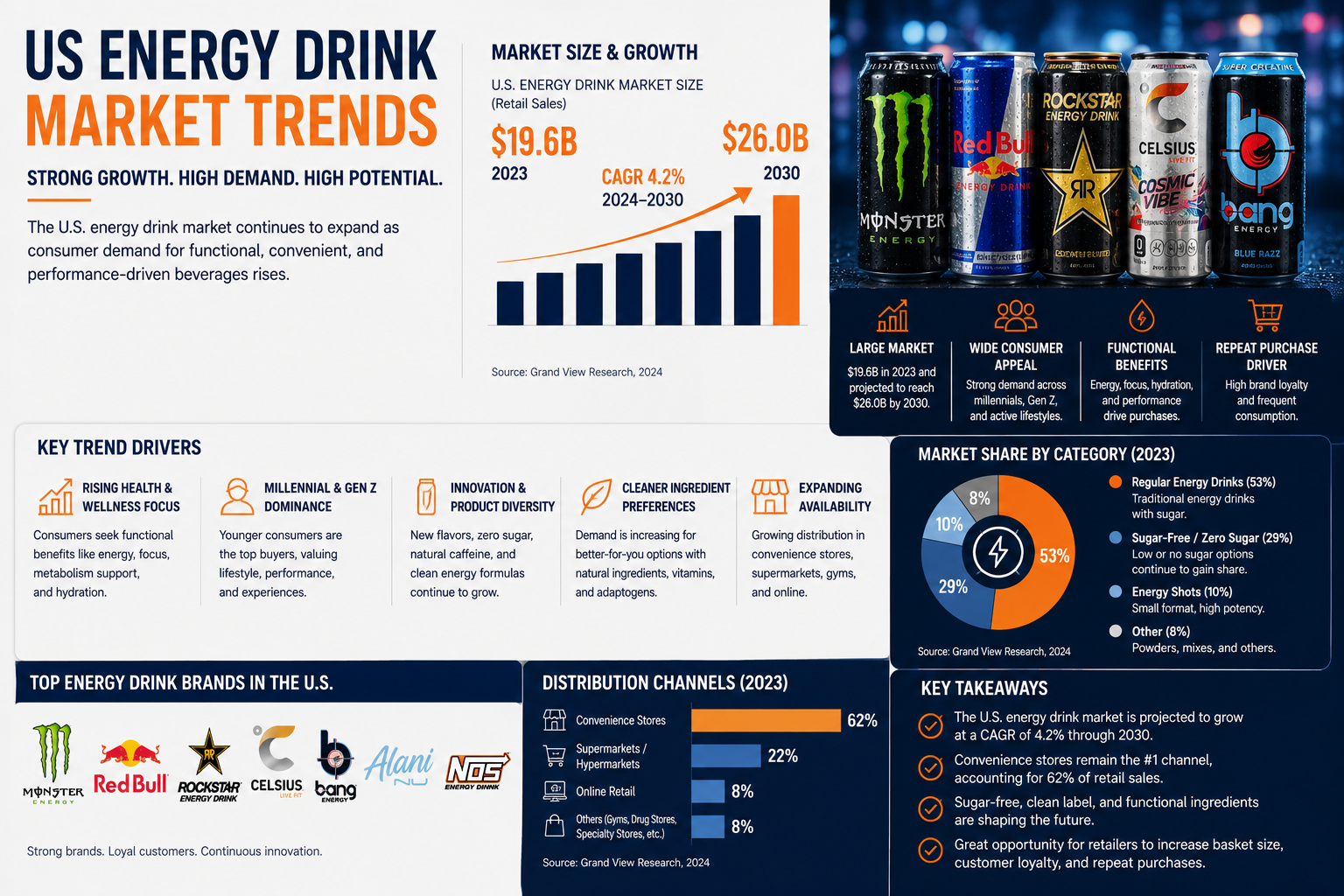

The U.S. energy drink market has moved well past the growth stage. It is a mature, large-scale category with confirmed consumer demand across demographics, retail formats and consumption occasions that were not part of the original market picture when Monster and Red Bull were establishing the category in the early 2000s. The category now generates tens of billions of dollars in annual sales, distributes through more commercial channels than any other functional beverage segment and continues to attract product innovation from both established manufacturers and new entrants with functional, clean-label or lifestyle-oriented positioning.
For commercial buyers, wholesalers, distributors and retailers operating in this market, the question is not whether energy drinks are worth carrying. The market has answered that definitively. The more useful questions are about how the category is evolving, which consumer trends are reshaping demand, which retail channels are growing fastest, and what that means for wholesale purchasing strategy, inventory planning and supplier selection over the next several years.
This report draws on publicly available industry research, retail trend data and wholesale market observations to provide commercial buyers with a practical analysis of where the U.S. energy drink market stands in 2026 and what the near-term trajectory looks like. Buyers who want to act on what they read here can review the energy drink wholesale USA overview for purchasing-specific guidance.
Market Size and Growth: Where the Category Stands
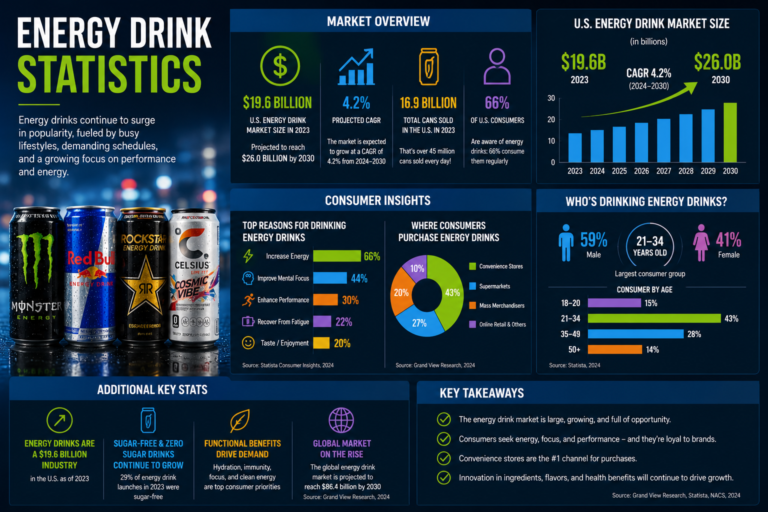
The U.S. energy drink market reached approximately $25 billion in retail sales in 2024, according to Grand View Research, with a projected compound annual growth rate that places the category among the strongest-performing segments in packaged beverages through 2030. That growth trajectory has been consistent for over a decade despite periodic predictions that the category was approaching saturation, which have consistently proven premature.
The National Association of Convenience Stores reported that energy drinks accounted for 27.8% of all packaged beverage category dollars in U.S. convenience stores in 2024, making energy drinks the largest single packaged beverage segment in the highest-frequency retail format in the country. That figure alone communicates the commercial weight of the category in ways that general market size estimates do not fully capture.
According to Statista, the per-capita consumption of energy drinks in the United States has increased consistently over the past decade, with the growth coming not only from existing consumers buying more but from new demographic segments entering the category that previously did not purchase energy drinks. This demographic expansion is one of the structural reasons the category has outperformed most growth forecasts made five years ago.
For commercial buyers, these numbers have a direct operational implication. A category generating this level of revenue across this many retail channels with this demographic breadth is not a niche opportunity. It is a core commercial category that requires serious purchasing strategy, reliable supply relationships and active inventory management to capture effectively.
What Is Driving Market Growth in 2026
Understanding the specific drivers behind energy drink market growth is more useful for commercial buyers than citing aggregate growth figures. The drivers determine which products are growing, which channels are capturing more volume and which consumer segments are entering the category, all of which affect purchasing decisions at the retail and wholesale level.
Lifestyle alignment with consumption occasions is the most durable growth driver. Energy drinks are purchased across a wider range of daily situations than any other functional beverage. Morning commutes, workplace afternoons, pre-workout sessions, study sessions, overnight shifts, long drives and post-lunch energy dips all generate purchase occasions. A beverage that serves this many functional moments throughout the day across this many consumer types has a structural demand advantage over categories tied to specific occasions.
Demographic expansion has driven category volume beyond the original base of younger male consumers. The energy drink buyer in 2026 is as likely to be a 35-year-old professional commuting to an office, a 50-year-old truck driver on an interstate route or a 28-year-old fitness enthusiast managing macros as they are to be the 19-year-old male consumer the category was originally built around. This broadening has added volume without cannibalizing the existing base.
Product innovation has sustained consumer interest in ways that prevent the category from stagnating. New flavors, sugar-free extensions, functional positioning and clean-label formulations give existing consumers reasons to try new products and give new consumers a product within the category that fits their preferences better than the traditional formats that may have deterred them previously.
Distribution expansion has put energy drinks in front of consumers in commercial environments where they were not previously available. Corporate workplace vending, hospital and healthcare facility channels, fitness center retail, travel center coolers and e-commerce delivery have all added purchase occasions that did not exist at meaningful scale five years ago.
Key market drivers commercial buyers should monitor:
- Continued demographic broadening beyond the category’s original core consumer
- Growth of functional and sugar-free formats attracting previously non-purchasing consumer segments
- Distribution expansion into non-traditional channels creating new volume opportunities
- Product innovation from both established brands and new entrants maintaining consumer engagement
- Consistent year-round demand across most retail formats, reducing seasonal revenue risk
- Strong brand loyalty among established consumers supporting predictable repurchase behavior
How Consumer Preferences Are Reshaping the Category
The consumer profile for energy drinks in 2026 is meaningfully different from what it was in 2015, and understanding those changes is directly relevant to product mix decisions at the retail and wholesale level.
Sugar reduction has moved from a health trend to a mainstream consumer expectation. Consumers across age groups and income levels are reducing sugar intake, and the energy drink category has responded with a range of zero-sugar and reduced-calorie options that have driven significant incremental volume. Monster Ultra, Red Bull Sugarfree and the full Celsius range have all demonstrated that sugar-free energy drinks are not a niche within the category. They are a mainstream segment with their own loyal consumer base and their own growth trajectory.
Functional positioning has expanded who considers energy drinks relevant. Celsius has been the most commercially successful example of this shift, growing from specialty fitness distribution into mainstream convenience, supermarket and vending channels by targeting a consumer who previously did not purchase energy drinks because the traditional format did not align with their lifestyle or nutritional preferences. Its success has validated the functional positioning approach and encouraged other brands to develop similar offerings.
Flavor innovation drives trial and repeat purchase even among consumers who are already loyal to a brand. Limited-edition releases, seasonal flavors and line extensions from Monster, Red Bull and other major brands consistently generate purchase behavior from consumers who already buy the brand regularly. For retailers and vending operators, this means that variety within a brand family is commercially valuable, not just a nice-to-have.
Premium positioning has gained traction as the consumer base has broadened to include higher-income professionals who expect quality ingredients, distinctive packaging and brands that align with their self-image. This trend has created space for premium-priced energy drink products that would not have found sufficient consumer demand in the original category demographics.
Consumer preference trends with direct implications for commercial buyers:
- Sugar-free and zero-calorie formats should now be treated as a core category requirement, not an optional addition to any retail or vending assortment
- Functional energy drinks serve a distinct consumer segment that traditional formats do not capture, making mixed-format assortments more commercially effective than single-format selections
- Flavor variety within core brands drives incremental purchase frequency from existing brand loyalists
- Premium positioning creates margin opportunity in channels serving higher-income consumer demographics
Retail Channel Analysis: Where Energy Drink Volume Is Being Generated
Understanding which retail channels drive energy drink volume and how that distribution is evolving is essential context for any commercial buyer making wholesale purchasing decisions. The channel mix affects which brands perform at each location type, what inventory depth is appropriate and how wholesale purchasing should be structured.
Convenience Stores Lead the Category
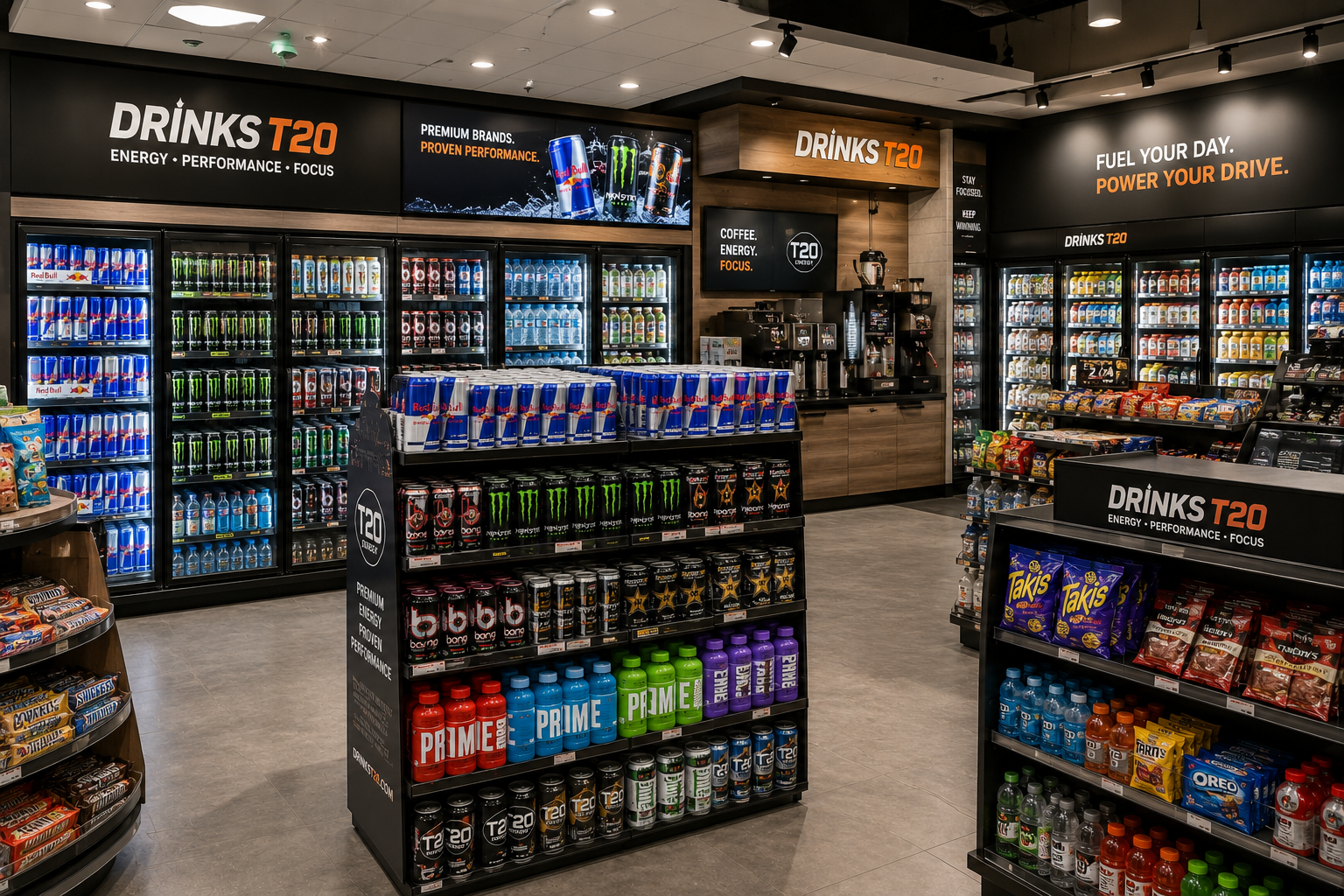
Convenience stores are the single largest retail channel for energy drink sales in the United States by a significant margin. The NACS 27.8% category dollar share figure cited earlier understates the channel’s importance when you consider that convenience stores also generate more transactions per square foot than any other retail format, which makes their energy drink velocity per door among the highest of any channel.
The convenience store energy drink purchase is characterized by high frequency, strong brand loyalty, significant impulse conversion and consistent year-round demand. Commuters, professional drivers, shift workers and regular daily shoppers all contribute to a purchase pattern that generates reliable repeat volume for operators who stock the right brands and maintain availability consistently.
For wholesale buyers supplying convenience retail, the operational implication is that supply continuity is the primary requirement. A convenience store that runs out of its top energy drink SKU loses sales that do not come back when the product is restocked. The demand was present and unfulfilled. Buyers at this level should plan their wholesale purchasing around maintaining a continuous inventory position, not a reactive replenishment model.
Operators in this channel can review the detailed convenience store energy drink trends guide for channel-specific purchasing and merchandising guidance.
Gas Stations and Travel Centers Drive Functional Demand
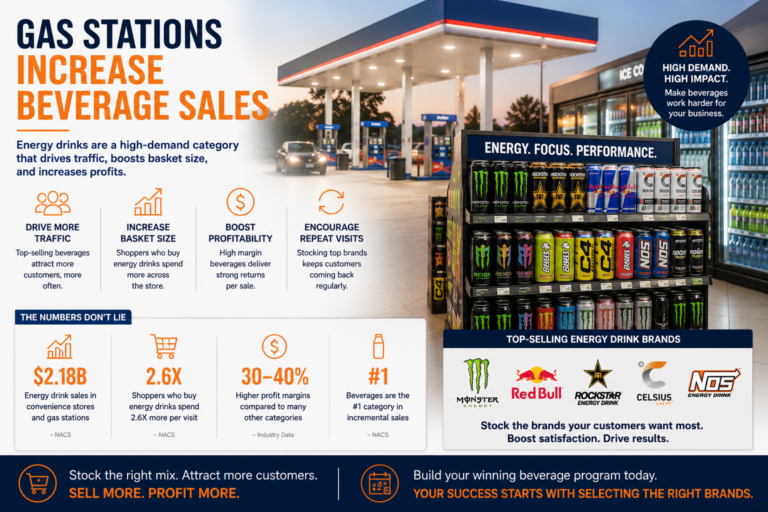
Gas stations and travel centers serve consumer segments with among the highest energy drink purchase frequency in any retail format. Professional drivers, long-distance travelers, commuters and delivery workers are all high-frequency buyers whose purchase motivation is functional and habitual rather than exploratory or occasion-specific.
The consistent traffic patterns at fuel retail locations, morning commuter peaks, afternoon drive-time waves, overnight trucking stops, create multiple daily purchase windows that generate reliable energy drink revenue for operators who maintain stock. Highway corridor and travel center locations in particular represent some of the highest per-door energy drink velocity in U.S. retail.
As non-fuel gross profit has become the primary financial focus for most fuel retail operators, beverage category management has received more strategic attention than it did when fuel margin was the dominant revenue driver. This has created more sophisticated wholesale purchasing behavior among fuel retailers who previously managed beverages as a secondary category.
The gas station beverage sales guide covers channel-specific purchasing strategy, merchandising and inventory planning for fuel retailers in detail.
Vending Machines Expand Distribution Into Non-Traditional Environments
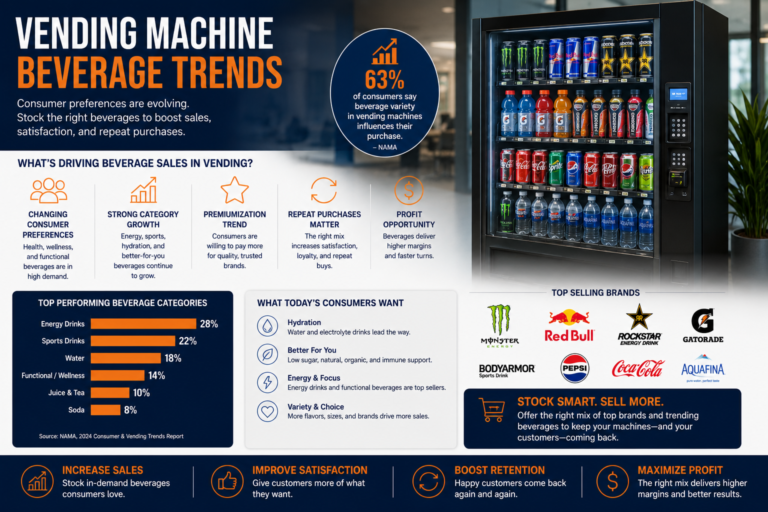
The vending channel has been one of the quieter but commercially significant growth areas for energy drink distribution over the past five years. Workplace vending modernization, cashless payment adoption, real-time inventory monitoring technology and the broadening of the energy drink consumer base into office, healthcare and educational environments have all contributed to meaningful category growth in vending.
Modern vending machines equipped with cashless payment, remote monitoring and digital displays are performing at higher revenue per machine than the previous generation of equipment, which has encouraged operators to invest in product mix optimization rather than treating vending as a passive distribution format. Energy drinks have benefited from this shift because they represent higher unit price points than most traditional vending beverages and generate consistent demand from the professional and institutional consumer segments that workplace and campus vending primarily serves.
The vending machine beverage trends guide provides detailed channel-specific analysis for vending operators managing energy drink assortments across distributed machine networks.
Supermarkets Reflect Broader Consumer Trends
Supermarkets play a different role in energy drink distribution than convenience or fuel retail. The supermarket energy drink purchase is more likely to involve multi-pack formats, home consumption and planned purchasing rather than immediate single-serve consumption. This distinction affects which products perform at the supermarket level, how they are merchandised and what promotional strategies drive category performance.
Supermarkets have expanded refrigerated beverage sections and energy drink shelf space in response to consumer demand, and the category’s performance in this channel has benefited from the same functional and sugar-free trends driving growth elsewhere. The Celsius emergence in mainstream supermarket distribution is one of the clearest recent examples of a functional energy drink moving from specialty channels into full grocery distribution on the strength of consumer demand rather than promotional placement alone.
The Rise of Functional Energy Drinks
The functional energy drink segment deserves specific analysis because it represents the most significant structural change in the category over the past five years. Celsius’s market performance has been the headline story, but the broader shift toward functional, clean-label and wellness-positioned energy beverages reflects a genuine change in consumer expectations that is reshaping both the product landscape and the retail positioning of the category.
Functional energy drinks differ from traditional formats primarily in their ingredient positioning and consumer targeting rather than their functional effect. A consumer who purchases Celsius is buying an energy drink positioned around thermogenics, active lifestyle alignment and cleaner ingredient panels. A consumer who purchases Monster Original is buying caffeine, flavor and brand identity. Both are energy drinks. The consumer decision to choose one over the other reflects lifestyle alignment as much as product performance.
For retailers and distributors, the practical implication is that the energy drink cooler or vending section should now be planned as serving two distinct consumer types. Carrying only traditional formats misses the functional consumer. Carrying only functional formats misses the core traditional energy drink buyer. A well-planned assortment serves both segments within the same physical space, capturing a wider share of available category revenue.
Brand Competition and Product Innovation
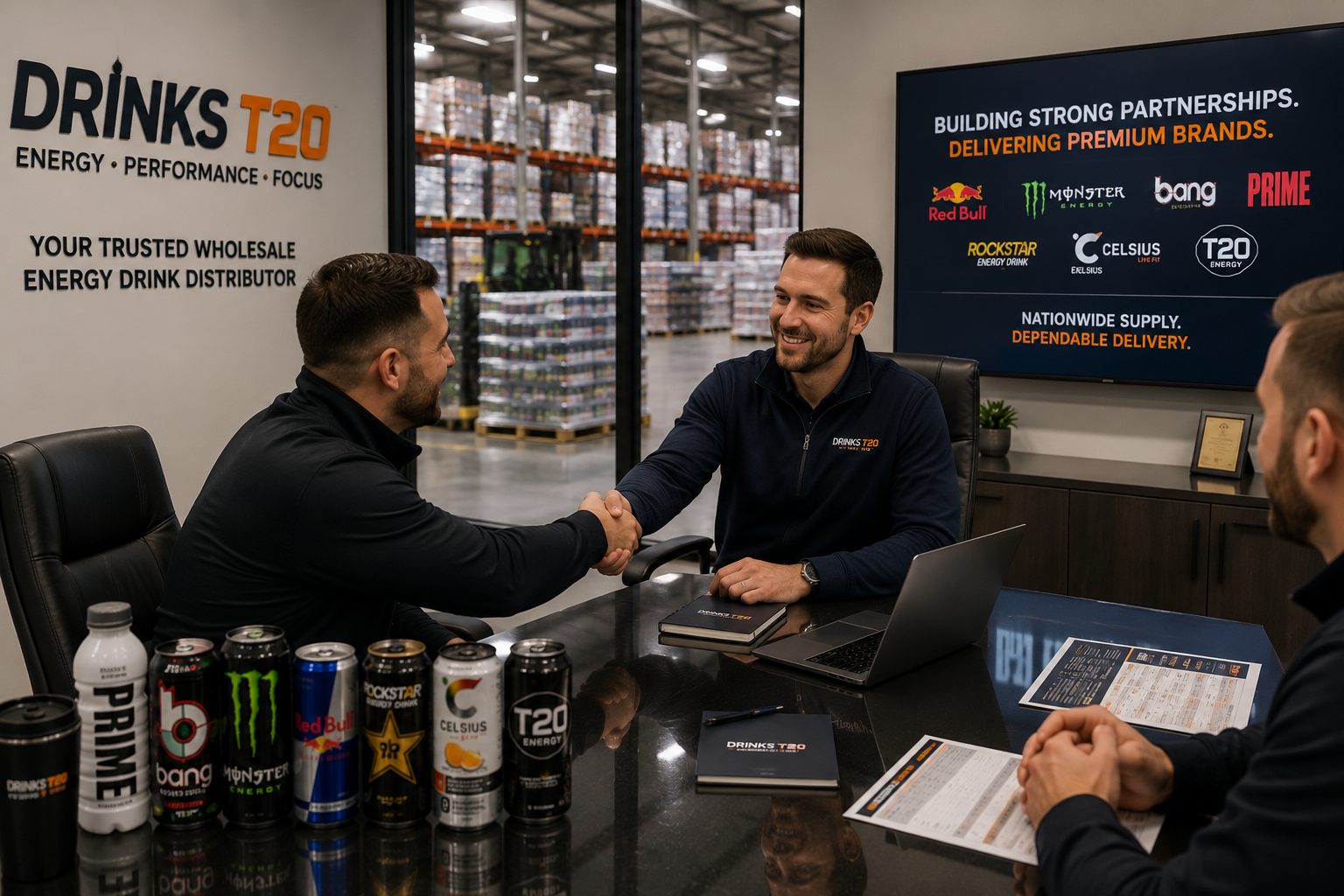
The U.S. energy drink market remains one of the most competitive packaged beverage categories in terms of brand activity, new product introduction and marketing investment. Monster and Red Bull maintain dominant market positions, but both continue to invest heavily in line extensions, flavor innovation and format experimentation. Celsius has established a third major brand position in mainstream distribution. Prime Energy has demonstrated that a new brand with the right cultural positioning can achieve significant retail presence quickly.
Commercial buyers managing energy drink assortments should think about brand competition as an asset rather than a complication. A competitive market means more product innovation, more consumer engagement and more reasons for existing buyers to try new products within the category. Each new SKU from a major brand is an opportunity for retailers to generate trial purchasing alongside their core volume drivers.
The brands that commercial buyers most commonly request and distribute:
- Monster Energy: Broadest SKU range, strongest convenience and gas retail performance, core volume driver across most commercial channels
- Red Bull: Premium positioning, strongest brand equity per dollar of shelf space, consistent performer in urban and corporate environments
- Celsius: Functional positioning, fastest growth trajectory among major brands, strongest in fitness, corporate and campus channels
- Prime Energy: Strong performance in youth-oriented and campus retail environments
- Rockstar Energy: Value-accessible positioning, useful for price-sensitive accounts and variety-oriented retail sets
- Bang Energy: High-caffeine positioning with a fitness-oriented consumer base
What Market Trends Mean for Wholesale Purchasing Strategy
The market trends described in this report have direct implications for how commercial buyers should approach wholesale energy drink purchasing. Market growth is not uniformly distributed. It is concentrated in specific consumer segments, specific product formats and specific retail channels. A buyer who understands where the growth is coming from makes better purchasing decisions than one who responds only to aggregate market statistics.
The shift toward sugar-free and functional formats means that wholesale buyers who stock only traditional high-caffeine formats are not capturing the full revenue opportunity available in the category at their retail locations or distribution accounts. Adding two or three sugar-free and functional SKUs alongside core traditional brands is a straightforward way to serve a broader consumer base without adding significant complexity to the purchasing or inventory management process.
The broadening of the consumer base means that the right product mix varies more by location type than it did when the category was more demographically concentrated. A vending operator who stocks the same energy drink mix in a hospital machine as in a manufacturing facility machine is under-serving both. Location-specific product selection is more important now than at any previous point in the category’s development.
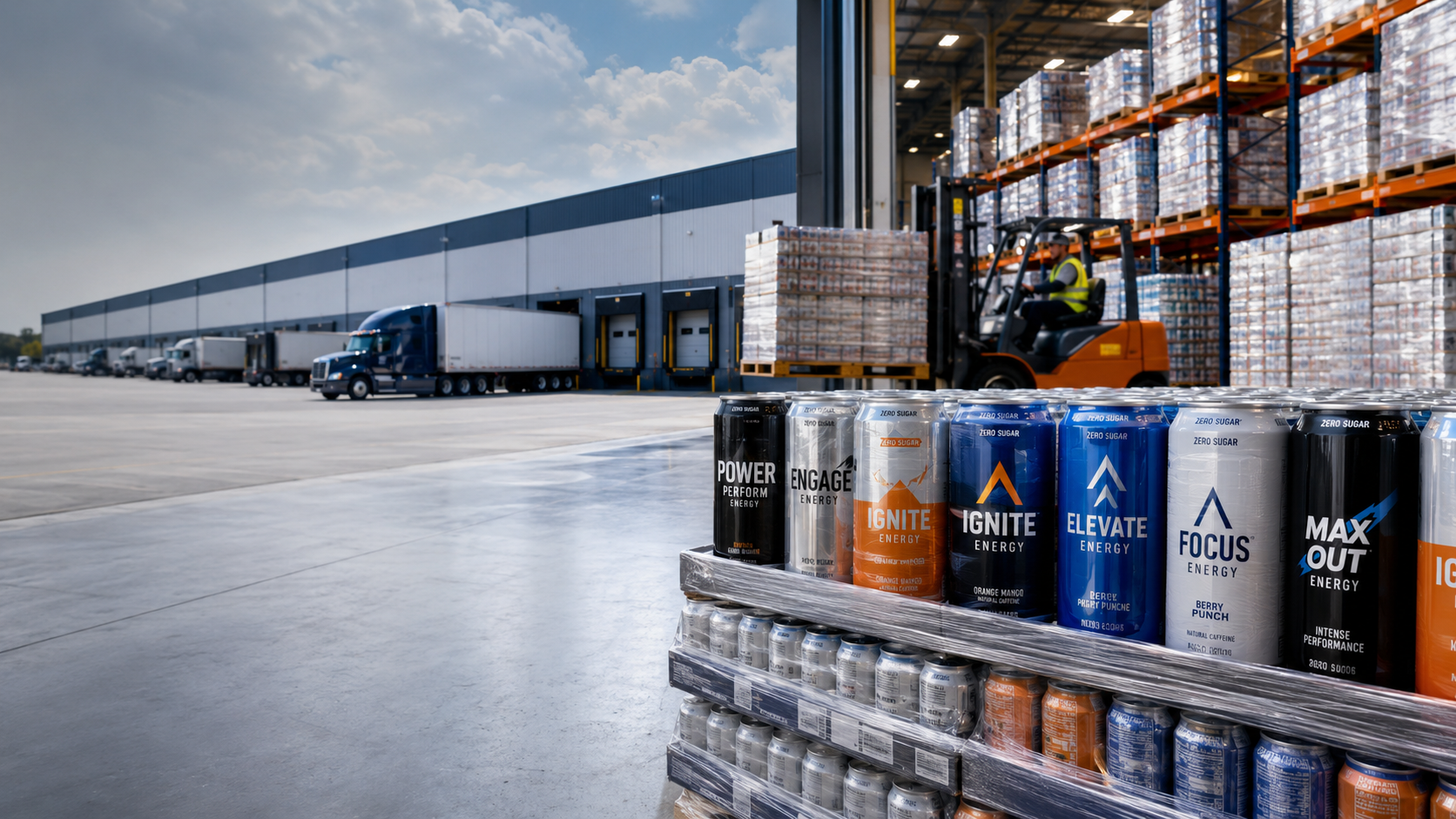
The growth of wholesale purchasing programs reflects a broader professionalization of energy drink procurement across commercial buyer types. Retailers, vending operators and distributors who have moved from reactive case-by-case purchasing to planned bulk, pallet or truckload programs consistently report better inventory performance, lower per-unit costs and more predictable supply than those still managing purchasing on an as-needed basis.
Wholesale Purchasing Formats and When Each Applies
The progression from bulk to pallet to truckload purchasing mirrors the natural growth trajectory of most commercial energy drink buyers. Understanding when each format is appropriate helps buyers align their purchasing structure with their actual operational stage rather than either overcommitting to volume they cannot move or underbuying in a way that creates unnecessary stockout risk.
Bulk orders are the entry point for commercial buyers establishing a wholesale relationship, testing new brands or building demand data before committing to larger volume. Bulk purchasing provides commercial pricing and product access with the flexibility to adjust quantities as demand patterns become clearer.
Pallet orders are the workhorse format for established commercial buyers with confirmed demand and adequate receiving infrastructure. Convenience stores, gas stations, vending operators and regional distributors with consistent weekly energy drink turnover typically find pallet purchasing more efficient than frequent bulk reordering. Better per-unit economics, fewer delivery events and more organized warehouse management are the primary benefits.
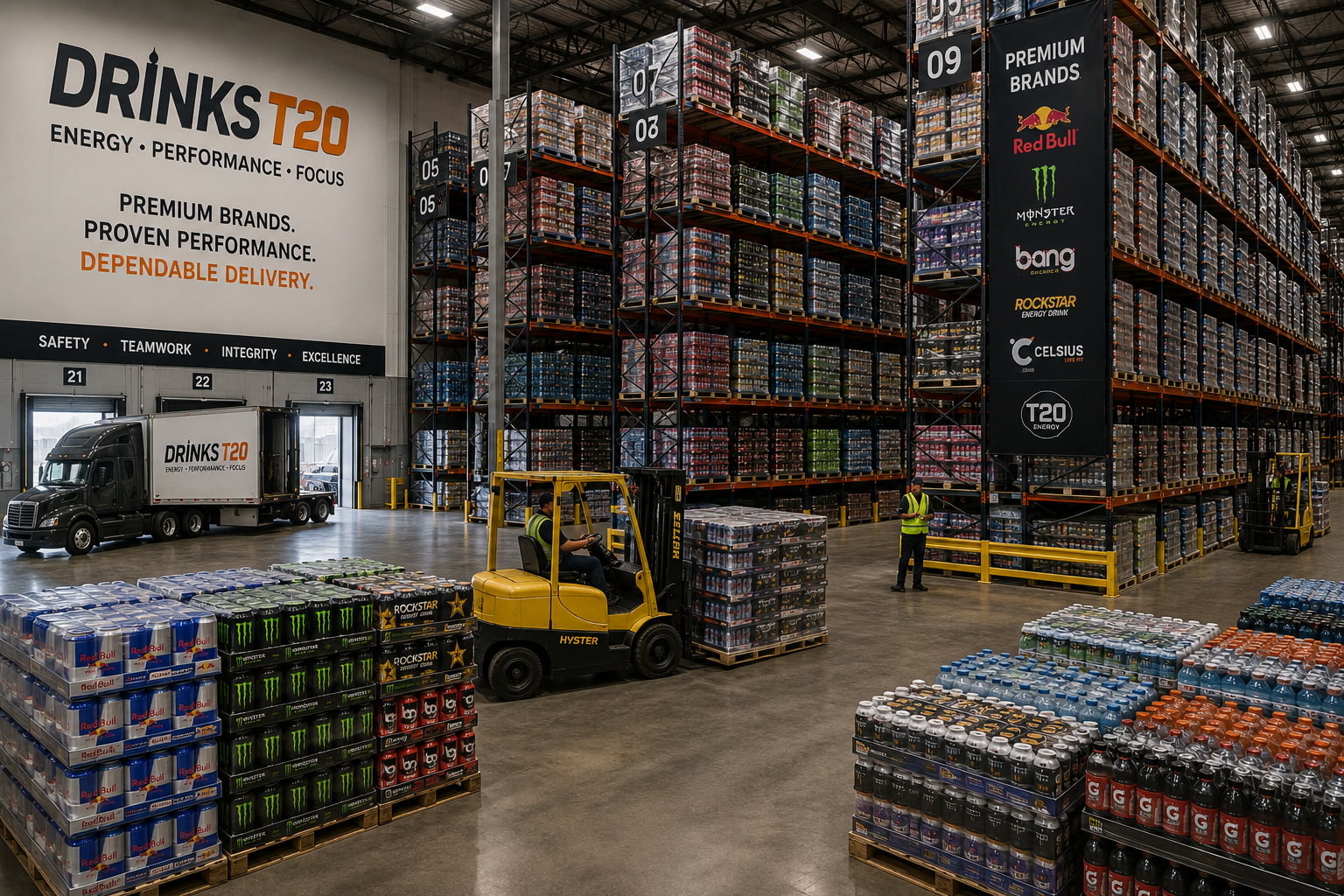
Truckload supply is for high-volume buyers with the warehouse infrastructure, confirmed downstream demand and cash flow to support full trailer quantities. Regional distributors, retail chains with central warehouse operations and large-scale vending operators managing extensive machine networks are the primary truckload buyers. The per-unit economics are the most favorable at this scale, but the planning and operational requirements are significantly greater.
Buyers can also explore the distributor program for supply structures designed specifically for buyers managing multiple downstream accounts.
The Five-Year Outlook for the U.S. Energy Drink Market
Projecting specific market outcomes five years forward is speculative in any category. What is more useful for commercial buyers is understanding the structural trends that are likely to continue shaping the U.S. energy drink market regardless of which specific brands or products lead each segment.
Sugar-free and functional formats will continue to grow as a share of total category volume. The consumer behavior driving this shift, awareness of sugar intake, interest in clean-label ingredients, lifestyle alignment with wellness and fitness, is not a trend that reverses. Retailers and distributors who build their product mix around a combination of traditional and functional formats are better positioned for this shift than those who maintain a traditional-only assortment.
Distribution will continue to expand into non-traditional channels. Corporate workplace programs, institutional vending, e-commerce delivery and emerging retail formats all represent incremental distribution opportunities that add category volume without competing with existing convenience or grocery channel sales.
Data-driven purchasing will become more standard across commercial buyer types. Retailers and vending operators who currently manage inventory by intuition or habit will face competitive pressure from buyers who use point-of-sale data to optimize assortments, reduce stockouts and improve replenishment timing. The technology required to do this is increasingly accessible to smaller operators, not just large chains.
Brand competition will remain intense, which benefits commercial buyers through continued innovation and consumer engagement. New product introductions, limited editions and format expansions from major brands give retailers reasons to refresh their assortments and give consumers reasons to keep engaging with the category.
Key developments commercial buyers should watch over the next five years:
- Sugar-free and functional format share of total category volume continuing to increase
- Distribution expansion into workplace, institutional and non-traditional channels adding incremental volume
- Data-driven inventory management becoming standard practice across commercial buyer types
- Brand competition driving continued product innovation and consumer engagement
- Wholesale purchasing program adoption growing as buyers professionalize procurement
- Premium positioning gaining traction in channels serving higher-income consumer demographics
Why Commercial Buyers Work With T20 Energy Drink USA LLC
T20 Energy Drink USA LLC is a Margate, Florida-based wholesale energy drink supplier serving commercial buyers across the United States. The company works with convenience stores, gas stations, supermarkets, vending operators, beverage distributors and retail organizations that need dependable wholesale energy drink supply structured for commercial purchasing rather than consumer transactions.
T20 supports buyers at every purchasing scale through bulk orders, pallet supply and truckload purchasing within the same supply relationship. The distributor program supports buyers managing multiple downstream accounts. Every pricing request is reviewed against the buyer’s stated product requirements, order volume, delivery destination and business context to produce a quote that reflects their actual commercial situation.
Request Wholesale Energy Drink Pricing
Whether you are expanding a retail business, managing a distribution network or sourcing inventory for multiple commercial locations, T20 Energy Drink USA LLC provides dependable wholesale energy drink supply across the United States. Submit your product requirements, preferred brands, estimated volume and delivery location to receive a customized wholesale quotation from the T20 team.
Frequently Asked Questions About U.S. Energy Drink Market Trends
How large is the U.S. energy drink market in 2026?
The U.S. energy drink market was valued at approximately $25 billion in 2024 according to Grand View Research, with consistent growth projected through 2030. Energy drinks account for 27.8% of all packaged beverage category dollars in U.S. convenience stores, making them the largest single packaged beverage segment in the highest-frequency retail format in the country.
What is driving growth in the U.S. energy drink market?
The primary growth drivers are demographic expansion beyond the original core consumer base, the rise of sugar-free and functional formats attracting previously non-purchasing consumer segments, distribution expansion into non-traditional channels including workplace and institutional vending, and continued product innovation from major brands that maintains consumer engagement with the category.
Which retail channels generate the most energy drink volume?
Convenience stores lead by a significant margin, accounting for over a quarter of all packaged beverage category dollars in that channel. Gas stations and travel centers generate strong functional and habitual purchase volume. Supermarkets contribute multi-pack and home consumption volume. Vending machines are a growing channel driven by workplace and campus demand expansion.
How have consumer preferences changed in the energy drink category?
The most significant shifts are the mainstream adoption of sugar-free and zero-calorie formats, the growth of functional energy drinks with clean-label positioning and the broadening of the consumer base to include health-conscious, fitness-oriented and professional demographics who previously did not purchase energy drinks.
What does the rise of functional energy drinks mean for wholesale buyers?
Wholesale buyers who stock only traditional high-sugar formats are missing a growing consumer segment that will not purchase those products. Adding functional options alongside traditional brands serves a broader consumer base without reducing traditional format sales. The two segments are largely additive rather than competitive within a well-planned assortment.
Which purchasing format is right for my business?
Bulk orders suit buyers establishing a wholesale relationship or confirming demand before committing to larger volume. Pallet orders suit established commercial buyers with consistent weekly energy drink turnover and adequate receiving infrastructure. Truckload supply suits high-volume distributors and retail chains with warehouse capacity and confirmed downstream demand. Most buyers progress through these formats as their business grows.
How can commercial buyers stay competitive as the energy drink market evolves?
Monitor consumer preference shifts toward sugar-free and functional formats and adjust product mix accordingly. Use point-of-sale data to make inventory decisions based on actual demand rather than habit or assumption. Establish a wholesale supply relationship that can scale alongside the business without requiring a supplier change at each purchasing stage. Review category performance regularly and adjust assortments before competitor moves capture demand you are not serving.
How do I request wholesale pricing from T20 Energy Drink USA LLC?
Submit your product requirements, preferred brands, estimated order volume and delivery location through the Request Pricing page. The T20 team reviews each submission and responds with a customized wholesale quotation based on the specific commercial requirements of your business.