
Gas stations serve a customer base that purchases energy drinks with above-average frequency and consistency. Commuters, professional drivers, delivery workers, long-haul truckers and road-trippers all stop for fuel regularly, and a significant portion of them add an energy drink to the transaction as a functional purchase rather than an impulse decision. That behavioral pattern, a customer who already knows what they want before they walk through the door, creates one of the most commercially reliable environments for energy drink sales in U.S. retail.
For gas station operators, the relevant question is not whether to stock energy drinks. The category earns its shelf space. The question is which brands to carry, in which formats, at what inventory depth and how to source them efficiently enough to keep coolers full without overcommitting storage space or cash. This guide answers those questions directly, covering the brands that consistently generate the strongest gas station performance, what drives their results, how to think about building a product mix and how wholesale purchasing supports the supply continuity that fuel retail requires.
For sourcing information, the energy drink wholesale USA guide explains how gas stations and fuel retailers purchase leading energy drink brands through bulk, pallet and truckload supply.
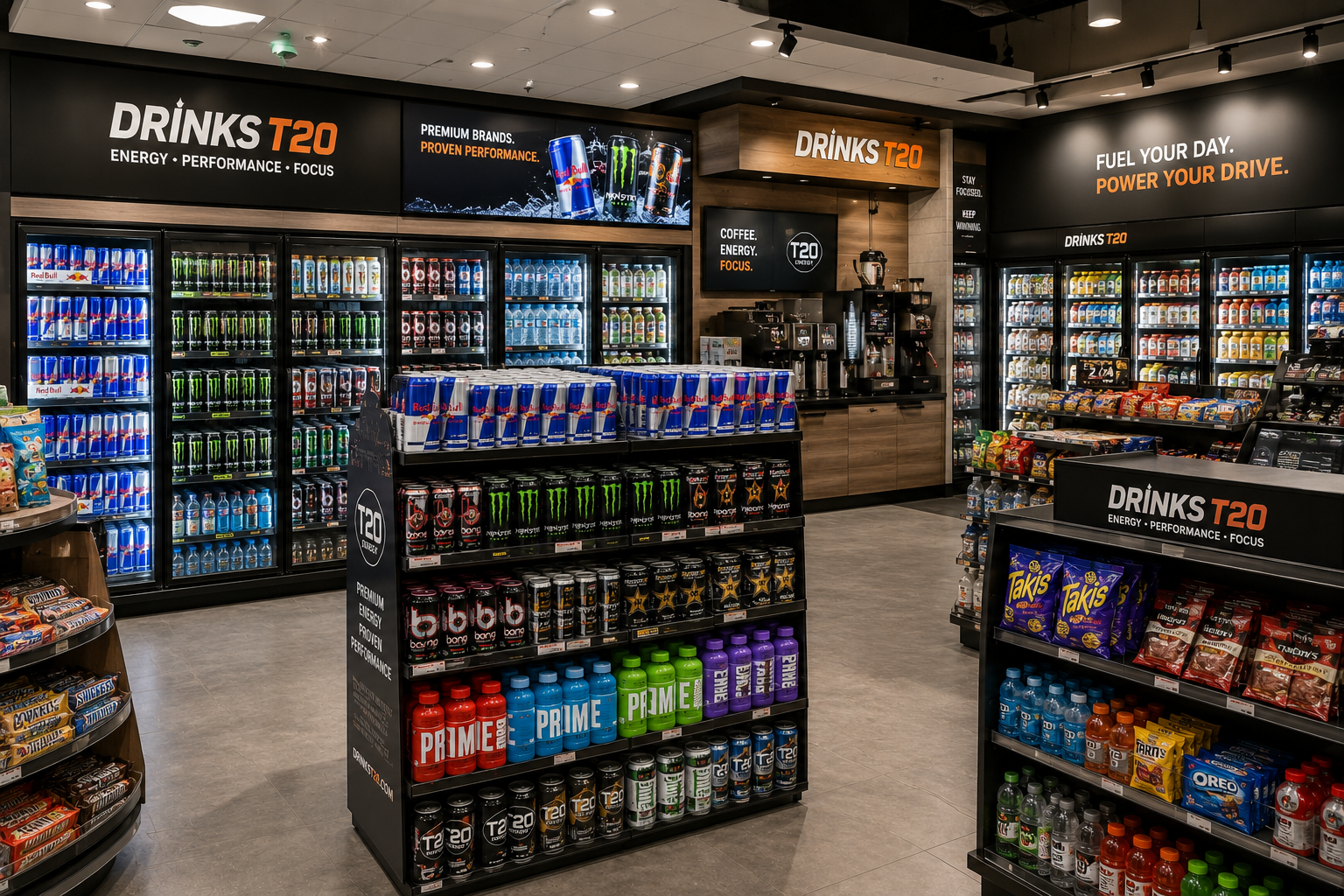
Why Energy Drinks Dominate Gas Station Beverage Sales
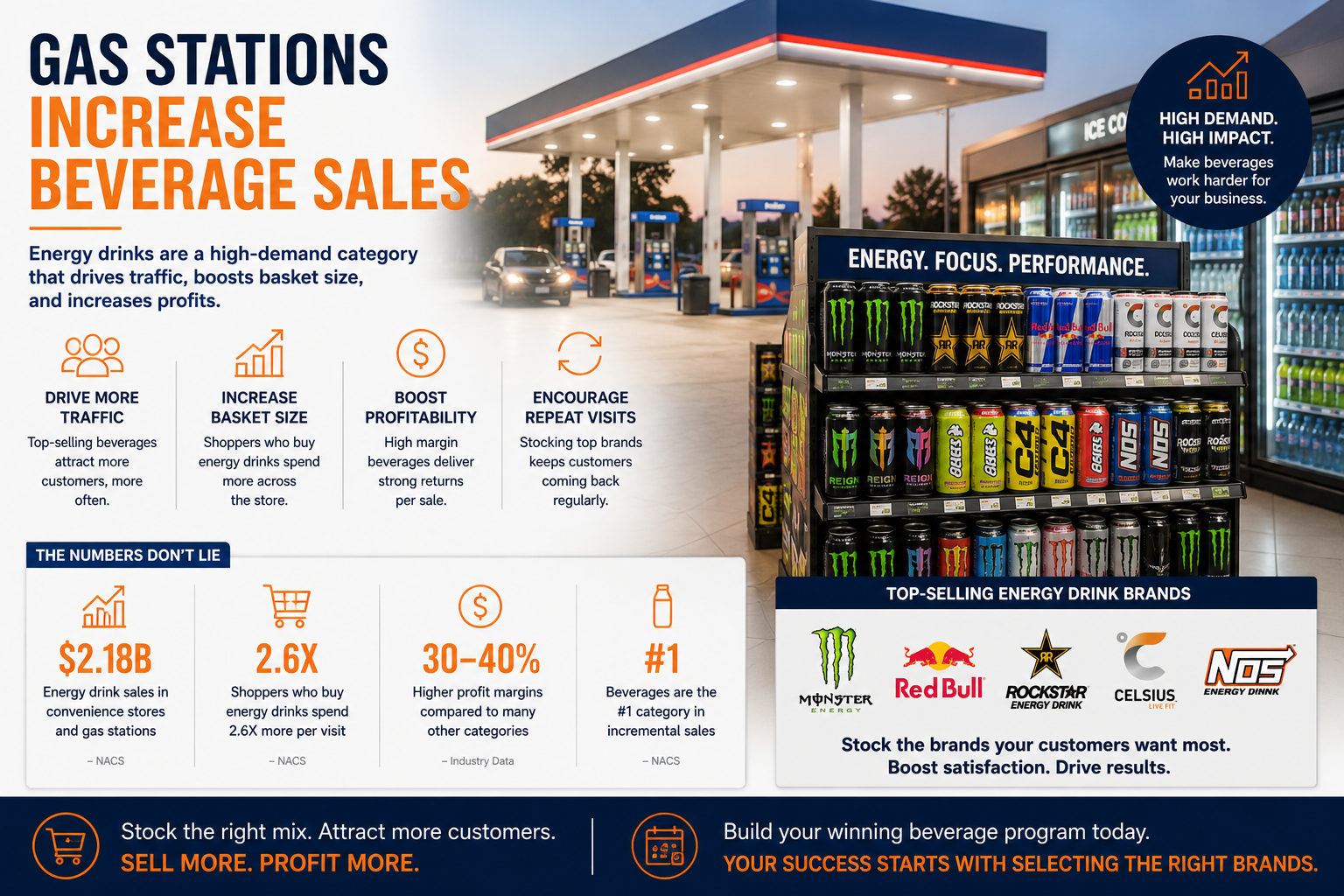
The National Association of Convenience Stores reported that energy drinks accounted for 27.8% of all packaged beverage category dollars in U.S. convenience stores in 2024, making energy drinks the largest single packaged beverage segment in the channel. Gas stations share much of the same consumer traffic and purchase behavior as convenience stores, which is why energy drink performance in fuel retail tracks closely with the broader convenience channel data.
The reason energy drinks generate this level of sales in gas stations comes down to consumer alignment. The gas station customer is often in transit, working or managing a schedule with limited time. They are not browsing for inspiration. They want a specific product that delivers a specific functional outcome, and they make that decision quickly based on what they recognize in the cooler. Energy drinks are ideally suited to this buying environment because strong brand recognition eliminates deliberation, single-serve formats match the on-the-go purchase occasion and the functional need they serve, alertness, energy, focus, is exactly what the commuter, driver or traveler is managing at the moment of the fuel stop.
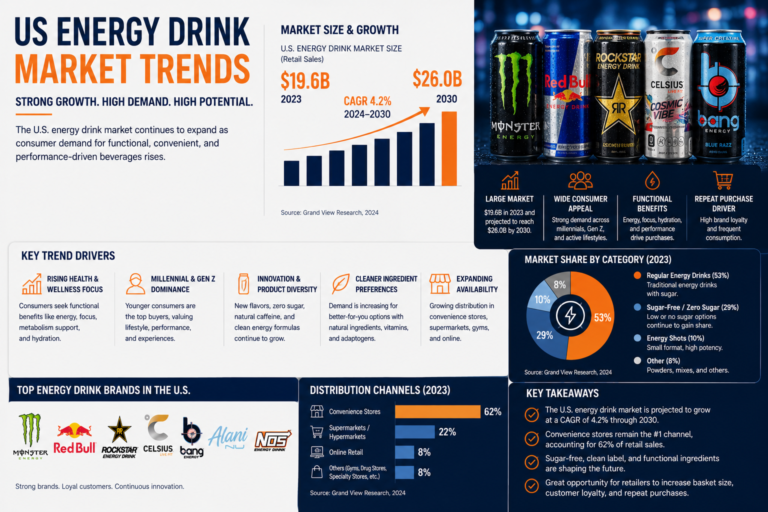
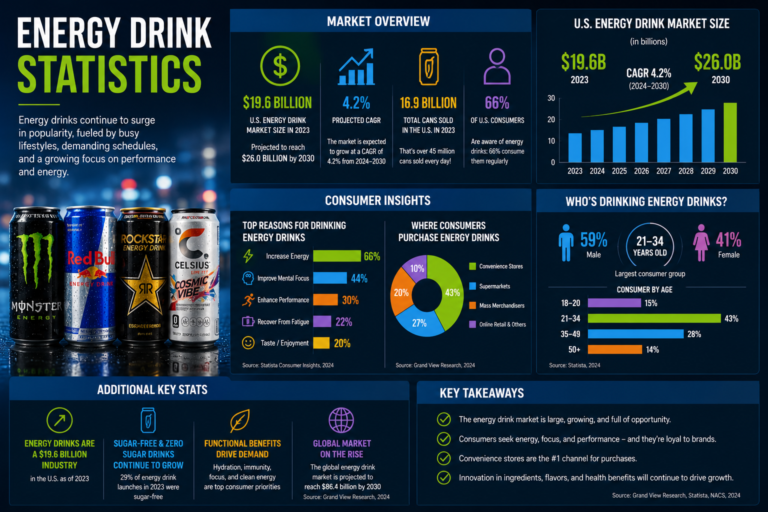
According to Grand View Research, the U.S. energy drink market reached approximately $25 billion in 2024 with consistent growth projected through 2030. For gas station operators, that market-level data translates into a category that continues to justify strong cooler allocation and active inventory management rather than passive restocking.
Top Selling Energy Drinks in U.S. Gas Stations
The brands below represent the most consistently stocked and commercially significant energy drink products in U.S. gas station retail. Performance varies by location type, regional demographics and store format, but these brands appear across fuel retail environments nationally because they have demonstrated the consumer demand that justifies consistent shelf space.
Monster Energy
Monster Energy is the highest-volume energy drink brand in U.S. convenience and fuel retail. Its SKU range spans the original green-label 16oz, the Ultra sugar-free line, Juice blends and various limited editions, which gives gas station operators coverage across multiple consumer segments from a single brand. Monster Original generates habitual repeat purchases from the core energy drink consumer, while Monster Ultra serves the growing segment of consumers who want Monster’s brand and caffeine delivery without the sugar content.
At highway and travel center locations, Monster in large formats, 24oz or 32oz, tends to outperform standard 16oz volume because long-haul drivers and road-trippers are buying for extended consumption rather than a single session. Operators at these locations should ensure large format Monster availability alongside the standard range.
Businesses interested in Monster wholesale purchasing can review the Monster Energy wholesale guide for brand-specific buying guidance.
Red Bull
Red Bull’s commercial position in gas station retail is built on premium brand equity and a compact can format that commands a higher per-ounce retail price than most competing products. Its 8.4oz slim can is the most recognized single-serve energy drink packaging in the world, and the consumer loyalty it generates makes Red Bull a non-negotiable cooler product at virtually every fuel retail location.
Red Bull performs particularly strongly at urban commuter gas stations and premium travel center formats where the customer base includes professional adults willing to pay for a brand they trust. Red Bull Sugarfree and the Editions flavored line have expanded the brand’s appeal beyond the original formula consumer, making a two to three SKU Red Bull representation the minimum practical allocation for most gas station coolers.
The Red Bull wholesale guide covers commercial purchasing considerations specific to the brand.
Celsius
Celsius has moved from specialty fitness distribution into mainstream gas station coolers by capturing a consumer segment that traditional energy drink formats were not serving. Health-conscious commuters, active-lifestyle consumers and calorie-aware buyers who previously bypassed the energy drink cooler are now purchasing Celsius, which makes it an additive rather than substitutional cooler addition for most gas station operators.
Celsius performs best at urban and suburban gas stations serving professional commuters and health-conscious demographics. Its performance at highway trucking routes and industrial area fuel stops tends to be lower relative to Monster and Red Bull. Gas station operators should calibrate their Celsius allocation to their specific customer profile rather than applying a uniform stocking decision across all locations.
The Celsius wholesale guide provides commercial purchasing information for fuel retailers sourcing Celsius in volume.
Rockstar Energy
Rockstar Energy has maintained consistent gas station distribution across the United States for over a decade, supported by broad national distribution infrastructure and a product range that covers traditional high-caffeine formats, sugar-free options and fruit-flavored varieties. Its accessible price positioning makes it a useful complement to Monster and Red Bull in a price-tiered cooler set where offering consumers a choice at different price points improves total category conversion.
Rockstar tends to perform best at locations where the consumer base is price-sensitive or where variety drives purchasing decisions. It is less likely to be the primary driver of energy drink revenue at premium or commuter-oriented locations, but fills a meaningful role in a well-rounded cooler assortment.
Prime Energy
Prime Energy has gained shelf space across gas stations nationally through the brand awareness generated by its high-profile marketing associations. Its strongest performance is in gas stations near universities, suburban family areas and locations serving younger consumer demographics. At highway and industrial locations, Prime Energy typically generates lower relative velocity than the established core brands.
Gas station operators should evaluate Prime Energy as a variety addition calibrated to their specific location’s demographic rather than as a universal cooler staple. Two to three SKU representation in locations serving younger or family-oriented consumers is typically the appropriate starting allocation. The Prime Energy wholesale guide covers commercial considerations for fuel retailers sourcing the brand.
Bang Energy
Bang Energy built its following in the fitness and high-caffeine consumer segment and maintains a presence in gas stations where the consumer base includes gym-goers, fitness enthusiasts and consumers seeking maximum caffeine content. Its zero-sugar positioning across the entire product line is a commercial advantage in environments where sugar-free demand is strong. Bang has faced some distribution shifts in recent years, so operators should confirm current regional availability with their wholesale supplier before committing to Bang inventory.
NOS Energy
NOS Energy has maintained a consistent gas station presence, particularly at locations serving automotive enthusiasts, truckers and consumers who associate the brand with the performance automotive culture its branding references. It is less common in premium or health-oriented retail environments but holds meaningful shelf presence at traditional fuel retail formats with strong working-class and automotive-oriented consumer traffic.
5-Hour Energy
5-Hour Energy occupies a distinct commercial position from canned energy drinks. Its compact 2oz shot format places it primarily at checkout counters and point-of-sale displays rather than in refrigerated coolers. The purchase occasion is typically different from canned energy drink purchases, serving consumers who want a fast, concentrated caffeine option without committing to a full beverage. For gas station operators, 5-Hour Energy is a checkout impulse category rather than a cooler competition with Monster or Red Bull.
Alani Nu
Alani Nu has grown its convenience retail presence by targeting female consumers and health-conscious buyers who respond to the brand’s clean-label positioning and lifestyle marketing. Its strongest gas station performance is at suburban locations serving demographic groups that include fitness-oriented women and younger health-conscious consumers. Operators at locations serving this demographic should evaluate Alani Nu as a potential addition that serves a consumer segment not fully covered by Monster, Red Bull or Celsius.
Ghost Energy
Ghost Energy has expanded into convenience retail from its specialty fitness and gaming culture origins, building brand recognition through flavor collaborations and distinctive product identities. Its growing retail presence makes it a relevant variety consideration at gas stations serving younger and enthusiast consumer demographics, though its overall velocity remains below the category leaders in most fuel retail formats.
Comparing the Best-Selling Energy Drink Brands
Most successful gas station operators stock multiple energy drink brands rather than concentrating on a single manufacturer. A balanced cooler set serves different consumer segments, reduces the risk that a stockout on one brand loses the entire transaction and improves total category revenue by giving each cooler door a product that performs for its specific consumer type.
| Brand | Typical Retail Presence | Zero-Sugar Options | Common Commercial Buyers |
|---|---|---|---|
| Monster Energy | Very High | Yes | Convenience stores, gas stations, distributors |
| Red Bull | Very High | Yes | Fuel retailers, supermarkets, convenience stores |
| Celsius | High | Yes | Convenience stores, supermarkets, fitness retailers |
| Rockstar Energy | High | Yes | Gas stations, convenience stores |
| Prime Energy | Growing | Yes | Convenience stores, supermarkets |
| Bang Energy | Moderate | Yes | Convenience stores, supplement retailers |
| NOS Energy | High | Limited | Gas stations, distributors |
| Ghost Energy | Growing | Yes | Convenience stores, fitness retailers |
| Alani Nu | Growing | Yes | Supermarkets, convenience stores |
| 5-Hour Energy | High | Varies | Checkout displays, fuel retailers |
What Makes an Energy Drink Sell Well in Gas Stations?
Strong gas station energy drink performance is not simply a function of brand size or marketing budget. The brands that generate the best per-door revenue in fuel retail share a specific set of commercial characteristics that operators should understand when making stocking and allocation decisions.
Brand recognition that enables fast purchase decisions is the most important single factor. A consumer at a gas station has a short transaction window. They are often paying for fuel, buying a snack and leaving within three to five minutes. The energy drink decision happens in seconds based on what they see and recognize. A brand without sufficient consumer recognition loses that transaction to a brand the consumer already knows, regardless of the product’s actual quality or value.
Repeat purchasing behavior driven by habitual consumption matters more in fuel retail than in most other channels. Commuters and professional drivers who stop at the same gas station regularly develop preferences for specific SKUs that they buy every time. A brand that generates this habitual repeat purchase from a loyal consumer base creates predictable daily volume that a novelty brand with trial purchases but no repeat behavior does not match on a sustained basis.
Cooler visibility amplifies both recognition and habitual purchasing. A product placed at eye level in a well-organized, fully stocked cooler converts more of the traffic that walks past it than the same product in a low position in a partially empty cooler. This is why merchandising discipline, consistent restocking and organized cooler layout are not cosmetic concerns. They are revenue decisions.
Retailers evaluating their product mix typically assess:
- Historical sales velocity by SKU at the specific location
- Consumer demographic profile of the location’s regular traffic
- Brand recognition among the location’s primary customer segments
- Inventory turnover rate to confirm sell-through is keeping pace with ordering cycles
- Profit margin per unit and per cooler door to optimize revenue per square foot
- Supplier reliability for the brands that generate the most volume
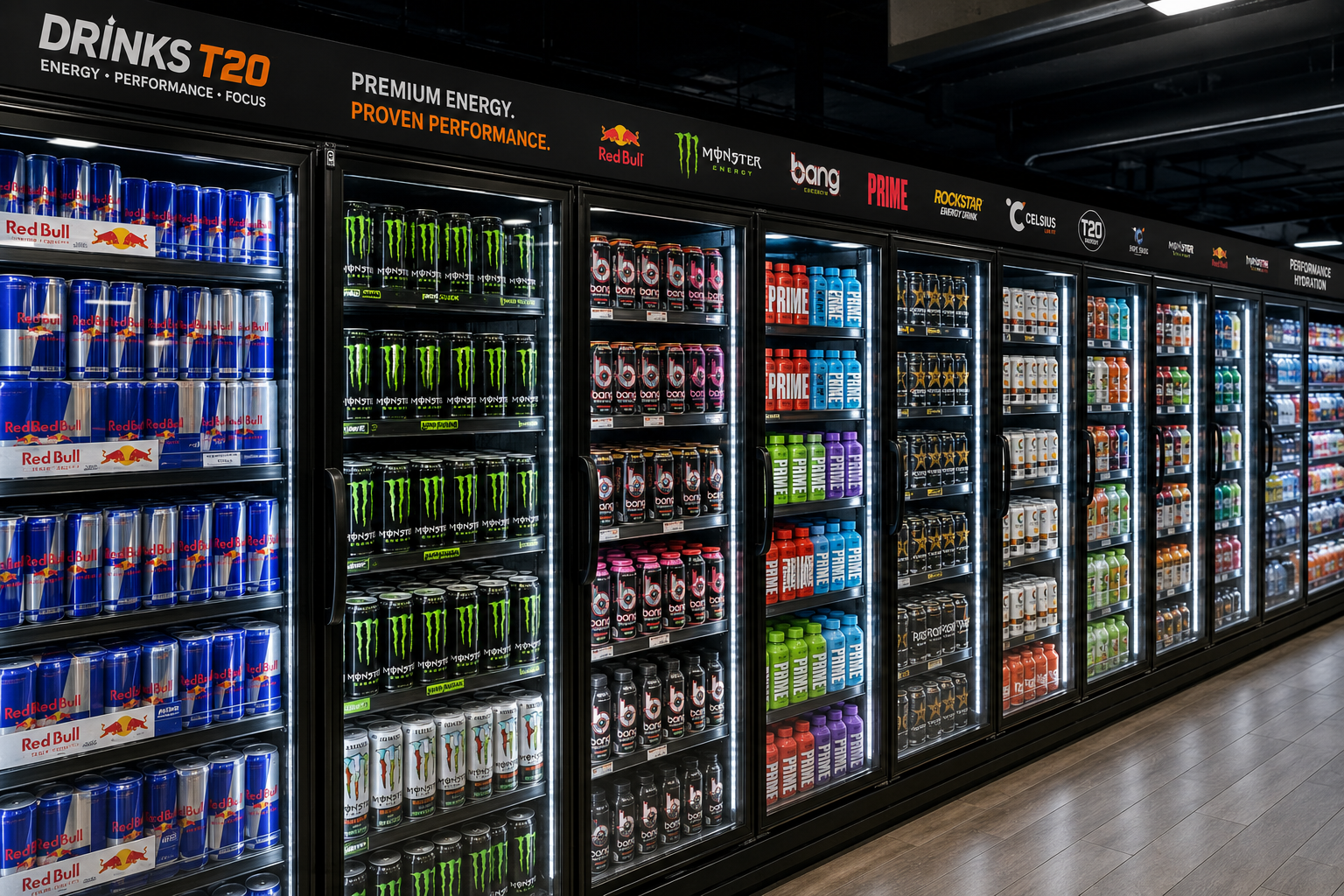
Building the Right Energy Drink Mix for Your Gas Station
A well-planned gas station energy drink assortment is not simply the ten most popular brands stocked equally. It is a deliberate allocation of cooler space to the brands that generate the most revenue at the specific location, with secondary representation for brands that serve distinct consumer segments the primary brands do not fully cover.
For most gas station locations, a practical approach follows three tiers. The first tier is core volume drivers: Monster Energy and Red Bull. These two brands together generate the majority of energy drink revenue at virtually every gas station location type in the United States. They should have the most cooler door allocation, the most SKU variety and the most consistent restocking priority.
The second tier is consumer segment coverage: Celsius, Rockstar and one additional brand based on the location’s specific demographic. Celsius covers the sugar-free and functional consumer who will not buy Monster or Red Bull. Rockstar provides value-tier variety. The third brand should reflect the location’s specific traffic, Prime Energy for campus-adjacent or youth-oriented locations, NOS for locations serving automotive or trucking demographics, Alani Nu for suburban family locations.
The third tier is trial and variety: one or two emerging or specialty brands in limited SKU representation for consumers who want something different. Ghost, Bang and new entrants fit here. These brands should have minimal cooler allocation until local demand is confirmed through actual sell-through data.
According to Statista, the U.S. energy drink market’s consistent per-capita consumption growth reflects a category where multiple brands can coexist profitably in the same cooler, which supports this tiered approach to cooler planning.
How Gas Stations Choose Which Energy Drinks to Stock
Experienced gas station operators approach energy drink category management as an ongoing process rather than a one-time product selection decision. The cooler that performed well six months ago may not reflect current consumer demand if a new brand has built local recognition, a demographic shift has changed who stops at the location or a core SKU’s velocity has changed with the seasons.
Factors operators consider when reviewing their energy drink assortment:
- Weekly sales velocity data by SKU from point-of-sale reporting
- Consumer demographic profile at the location and whether it has shifted
- Seasonal demand patterns, particularly summer travel increases and holiday weekend spikes
- New brand or SKU performance data from the first 60 days after introduction
- Stockout frequency by product to identify where reorder points need adjustment
- Cooler door allocation versus revenue contribution to identify underperforming positions
- Supplier reliability for the brands generating the highest volume
Why Wholesale Supply Reliability Matters for Gas Station Energy Drink Operations
A gas station that runs out of Monster Original or Red Bull during a morning commuter rush loses revenue that does not return when the product is restocked. The commuter who could not get their usual drink either buys a substitute they did not prefer or stops somewhere else tomorrow. For locations serving habitual daily buyers, supply continuity is not a convenience. It is a direct revenue requirement.
This is why wholesale supply reliability matters as much as pricing for gas station energy drink purchasing. A supplier who quotes attractively but delivers inconsistently creates stockouts that cost more in lost sales and customer relationship damage than any per-unit saving justifies. The U.S. Small Business Administration notes that small retail businesses consistently identify supply reliability as a primary factor in supplier selection, particularly for high-frequency categories like beverages where stockouts directly affect customer satisfaction and repeat visit behavior.
Most gas station operators improve purchasing efficiency by transitioning from reactive case purchases to structured wholesale programs as their energy drink volume grows:
- Bulk energy drink orders for independent fuel retailers building their wholesale relationship
- Pallet shipments for established operators with confirmed consistent demand and freight receiving capability
- Truckload deliveries for multi-location fuel retail groups and distributors with central warehouse operations
Working with an experienced energy drink distributor can also simplify procurement, improve inventory planning and provide the commercial supply relationship that gas station operators need to maintain consistent cooler performance.
Merchandising Strategies That Increase Gas Station Energy Drink Sales
The cooler is where energy drink revenue is won or lost at the gas station level. Product selection determines the ceiling. Merchandising determines how close to that ceiling the location actually performs on a daily basis.
Practical merchandising actions that improve gas station energy drink revenue:
- Place Monster and Red Bull at eye level in the most visible cooler door positions, since these are the products the highest-frequency buyers are looking for first
- Group products by brand rather than mixing brands across the same door, which makes the shopping experience faster for brand-loyal consumers
- Maintain full cooler facing at all times by pulling product forward during the day, not only during scheduled restocking
- Position a secondary single-door or countertop cooler near the checkout for last-minute impulse purchases from customers who did not pass the main cooler
- Review cooler allocation quarterly against sales velocity data and move products that have grown in velocity into better positions
- Rotate new SKU introductions into secondary positions before deciding whether they warrant primary placement based on confirmed local demand
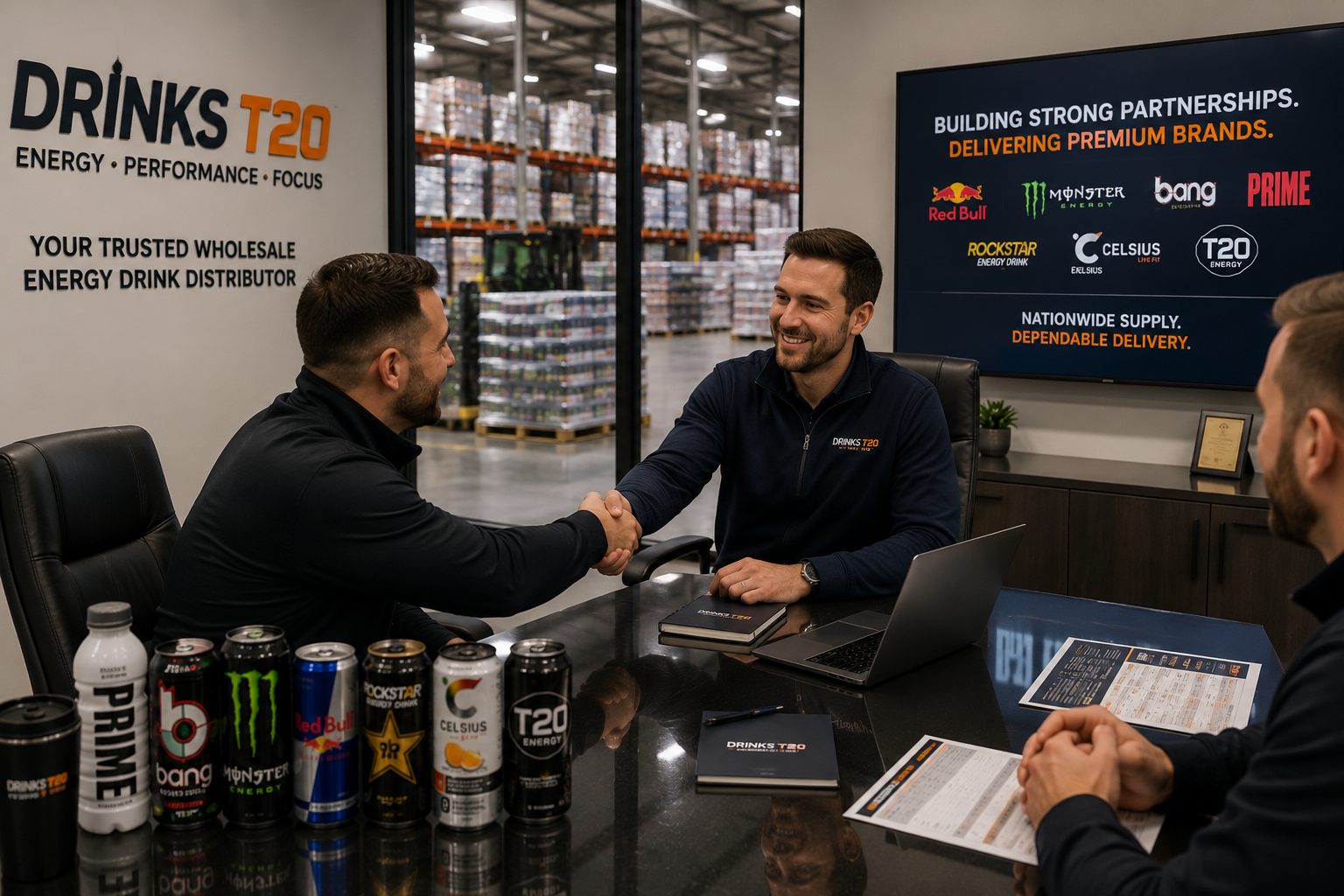
Why Businesses Choose T20 Energy Drink USA LLC
T20 Energy Drink USA LLC is a Margate, Florida-based wholesale energy drink supplier serving gas stations, convenience stores, supermarkets, vending operators and beverage distributors across the United States. The company’s supply model is built for B2B commercial accounts rather than consumer purchasing, which means gas station operators interact with a purchasing process designed for business requirements.
T20 supplies major energy drink brands including Monster Energy, Red Bull, Celsius, Prime Energy and other leading brands through bulk orders, pallet supply and truckload purchasing within the same commercial relationship. Gas station operators can begin with bulk purchasing to establish demand data and supplier confidence, then progress to pallet or truckload supply as volume justifies it.
Each pricing request is reviewed against the buyer’s specific product requirements, order volume and delivery destination. Gas station operators receive a quotation that reflects their actual purchasing situation, including the brand mix, can formats and delivery logistics specific to their location and receiving setup.
Build a Better Gas Station Energy Drink Selection
T20 Energy Drink USA LLC helps gas stations, convenience stores and commercial buyers source leading energy drink brands through flexible wholesale purchasing programs. Submit your preferred brands, estimated volume, delivery location and business type to receive a customized wholesale quotation.
Frequently Asked Questions About Top Selling Energy Drinks in Gas Stations
What are the top selling energy drinks in U.S. gas stations?
Monster Energy and Red Bull consistently generate the highest energy drink revenue at most U.S. gas station locations. Celsius has grown significantly in mainstream fuel retail. Rockstar Energy maintains broad national gas station distribution. Prime Energy, Bang Energy, NOS Energy, Ghost Energy, Alani Nu and 5-Hour Energy each maintain meaningful retail presence across different gas station formats and demographic environments.
Why do Monster Energy and Red Bull dominate gas station energy drink sales?
Both brands benefit from the strongest consumer recognition in the category, which is the primary driver of fast purchase decisions in the time-pressured gas station environment. Monster’s dominance comes from volume and SKU breadth across consumer segments. Red Bull’s strength comes from premium brand equity and consumer loyalty that produces consistent repeat purchasing. Both generate habitual buying behavior that sustains daily revenue independent of promotional activity.
How should a gas station operator decide which energy drinks to stock?
Start with the location’s confirmed consumer demographic. A highway travel center serving truckers and road-trippers needs a different mix than an urban commuter gas station or a suburban family fuel stop. Build the cooler set around core volume drivers first, Monster and Red Bull, then add functional and sugar-free coverage with Celsius, then select one or two additional brands based on the specific demographics the location serves. Evaluate all product decisions using actual sell-through data rather than general market rankings.
Should gas stations stock multiple energy drink brands?
Yes. A single-brand cooler misses the consumer segments that other brands serve exclusively. Monster buyers and Red Bull buyers have largely separate brand loyalties and tend not to substitute. Adding Celsius captures consumers who will not purchase traditional high-sugar formats. Adding a variety brand in limited representation serves the consumer looking for something different. Each brand in a well-planned mix earns its slot by serving a consumer segment that the other brands do not fully cover.
What purchasing options are available for gas stations sourcing energy drinks wholesale?
Gas station operators can purchase through bulk orders for moderate confirmed demand, pallet shipments for established consistent velocity with freight receiving capability, or truckload deliveries for multi-location operators with central warehouse infrastructure. Most operators begin with bulk purchasing to establish demand data before progressing to pallet supply as volume grows.
How do I request wholesale energy drink pricing for my gas station?
Submit your preferred brands, can format requirements, estimated order volume and delivery location through the Request Pricing page. The T20 team reviews each submission and responds with a customized wholesale quotation based on the specific commercial requirements of your fuel retail operation.